Helen Frankenthaler, her artist quotes on ‘soak’ painting method & her biography story
Helen Frankenthaler (1928 - 2011), with quotes on her ‘soak painting’ and biography & life facts as a American woman-artist in Abstract-Expressionism / Color field. Frankenthaler was one of the most famous artists in American Abstract Expressionism. Her art quotes tell about painting in her typical soak method and the relation with other painter-friends like the Pollock’s; her quotes give moreover essential biography facts about her life as woman painter in New York. Frankenhaler was a woman painter in American Abstract Expressionism / New York School of the 2nd generation and attributed by Greenberg to early Color Field because of her flat way of painting. Her most famous painting is ‘Mountains and sea’.
* At the bottom short biography story & life facts, and some links for art images of the famous American woman-artist Helen Frankenthaler. - the editor
|
|
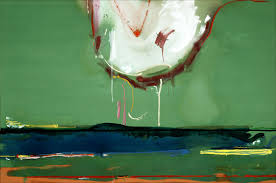
Helen Frankenthaler: ‘High Spirits’, 1988 |
Helen Frankenthaler, her quotes on soak painting art & her life story as woman-artist in American Abstract Expressionism
- I painted ‘Mountains and Sea’ (in 1952, ed.) after seeing the cliffs of Nova Scotia. It’s a hilly landscape with wild surf rolling against the rocks. Though it was painted in a windowless loft, the memory of the landscape is in the painting, but it has also equal amounts of Cubism, Pollock, Kandinsky, Gorky.
* Helen Frankenthaler, source of her artist quote on her most famous painting ‘Mountains and Sea’, she painted in 1952, from: “Abstract Expressionism”, Barbara Hess, Taschen, Köln, 2006, p. 80
- Total abstraction was something intellectual to me. I didn’t feel it; I could talk about Mondrian but it didn’t occur to me to do it. (around 1950, fh). I saw a Dubuffet show at Pierre Matisse (galleries, fh) in the late forties and came back with a new vocabulary. Also when Baziotes won the Carnegie (1948) there was a reproduction in the Times. I remember bringing it to class. It was source of bewilderment, delineated configurations that seemed to come out of Cubism. It was something new. Those were the tastes of a whole dimension that was to come, much more abstract and allover and I didn’t see much more of it until I came to New York. I would go to the old Guggenheim to look at Kandinsky I liked the early abstractions but the later ones I didn’t like at all….
* source of her artist quote on her relation to abstraction in painting, like Kandinsky did in his paintings, in a: ‘Interview with Helen Frankenthaler’, Henry Geldzahler; ’Artforum’ 4. no. 2, October 1965, p. 36
- The first Pollock show I saw was in 1951 at Betty Parson’s gallery, early in the fall, probably September or October. It was staggering. I really felt surrounded. I went with Clement Greenberg (famous art-critic of Abstract Expressionism / New York School, fh) who threw me into the room and seemed to say ‘swim’. By then I had been exposed to enough of it so it hit me and had magic but didn’t puzzle me to the point of stopping my feelings.
* her quote on the experience to see the first Pollock-painting in her life, with Greenberg, in a: ‘Interview with Helen Frankenthaler’, Henry Geldzahler; ’Artforum’ 4. no. 2, October 1965, p. 36
- I went out to Springs and saw Pollock and his work, not only the shows. In 1951 I looked at de Kooning as much as at Pollock. Earlier Kandinsky (his Murnau paintings, fh) and Gorky had led me into what is now called ‘Abstract expressionist’ painting; but these came after all the Cubist training and exercise. It all combined to push me on. Like Cubism… …I felt many more possibilities in Pollock’s work. That is, I looked.. .. and was influenced by both Pollock and de Kooning and eventually felt that there were many more possibilities for me out of the Pollock vocabulary.
* artist quote on the influence of the art by the abstract expressionists Jackson Pollock and Willem de Kooning on her own painting art, in a: ‘Interview with Helen Frankenthaler’, Henry Geldzahler; ’Artforum’ 4. no. 2, October 1965, p. 37 (American woman painter, famous for her soak method
- De Kooning made enclosed linear shapes and ‘applied’ the brush. Pollock used shoulder and ropes and ignored the edges and the corner. I felt I could stretch more in the Pollock framework. I found that in Pollock I also responded to a certain Surreal element – the understated image that was really present: animals, thoughts, jungles, expressions. You could become a de Kooning disciple or satellite or mirror, but you could depart from Pollock….
* source of her quote on the inspiring and free force she experienced in Pollock’s paintings, concerning her own painting art, in a: ‘Interview with Helen Frankenthaler’, Henry Geldzahler; ’Artforum’ 4. no. 2, October 1965, p. 37
- I still, when I judge my own pictures (either while I’m working or after I think it’s finished) determine if they work in a certain kind of space through shape or color. I think all totally abstract pictures – the best ones that really come off – Newman , Pollock, Pollock , Noland – have tremendous space; perspective space despite the emphasis on flat surface. For example, in Noland a band of yellow in relation to a band of blue and one of orange can move in depth although they are married to the surface. This has become a familiar explanation, but few people really see and feel it that way…. …In my work, because of color and shape a lot is read in the landscape sense….
* her artist quote on the quality of space, generated through shape or color, like the painting art of Noland, Pollock and Noland showed her very clearly, in a: ‘Interview with Helen Frankenthaler’, Henry Geldzahler; ’Artforum’ 4. no. 2, October 1965, p. 37
- Sometimes I think the worst thing is the current ‘worldliness’ of the whole (art, fh) scene. It is the most deceptive, corrupting, transient thing, full of kicks and fun but so little to do with what it’s all really about… …It has to do with our time, a desperate pact about the power of immediate-in-ness. But I feel less and less concerned with this as an issue. So what? No threat.
* her woman-artist comment on the current deceptive ‘worldliness’ of the modern art, circa 1965, in a: ‘Interview with Helen Frankenthaler’, Henry Geldzahler; ’Artforum’ 4. no. 2, October 1965, pp. 37-38
- ..I’ve been touched, in the work of Miró and Pollock, by a Surrealist – by Surrealist I mean ‘associative’ – quality. It’s what comes through in association after your eye has experienced the surface as a great picture; it is incidental but can be enriching. Gorky too has affected me this way, but in Gorky, though it fascinated me, it often got in my way. I was too much aware of, let’s say, what read as sex organs arranged in a room… …I leave it (the ‘associative’ element, fh) out of my own pictures more and more as I become increasingly involved with colors and shapes. But it is still there.
* Frankenthaler, her quote on the Surrealist / ‘associative’ – quality in the art of Pollock and Miro she appreciated very much, in a: ‘Interview with Helen Frankenthaler’, Henry Geldzahler; ’Artforum’ 4. no. 2, October 1965, pp. 37-38
- I am very poor at naming them (her paintings, f.h.)… … I usually name them for an image that seems to come out of the pictures like Blue territory, or I look and see Scattered Shapes,, or Red Burden>. I don’t like sentimental titles… …One names a picture in order to refer to it….
* artist quote on naming her paintings, in a: ‘Interview with Helen Frankenthaler’, Henry Geldzahler; ’Artforum’ 4. no. 2, October 1965, pp. 37-38
- I will sometimes start a picture feeling ‘What will happen if I work with three blues and another color, and maybe more or less of the other color than the combined blues?’ And very often midway through the picture I have to change the basis of the experience. Or I add and add to the canvas. And if it’s over-worked and beyond help I throw it away.
* artist quote on her way of painting or destroying if it got over-worked (she liked very much to realize flat paintings, f.h.), in a: ‘Interview with Helen Frankenthaler’, Henry Geldzahler; ’Artforum’ 4. no. 2, October 1965, pp. 37-38
- I used to try to work from a given, made shape. But I’m less involved now with the shape as such. I’m much more apt to be surprised that pink and green within these shapes are doing something.
* her woman artist quote on shape and the power of colors in her own art: ‘Interview with Helen Frankenthaler’, Henry Geldzahler; ’Artforum’ 4. no. 2, October 1965, pp. 37-38
- When I say gesture, my gesture, I mean what my mark is. I think there is something now I am still working out in paint; it is a struggle for me to both discard and retain what is gestural and personal, “Signature”. I have been trying, and the process began without my knowing it, to stop relying on gesture,, but it is a struggle. “Gesture” must appear out of necessity not habit. I don’t start with a color order but find the color as I go. I’d rather risk an ugly surprise then rely on things I know I can do. The whole business of spotting; the small area of color in a big canvas; how edges meet; how accidents are controlled; all this fascinates me, though it is often where I am most facile and most seducible by my own talent.
* Frankenthaler, a quote on her way of painting, concerning the gestural and personal signature in it, from a: ‘Interview with Helen Frankenthaler’, Henry Geldzahler; ’Artforum’ 4. no. 2, October 1965, pp. 37-38
- The gesture today (1965, fh) is surely more purely abstract than it was. There is a certain moment when one can look so pure that the result is emptiness – many readings of a work of art are eliminated and you are left with one note that may be real and pure but it’s only that, one shaft. For example, the best Mondrian’s, Newman’s, Noland’s, or Louis’ Morris, fh) are deep and beautiful and get better and better. But I think that many of the camp followers are empty.
* artist quote on the gesture in abstract painting and the loss of the sense of ‘deep’ in the painting, from the: ‘Interview with Helen Frankenthaler’, Henry Geldzahler; ’Artforum’ 4. no. 2, October 1965, pp. 37-38 (American woman painter, famous for her soak method
- When you first saw a Cubist or Impressionist picture there was a whole way of instructing the eye of the subconscious. Dabs of color had to stand for real things; it was an abstraction of a guitar or of a hillside. The opposite is going on now. If you have bands of blue, green and pink, the mind doesn’t think sky, grass and flesh. These are colors and the question is what are they doing with themselves and with each other. Sentiment and nuance are being squeezed out so that if something is not altogether flatly painted then there might be a hint of edge, chiaroscuro, shadow and if one wants just that pure thing these associations get in the way.
* source of her woman artist quote in which she compares representation by Cubism / Impressionism art and the modern abstract art of her own time: Abstract Expressionism / Color Field, in a: ‘Interview with Helen Frankenthaler’, Henry Geldzahler; ’Artforum’ 4. no. 2, October 1965, p. 39
- I wonder if my pictures are more “lyrical” [that loaded word!] because I’m a woman. Looking at my paintings as if they were painted by a woman is superficial, a side issue, like looking at Klines and saying they are bohemian. The making of serious painting is difficult and complicated for all serious painters. One must be oneself, whatever.
* her artist quote criticizes the idea that her art is feminine and lyrical painting, because she is a woman artist: ‘Interview with Helen Frankenthaler’, Henry Geldzahler; ’Artforum’ 4. no. 2, October 1965, p. 39
- I had no desire to copy Pollock. I didn’t want to take a stick and dip it in a can of enamel (paint, fh) I needed something more liquid, watery, thinner. All my life, I have been drawn to water and translucency. I love the water; I love to swim, to watch changing seascapes. One of my favorite childhood games was to fill a sink with water and punt nail polish into to see what happened when the colors burst up the surface, merging into each other as floating, changing shapes.
* woman-artist quote on her fascination as a child already of water and diluting colors in floating shapes, from: “Abstract Expressionism”, Barbara Hess, Taschen, Köln, 2006, p. 80
- I’ve explored a variety of directions and themes over the years. But I think in my painting you can see the signature of one artist, the work of one wrist.
* Helen Frankenthaler on the typical individual character of her own painting art, from: “Abstract Expressionism” Barbara Hess, Taschen Köln, 2006, p. 15
- It was as if I suddenly went to a foreign country but didn’t know the language, but had read enough and had a passionate interest, and was eager to live there… …and master the language. (reacting on Jackson Pollock’ss famous ‘Black and White’ paintings show, she saw in 1951, fh) .
* her artist quote expressing the influence and impact of seeing Pollock’s ‘Black and White’ paintings show, in: “Abstract Expressionism” Barbara Ross, New York, Abrams, 1971, p. 29
- Before (Fall of 1952, fh), I had always painted on sized and primed canvas – but my paint was becoming thinner and more fluid and cried out to be soaked, not resting. In ‘Mountains and Sea’ I put in the charcoal line gestures first, because I wanted to draw in with color and shape the totally abstract memory of the landscape. I spilled on the drawing in paint from the coffee cans. The charcoal lines were original guideposts that eventually became unnecessary.
* her important quote on the start of her typical soak-painting technique, which she started with her famous canvas ‘Mountains and Sea’, from: ‘The Achievement of Helen Frankenthaler’, Gene Baro, Art International, 20 September 1967, p. 36
- The ‘why’ of how a picture works best for me involves how much working false space it has in depth… …It’s a play of ambiguities.
* her artist quote on the working false space in the depth of the painting, in: ‘The Achievement of Helen Frankenthaler’, Gene Baro, Art International, 20 September 1967, p. 36
- When I say gesture, my gesture, I mean what my mark is… …It is a struggle for me to both discard and retain what is gestural and personal, Signature’… …’Gesture’ must appear out of necessity, not habit.
* her artist quote on the difference between gesture and signature in her painting, from : ‘An interview with Helen Frankenthaler’ Geldzahler, ‘The New York school – the painters & sculptors of the fifties’ Irving Sandler, Harper & Row, Publishers, 1978, p. 67
- A really good picture looks as if it’s happened at once. It’s an immediate image. For my own work, when a picture looks labored and overworked, and you can read in it - well, she did this and then she did that, and then she did that - there is something in it that has not got to do with beautiful art to me. And I usually throw these out, though I think very often it takes ten of those over-labored efforts to produce one really beautiful wrist motion that is synchronized with your head and heart, and you have it, and therefore it looks as if it were born in a minute.
* quote on over-labored paintings, from:”Frankenthaler”, Barbara Rose, Harry N. Abrams Inc., New York, p. 85
- After the first day there (In 1961, at the invitation of Tatyana Grosman, Frankenthaler ventured out to Universal Limited Art Editions (ULAE), Grosman’s Long Island printmaking studio, and began making lithographs, Deborah Wye) I felt no hesitation. I was very committed. All I had to do was start work on that print. It was a whole new road -and a very connected road.
* Helen Frankenthaler’s on het start to make lithography prints, from: “Artists and Prints: Masterworks from The Museum of Modern Art, New York”, Deborah Wye, The Museum of Modern Art, 2004, p. 146; http://www.moma.org/collection/object.php?object_id=69050
- …(from Pollock, fh)… concern with line, fluid line, calligraphy, and… …experiments with line not as line but as shape.
* Frankenthaler, her artist quote on line as a shape, from: “The Museum of Modern Art , MoMA Highlights , New York”, The Museum of Modern Art, revised 2004, originally published 1999, p. 219; http://www.moma.org/collection/object.php?object_id=78722
- The picture developed - bit by bit while I was working on it - into shapes symbolic of an exuberant figure and ladder… …therefore: ‘Jacob’s Ladder’. (the title of the work she made in 1966, fh) .
* Helen Frankenthaler on the birth of a title of the art-work ‘Jacob’s Ladder’, from: “MoMA Highlights , New York”, The Museum of Modern Art, revised 2004, originally published 1999, p. 219; http://www.moma.org/collection/object.php?object_id=78722 (American woman painter, famous for her soak method (‘Mountains and Sea’) and flat colourful painting technique in Color Field)
- It (the Mauve district in the U.S., fh) relates to a theme which appears on-and-off, of pictures that often have one central vast shape, district, or territory; in this case, the shape itself (a square) is a play on the very shape of the canvas (1969.
* Helen Frankenthaler’s quote on a square shape in the painting: “The collection”, MOMA, online http://www.moma.org/collection/object.php?object_id=80712
- I have always been concerned with painting that simultaneously insists on a flat surface and then denies it.
* Helen Frankenthaler’s quote on the aspect of the surface in her paintings: “The collection”, MOMA, online http://www.moma.org/collection/object.php?object_id=80712
- I frequently leave areas of raw, unprimed canvas unpainted (as in her painting Chairman of the Board, 1971, fh… …That ‘negative’ space has just as active a role as the ‘positive’ painted space. The negative spaces maintain shapes of their own and are not empty.
* Frankenthaler, her painter quote on ‘negative and positive space in the painting as two visual forces: “The collection”, MOMA, online http://www.moma.org/collection/object.php?object_id=80139
short biography and history facts of the famous American woman-artist Helen Frankenthaler
Helen Frankenthaler (b. 1928) begun studying painting in 1946; she studied at Bennington college Vt., the Art Students League in New York and later at the famous Hans Hofmann‘s School. In 1946 she took part in a group exhibition where she was invited to by the art-critic Greenberg; they became later close friends. She had her first important solo-exhibition in Nag Gallery in 1951.
In 1952 Frankenthaler painted her most famous painting ‘Mountains and Sea’, in which she used her ‘soak-stain’ technique (painting on not primed canvas, so the canvas soaks the liquid paint, fh) she had developed herself; a method by which she could paint very flat and thin on the canvas. Frankenthaler was friend of the Pollock’s (Jackson and his wife the woman painter Lee Krasner; she admired them and visited the Pollock’s frequently, so she became very familiar with their art. Frankenthaler tells in her quotes the overall approach of Jackson Pollock inspired her a lot, see her quotes. She on her turn influenced new young painters as Morris Louis and Kenneth Noland; both Color Field painters who have reported the impact of Frankenthaler’s painting art themselves in their quotes. In her art Frankenthaler used very frequently impressions of nature and landscape as an inspiration for her paintings; as many of her titles illustrate like her famous painting: ‘Mountains and Sea’ made in 1952.
Art links for more biography information and art images of American woman painter in Abstract Expressionism, Helen Frankenthaler
* many images and pictures of Helen Frankenthaler’s paintings and her soak technique, on Google
* I thank the MOMA for selecting and mailing me some quotes of Helen Frankenthaler, Fons Heijnsbroek (see the MOMA-links)
