Umberto Boccioni, quotes by the artist on his painting art in Italian Futurism
statements of the Futurist painter & sculptor and biography facts; co-editor of Futurist Manifesto
Umberto Boccioni (1882 - 1916) quotes by the artist on creating his painting and sculpture art as active member in Italian Futurism. Boccioni was a very passionate and inspirational artist in the Futurist art movement; he was explaining and developing the Futurist ideas in vivid art-debates with Parish Cubist artists very firmly. Moreover he was leading editor of the ‘Manifesto of Futurist Painters’, which was co-published by Carrà, Severini and Russolo.
* At the bottom more biography facts & art links for Italian Futurism & the artist Umberto Boccioni. - the editor
|
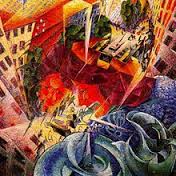
Boccioni: ‘Visioni simultanee’ painting, 1912 |
Umberto Boccioni, his quotes on Futurism & his painting art
- Get all the information you can about the Cubists, and about Georges Braque and Pablo Picasso (to Severini in Paris, fh). Go to Kahnweilers’ (gallery, fh). And if he’s got photos of recent works - produced after I have left -, buy one or two. Bring us (= the Futurists in Italy, fh) back all the information you can get.
* Umberto Boccioni, source of his artist quote on the Cubists in Paris: a letter to Gino Severini in Paris, Summer 1911; as quoted in “Futurism”, ed. By Didier Ottinger; Centre Pompidou / 5 Continents Editions, Milan, 2008, p. 27 (painter sculptor in Italian Futurism and co-editor of the Futurist Manifesto; famous for his futurist paintings like ‘City rises’; links for more biography facts and images of his art at the bottom)
- … it is also true that without flashes of the absolute, which are granted to only a few, humanity would proceed in the dark, indeed it would not exist, because it would not acknowledge itself to itself! And as far as I know the flash as never preceded by explanations or preambles, and only a very small mind… could fail to understand that eternal aspirationabsolute and that the work is the relative, that to create is already to circumscribe; that to comment is to circumscribe the circumscribed, is to subdivide the divided; is to reduce to minimum terms, is to annihilate.
* Boccioni, his artist statement on the ‘flash of the Absolute’: his lecture ‘La Pittura Futurista’, at the Associazione Artistica Internationale, Rome May 1911; as quoted in “Futurism”, ed. By Didier Ottinger; Centre Pompidou / 5 Continents Editions, Milan, 2008, p. 55
- A time will come when the picture will no longer be enough. Its immobility will become an archaism with the vertiginous movement of human life. The eye of man will perceive colours as feelings within itself. Multiplied colours will not need form to be understood and paintings will be swirling musical compositions of great coloured gases, which, on the scene of a free horizon, will move and electrify the complex soul of a crowd that we cannot yet conceive of.
* Umberto Boccioni’s statement on the future character of the painting: his lecture ‘La Pittura Futurista’; as quoted in “Futurism”, ed. By Didier Ottinger; Centre Pompidou / 5 Continents Editions, Milan, 2008, p. 55
- Your eyes, accustomed to semi-darkness, will soon open to more radiant visions of light. The shadows which we shall paint shall be more luminous than the high-lights of our predecessors, and our pictures, next to those of the museums, will shine like blinding daylight, compared with deepest night. We conclude that painting cannot exist today without divisionism… …Divisionism, for the modern painter, must be an innate complementariness which we declare to be essential and necessary.
* Umberto Boccioni, his statement on Divisionism as necessarily element for modern painting: ‘Manifesto of Futurist Painters’, Boccocione, Carrà, Russolo, April 1910; as quoted in “Futurism”, ed. By Didier Ottinger; Centre Pompidou / 5 Continents Editions, Milan, 2008, p. 92
- The gesture which we would reproduce on canvas shall no longer be a fixed moment in universal dynamism. It shall simply be the dynamic sensation itself. Indeed, all things move, all things run, all things are rapidly changing… …We would at any price re-enter into life. (in contrast to cubism, these conceptions are strongly related to the idea of ‘élan vitale’, the leading concept of the French philosopher Bergson, fh) .
* Boccioni’s artist statement on ‘dynamic sensation’: ‘Manifesto of Futurist Painters’, Boccioni, Carrà, Russolo, 1912; as quoted in “Futurism”, ed. By Didier Ottinger; Centre Pompidou / 5 Continents Editions, Milan, 2008, p. 23
- The time has passed for our sensations in painting to be whispered. We wish them in the future to sing and re-echo upon our canvasses in deafening and triumphant flourishes.
* Umberto Boccioni quote on painting in future: ‘Manifesto of Futurist Painters’, Boccioni, Carrà, Russolo, 1912; as quoted in “Futurism”, ed. By Didier Ottinger; Centre Pompidou / 5 Continents Editions, Milan, 2008, p. 132 (co-editor of the Futurist Manifesto
- It will be readily admitted that brown tints have never coursed beneath our skin; it will be discovered that yellow shines forth in our flesh, that red blazes, and that green, blue and violet dance upon it with untold charms, voluptuous and caressing.
* Boccioni statement on the future role of colors in painting art: ‘Manifesto of Futurist Painters’, Boccioni, Carrà, Russolo, 1912 (painter & sculptor in Italian Futurism with his famous futurist painting ‘City rises’)
- (to erect)… a new altar throbbing with dynamism as pure and exultant as those which were elevated to divine mystery through religious contemplation.
* Umberto Boccioni quote on future art: a letter to Nino Barbantini; as quoted in “Futurism”, ed. By Didier Ottinger
- Our bodies penetrate the sofas upon which we sit and the sofas penetrate our bodies. The motorbus rushes into the houses which it passes, and in their turn the houses throw themselves upon the bus and are blended with it. (interpenetration of the human and the machine world, fh).
* artist quote on the mutual penetration of things in Futuristic painting: ‘Manifesto of Futurist Painters’, Boccioni, Carrà, Russolo, 1912; as quoted in “Futurism”, ed. By Didier Ottinger; Centre Pompidou / 5 Continents Editions, Milan, 2008, p. 64 (leading painter & sculptor in Italian Futurism)
- The sixteen people around you in a rolling omnibus are in turn and at the same time one, ten, four, three; they are motionless and they change places; they come and go, bound into the street, are suddenly swallowed up by the sunshine, then come back and sit before you., like persistent symbols of universal vibration. How often have we not seen upon the cheek of the person with whom we are talking the horse which we passes at the end of the street.
* his artist quote on the moving things and people in the perception of the modern city: ‘Manifesto of Futurist Painters’, Boccioni, Carrà, Russolo, 1912;
- A profile is never motionless before our eyes, but it constantly appears and disappears. On account of the persistency of an image upon the retina, moving objects constantly multiply themselves; their form changes like rapid vibrations… …To paint a human figure you must not paint it; you must render the whole of its surrounding atmosphere.
* his artist statement on motion of things in Futuristic painting and perception: ‘Manifesto of Futurist Painters’, Boccioni, Carrà, Russolo, 1912; as quoted in “Futurism”, ed. By Didier Ottinger; Centre Pompidou / 5 Continents Editions, Milan, 2008, p. 172
- How is it possible still to see the human face pink, now that our life, redoubled by noctambulism, has multiplied our perceptions as colourists? The human face is yellow, red, green, blue, violet.
* his artist quote on the modern perception and use of colors in Futurism: ‘Manifesto of Futurist Painters’, Boccioni, Carrà, Russolo, 1912;
- Who can still believe in the opacity of bodies since our sharpened and modified sensitivity has already penetrated the obscure manifestations of the medium? Why should we forget in our creations the double power of our sight, capable of giving results analogous to those of X-rays?
* his artist quote on ‘sight giving results, comparable with X-rays for futuristic painting art: ‘Manifesto of Futurist Painters’, Boccioni, Carrà, Russolo, 1912
- The harmony of the lines and folds of modern dress works upon our sensitiveness with the same emotional and symbolical power as did the nude upon the sensitiveness of the old masters.
* his artist quote on modern sensitiveness for futurist painting: Futurism”, ed. By Didier Ottinger; Centre Pompidou / 5 Continents Editions, Milan, 2008, p. 154
- (the Cubist painters who) continued to paint objects
motionless, frozen, and all the static aspects of Nature; they worship the traditionalism of Poussin, of Ingres, of Camille Corot, ageing and petrifying their art with an obstinate attachment to the past, which to our eyes remains totally incomprehensible.
* Boccioni’s critical art statement on the static and classical character of contemporary Cubism in Paris: ‘Les exposants au public’, Boccioni et al.; exh. Cat. Galerie Bernheim-Jeune & Cie February 1912, pp. 2, 3
- …is it indisputable that that several aesthetic declarations of our French comrades (of Cubism, fh) display a sort of masked academicism. It is not, indeed, a return to the Academy to declare that the subject, in painting, has a perfectly insignificant value?… …To paint from the posing model as an absurdity, and an act of mental cowardice, even if the model be translated upon the picture in linear, spherical and cubic forms…
* critical art statement on the static and academical character of contemporary Cubism in Paris; ‘Les exposants au public’, Boccioni et al.; exh. Cat. Galerie Bernheim-Jeune & Cie February 1912, pp. 2, 3
- Let us explain again by examples. In painting a person on a balcony, seen from inside the room do not limit the scene to what the square of the window renders visible; we try to render the sum total of visual sensations which the person on the balcony has experienced; the sun-baked throng in the street, the double row of houses which stretch to right and left, the beflowered balconies etc. This implies the simultaneity of the ambient, and, therefore, the dislocation and the dislocation and dismemberment of objects, the scattering and fusion of details, freed from accepted logic and independent from one another. In order to make the spectator live in the center of the picture, as we express it in our manifesto (the ‘Manifesto of Futurist Painters’, 1910, fh), the picture must be the synthesis of what one remembers and what one sees. You must render the invisible which stirs lives beyond intervening obstacles, what we have on the right, or the left, or behind us, and not merely the small square of life artificially compressed, as it were, by the wings of a stage set. We have declared in our manifesto that what must be rendered is the dynamic sensation, that is to say, the particular rhythm of each object, its inclination, its movement, or more exactly, its interior force.
* Boccioni’s famous statement on the simultaneity (like Delanunay emphasized) of the ambient, and the dislocation and dismemberment of objects in our perception ‘Les exposants au public’, Boccioni et al.; exh. Cat. Galerie Bernheim-Jeune & Cie February 1912, p. 47
- The simultaneousness of states of mind in the work of art: that is the intoxicating aim of our art… …In the pictorial description of the various states of mind of a leave-taking, perpendicular lines, undulating lines and as it were worn out, clinging here and there to silhouettes of empty bodies, may well express languidness and discouragement. Confused and trepidating lines, either straight or curved, mingled with the outlined hurried gestures of people calling to one another will express a sensation of chaotic excitement. On the other hand, horizontal lines, fleeting, rapid and jerky, brutally cutting in half lost profiles of faces or crumbling and rebounding fragments of landscape, will give the tumultuous feelings of the person going away.
* his artist quote on the simultaneousness of states of mind in the work of futuristic art ‘Les exposants au public’, Boccioni et al.; exh. Cat. Galerie Bernheim-Jeune & Cie February 1912, pp. 4, 9-10, 47, 49
- If we paint the phases of a riot, the crowd bustling with uplifted fists and the noisy onslaughts od cavalry are translated upon the canvas in sheaves of lines corresponding with all the conflicting forces, following the general laws of violence of the picture… …These force-lines must encircle and involve the spectator so that he will an a manner be forced to struggle himself with the persons in the picture.
* Boccioni’s quote on the role of force-lines to influence the source of his artist quotes on futurist painting art & sculpture: ‘Les exposants au public’, Boccioni et al.; exh. Cat. Galerie Bernheim-Jeune & Cie February 1912, p. 8
- Not only have we radically abandoned the motive fully developed according to its determined and, therefore, artificial equilibrium, but we suddenly and purposely intersect each motif with one or more other motifs of which we never give the full development but merely the initial, central, of final notes… …We thus arrived at what we call the painting of states of mind.
* Umberto Boccioni’s statement of the futuristic concept ‘painting of states of mind’: ‘Les exposants au public’
The street enters the house.
* short quote, expressing the modern intention of futurist painting: a title of one if his paintings, 1911 (Boccioni, leading co-editor of the Futurist Manifesto)
- Sculpture is based on the abstract of the planes and volumes that determine the forms, not their figurative value.
* Umberto Boccioni’s quote on modern sculpture, from : his famous ‘Sculptural Manifesto’, 1912 ( including some links for more biography facts and images of his art at the bottom)
- I work a lot but don’t seem to finish. That is, I hope what I am doing means something because I don’t know what I am doing (1912, doing sculpture in one of his early attempts, fh). It’s strange and terrible but I feel calm. Today I worked non-stop for six hours on a sculpture and I don’t know what the result is… …Planes upon planes, sections of muscles, of a face and then? And the total effect? Does what I create live? Where will I end up?
* Boccioni’s quote on one of his early attempts of futuristic sculpture: an undated letter to Gino Severini (probably July or August 1912 or November, fh) ; as quoted in “Futurism”, ed. By Didier Ottinger; Centre Pompidou / 5 Continents Editions, Milan, 2008
- (letter a few days later to Severini) The commitment I have made is terrible and the plastic means appear and disappear at the moment of implementation (1912, doing sculpture in one of his early attempts, fh). It’s terrible… …And the chaos of will? What law? It’s terrible… …Then I struggle with sculpture: I work, work and work and I don’t know what I give. Is it interior? Is it exterior? Is it sensation? Is it delirium? Is it brain? Analysis? Synthesis? I don’t know what the f… it is! Forms on forms…confusion…..The Cubists are wrong. Picasso is wrong. The academics are wrong. We’re all a bunch of d…heads.
* Boccioni’s quote in a letter to Severine, on his struggle with futuristic sculpture and the many planes: an undated letter to Gino Severini (probably July or August 1912, or November, fh) ; as quoted in “Futurism”, ed. By Didier Ottinger
- ……since our past is the greatest in the world and thus all the more dangerous for our life!… …We must smash, demolish and destroy our traditional harmony, which makes us fall into a ’gracefullness’created by timid and sentimental cubs (an attack on Cubism, fh)
* Umberto Boccioni’s statement on the necessity of destroying tradition, ( like also the by the Futurists admired Mondrian declared; from his: Sculptural Manifesto, 1912; as quoted in “Futurism”, ed. By Didier Ottinger; Centre Pompidou / 5 Continents Editions, Milan, 2008
- Balla (his former art teacher in Italy, fh) flabbergasted us because, not content with being involved in a Futurist campaign, as you can well imagine him doing, he launched himself into a complete transformation. He rejected all his works and all his working methods. He started work on four pictures of movement (as the painting ‘Girl running on a balcony’, fh), which were still realist but incredible ahead of their time… …He confided this to Aldo Pallazzeschi: ‘They (Balla’s former pupils a.o. Boccioni himself, fh) did not want anything to do with me in Paris and they were right: they have gone much further than I, but I will work and I too will progress.’
* Boccioni’s quote referring to his former teacher Balla: a letter of Umberto Boccioni to Severini, Jan. 1913; as quoted in “Futurism”
- With this new tendency the Cubism dubbed “impressionism of forms” according to Appolinaire, is entering s final and glorious phase: ….”Orphism, pure painting, simultaneity…”….And there you have it, as many obvious plagiaries of what has formed, from its earliest appearances, the essence of Futurist painting and sculpture… …But we insist on sorting things out. Orphism, let us say it right away, is just an elegant masquerade of the basic principles of Futurist painting. This new trend simply illustrates the profit that our French colleagues managed to driver from our first Futurist exhibition in Paris.
* Umberto Boccioni’s critical art statement on Orphism and simultaneity by Delaunay as a soft kind of futurism painting: ‘Les futurists plagues en France’, Boccioni, in ‘Lacerba, Florence 1, no. 7, 1 April 1913
- From our very first conversation in the Closerie des Lilas the day after the opening of the first exhibition of Futurist painting (in Paris, February 1912, fh), I noticed that Fernand Léger was one of the most gifted and promising Cubists… …Léger’s article (‘Les origins de la peinture et sa valeur representative’, Mai 1913, fh) is a true act of Futurist faith which give us great satisfaction (all the more so since the author is kind enough to mention us)
* quote on the position of Fernand Leger in the debate between Futurism and Cubism in Paris: ‘Il dinamismo futurista et la pittura francese’, Boccioni; as quoted in “Futurism”, ed. By Didier Ottinger; Centre Pompidou / 5 Continents Editions, Milan, 2008, p. 118
- …the moving whirlwind of modernity through its crowds, its cars, its telegraph poles, its bare, working-class neighbourhoods, its noises, its squeals, its violence, its cruelty, its cynicism, and its relentless pushiness.
* Boccioni’s statement on the role of crowds in modernity and modern art ‘Pittura scultura futuriste’, Milan 1914
- A horse in movement is not a stationary horse that moves but a horse in a movement, which is to say something other, that should be conceived and expressed as something completely different. It is a question of conceiving objects in movement over and above the motion they carry within themselves.. That is, a question of finding a form which is the expression of this new absolute… …A question of studying the aspects that life has taken on in haste and in consequent simultaneity.
* Umberto Boccioni’s statement on movement and the perception of a moving horse: ‘Pittura scultura futuriste’, Milan 1914
-… the characteristic motion peculiar to the object (absolute motion), with the transformations the object undergoes in its shifting in relation to the environment, mobile or immobile (relative motion;, both motions should be conceived in art, fh)
* artist quote of Boccioni on motion in futurist painting art and sculpture: ‘Pittura scultura futuriste’, Milan 1914; as quoted in “Futurism”, ed. By Didier Ottinger; Centre Pompidou / 5 Continents Editions, Milan, 2008, p. 328
- The first painting to appear with an affirmation of simultaneity was mine and had the following title: ‘Simultaneous visions, (1911, fh). It was exhibited in the galerie Bernheim in Paris, and in the same exhibition my Futurist painter friends also appeared with similar experiments in simultaneity.
* Umberto Boccioni quote on realized simultaneity in his painting: Simultaneous visions’, source of his artist quotes on futurist painting art & sculpture: ‘Pittura scultura futuriste’, Milan 1914, p. 458
- We wanted a complementarity of form and colour. So we made a synthesis of analyses of colour (the divisionism of Seurat, Signac and Cross) and analyses of form (the divisionism of Picasso and Georges Braque).
* his artist quote on the complementarity of form and colour in futurist painting art ‘Dynanisme plastique’ 1914, Boccioni
- All shadows have their light, each shadow being an autonomous unit forming a new individuality with its own chiaroscuro: it is no longer a form that is half-shadow, half-light, as hat hitherto been the case; is it a
* Umberto Boccioni’s artist quote on the new perception of shadow in futuristic painting, in: ‘Dynanisme plastique’ 1914, Boccioni; as quoted in “Futurism”, ed. By Didier Ottinger; Centre Pompidou / 5 Continents Editions, Milan, 2008, p. 132
- No one can any longer believe that an object ends where another begins. (remark referring to early photography of moving horses, fh) .
* Umberto Boccioni’s quote referring to the new photography of moving horses: his text ‘Dynamism of a Speeding Horse & Houses’, 1914/15.
Art links for more information and biography facts of Umberto Boccioni; Italian Futurism
* many images and pictures of the Italian futurist artist, painting & sculpture art, on Google
