DaDa & Dadaism explained in characteristics and meaning of the revolting art movement
DaDa / Dadaism, explained in short art quotes. It was the art movement by revolting Dadaist artists and their provocative art, which started during World War 1. Dada peaked from 1916 to 1920 in Berlin Paris, Geneve. Jacob Bendien explains here Dada & Dadaism as a new art style that despised and ridiculed ruling society without becoming a serious and theoretical art movement. The meaning and origin of Dada history was to criticize dominant culture fundamentally by making fun out of everything. Bendien gives information about its Manifesto, theory, history and its strong impact on later Surrealism. Famous Dada artists were a.o. Hans / Jean Arp, Tzara, Marcel Duchamp, Paul Klee, Kurt Schwitters, Tzara, Theo van Doesburg, Heartsfield, George Grosz, Picabia, Man Ray and others.
These art-quotes are taken from Dutch art critic Jacob Bendien (1890 – 1933): “Trends in the Present Day Art of Painting” - selection: Fons Heijnsbroek / translation: Anne Porcelijn.
|
German DaDa poster, 1916 |
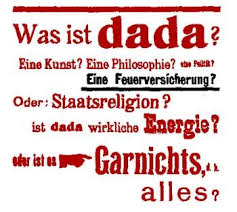
DaDa art movement explained in meaning, characteristics, ideas and the history of Dadaism
- The Dada artist Kurt Schwitters wrote in the first edition of his magazine “Merz”: ‘We, members of the Dada movement, merely hold up a mirror to the times.’
- Dada consciously renounced all monumentality. It does not see itself as the only real truth amongst relativism, it sees itself as no less relative. By first renouncing monumentality we will have a better view of life.
- Dada does not point its hate and contempt at anyone in particular. He does not despise our culture less than he despises its moralistic fighters, who comatise themselves in the rhetoric of their sermons. The Dadaist is serious enough to doubt his own seriousness, and to convince the viewer to doubt him as well.
- Neither does he (the Dada artist, fh) want the public to revere him. In his work, in form as well as content, he attempts to reach the lowest common denominator, to give the work an everyday character, and to force the public to lower themselves to this level.
- He (the Dadaist, fh) would rather fight with the public. He wants to arouse Dada in the public so that it may actively react against his own Dada in order that the whole will form a “Dada Complet”.
- The Dada artist does not see public, everyday life as being beneath his dignity. Quite the opposite. Public, everyday life is the main point for him. By sending false reports to the press he tries to fool the public who want more and more sensational news. They even play-acted riots with the police….
- For Dada, nearly all art is just too much pretence, even if it is often pretence with finesse,- but worse still – it is hypocritical. That is why Dada has nothing against being outright bombastic. Huelsenbeck states in the Dada Almanac the ‘Dada values calling a table a table and a plum a plum’.
- Dada sees all life as an industrial chaos, as ridiculous as it is pointless…. .Dadaists see themselves reflected in the cynical eccentricity of the streets in our cultural centers… ..Cars race past a cathedral. The sound of car horns and the calls of street vendors selling new herrings, beautiful roses, hat boxes and goldfish, all vying for attention. Then in the midst of all this street clamor, a sermon can be heard, coming from a shop selling radios.
- However, not all Dadaists valued this cacophony of nonsense and eccentric chaos to the same extent. For instance Kurt Schwitters (German not-political Dada artist, famous for his glue collages, fh) writes in Merz 1: ‘Out of love for our style we put all our strength into the Dada movement’ (Because Dada exposes our lack of style.)
- Dada was first able to express itself completely in collages. It is often very difficult to decide if a Dada work is ‘abstract’, being without a subject, or ‘concrete’, with a realistic image. If a Dadaist attaches a bicycle wheel to his work it does not represent a bicycle wheel, it is a bicycle wheel! However, it is not in any way about the bicycle wheel in itself. Quite the opposite; in the artwork it is only an element in the interchange between the various elements.
- When Dada artists stick the most fanciful things on their collages, such as a comb, a cigarette box, a coin etc., they do so because they suppose the effect will be the same for the viewer as it was for them. Possible intellectual relationships lay no role whatsoever.
- Colored paper, materials, celluloid, bits of newspaper, a horseshoe, a matchbox, a tram card etc. Photo fragments, preferably with no artistic value, are all stuck together. These photo collages let to photomontage, the first was made by the Dada artist John Heartsfield.
<
- The Dada artist generally chooses the direct-suggestive action produced by the inner activity of the objects applied to the canvas, above their subjective artistic interpretation.
- The subjects chosen by Dada for collages are preferably the most vulgar everyday objects, mainly because of their lack of importance and their neutrality, and also because they evoke, as little as possible, any other milieu.
- Quite apart from anything else, the realistic objects appear in a different relationship to one another, that only exists in emotion, beside the practical, realistic, intellectually understandable relationship. Dada avoids any logical connection between objects and only brings them to an emotional connection. Thus giving them a curious meaning and value.
- When the artist allows objects to speak completely for themselves, and does not change them to suit his idea of the subject, but only groups them together, these connections come into their purest form.
- Some Dada artists (Marcel Duchamp, Man Ray etc.) preferred using entire objects as a direct expression, preferably industrial, mass-produced objects, so-called ’ready-made’ objects.
- The more ready made and concrete the material, the more concrete, active and humorous can be the active connection to other objects and the less involved becomes the constructive intellect of the artist.
- (Kurt) Schwitters’ manner of work is of importance, what he called ‘i’. This consists of searching for fragments he sees in the reality around him, or complexities of objects, that only become art through their boundaries (edges), within which they form a rhythmic whole, for instance a piece of printing. This is the simplest way to produce a work of art. Within and except for the boundaries, everything, including the grouping, is entirely a work of coincidence.
- Generally speaking, the light capriciousness of coincidence was not unwelcome to Dada. Sometimes the airiness of coincidence was not wholly left to coincidence, but systematically sought after.
- For instance, Hans Arp laid colored papers of various shapes and sizes, face down on a sheet of paper. After some shaking about, he would stick them on the paper, color side up, in the way they had grouped themselves on the paper. Thus a composition came about purely by chance. (invented in Dada first, and later as technique radicalized in Futurism by a.o. Hans Arp, fh)
- In the same way as Dada, Surrealism often allow objects to speak for themselves. Both leave space for chance. They reject flattery and want acceptance of reality. We could call Surrealism adult Dada.
- Dada also shows similarities to Futurism. Both attempt to involve the viewer, both in completely different ways. Both wanted a close contact with everyday life, and both rejected the standards of good taste.
- Both (Dada & Futurism, fh) are also destructive. Futurism only externally, but in Dada this is deeper: Dada wants to destroy inner, intellectual and moral constructions.
- Nearly all Dada artists continued to become Surrealists (as Hans Arp and Marcel Duchamp, fh), unless they went on to fight against middle class civilization, not only through art, but through politics by embracing communism.
- Surrealism continued all the important Dada tendencies: against middle class, bourgeois culture, against bourgeois lyric and harmony, and pro the mystical connections between objects. In the same way as Dada, Surrealism allow objects to speak for themselves.
- It is difficult to separate one from the other of the three revolutionary movements, Dada, Expressionism and Surrealism. Expressionism artists like Nolde and Schmidt-Rothluff, will not easily be mistaken for Dada or Surrealists. But the subtle Expressionist Paul Klee is often thought of as a Surrealist, in the same way Masson and Bores can be included with Expressionists.
Art links for more information about DaDa / Dadaism art movement & its Dadaist artists
* * many images of modern art, created in Dada / Dadaism, on Google
