Hans Hofmann, his artist quotes on painting art & colors, in American Abstract Expressionism
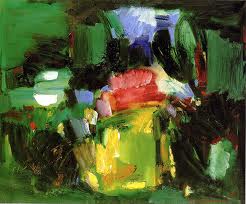
Hans Hofmann (1880 - 1966), quotes on painting art and stories on his life by the German-born American artist. Hofmann was an famous senior-artist & a leading painter in American Abstract Expressionism in New York. He became famous for his expressive, energetic colorful art and his innovative ideas for creating modern painting like his ‘Push Pull’ concept. A famous Color Field painting is Hofmann’s art work ‘The Gate’, he painted circa 1959. Hans Hofmann was an important art teacher for Abstract Expressionist painters like Lee Krasner, Joan Mitchell, Frankenthaler and Larry Rivers.
* At the bottom short biography story facts & selected art links for the famous American artist Hans Hofmann.
|
Hans Hofmann: ‘Jardin d’Amour’, 1959 |
Hans Hofmann, quotes & statements on his color art & his famous Push Pull concept
- Nature’s purpose in relation to the visual arts is to provide stimulus - not imitation…. ….From its ceaseless urge to create springs all Life - all movement and rhythm - time and light, color and mood - in short, all reality in Form and Thought.
* Hans Hofmann, of his artist quote on creation as the source in nature; in ‘Hofmann, Hans; Sara T Weeks; Bartlett H Hayes’, Addison Gallery of American Art; in ”Search for the real, and other essays”, Cambridge, Mass., M.I.T. Press, 1967.
- The creative process lies not in imitating, but in paralleling nature – translating the impulse received from nature into the medium of expression, thus vitalizing this medium. The picture should be alive, the statue should be alive, and every work of art should be alive.
* Hans Hofmann, his critical quote against imitating in modern art because that generates no life in it; from ‘Hofmann, Hans; Sara T Weeks; Bartlett H Hayes’, Addison Gallery of American Art; in ”Search for the real, and other essays”, Cambridge, Mass., M.I.T. Press, 1967.
- A plastic art cannot be created through a superimposed literary meaning. The artist who attempts to do so produces nothing more than a show-booth. He contents himself with visual storytelling. He subjects himself to a mechanistic kind of thinking, which disintegrates into fragments. (Hans Hofmann denies any option of story-telling in modern art, and had so a strong impact on the younger American Expressionism artists, fh)
* his artist quotes on modern plastic painting art, in his lecture ‘Search for the Real’, Hans Hofmann, Addison Gallery of modern Art, 1948, p. 46.
- The significance of a work of art is determined then by the quality of its growth. This involves intangible forces inherent in the process of development. Although these forces are surreal (that is, their nature is something beyond physical reality), they, nevertheless, depend on a physical carrier. The physical carrier (commonly painting or sculpture) is the medium of expression of the Surreal (this quote of Hans Hofmann expresses very clearly the influence of Surrealism on modern American art, circa 1947, fh). Thus, an idea is communicable only when the Surreal is converted into material terms. The artist’s technical problem is how to transform the material with which he works back into the sphere of the spirit.
* source of his quote on the importance of Surrealism in modern painting art ”Search for the Real and other Essays”, Addison Gallery of American Art, 1948, Andover, M.A. pp. 40 – 48.
- This two-way transformation proceeds from metaphysical perceptions, for metaphysics is the search for the essential nature of reality. And so artistic creation is the metamorphosis of the external physical aspects of a thing into a self-sustaining spiritual reality. Such is the magic act which takes place continuously in the development of a work of art. On this and only on this is creation based.
* Hans Hofmann, source of his artist quote on the magic aspect in creating modern art ”Search for the Real and other Essays”, Addison Gallery of American Art, 1948, Andover, M.A. pp. 40 – 48.
- A thought that has found a plastic expression must continue to expand in keeping with its own plastic idiom. A plastic idea must be expressed with plastic means just as a musical idea is expressed with musical means, or a literary idea with verbal means. Neither music nor literature are wholly translatable into other art forms; and so a plastic art cannot be created through a superimposed literary meaning. The artist who attempts to do so produces nothing more than a show-booth. He contents himself with visual story-telling. He subjects himself to a mechanistic kind of thinking which disintegrates into fragments.
* source of this artist quote by Hans Hofmann on the plasticity of modern painting art which exclude radically any kind of story-telling, from, ”Search for the Real and other Essays”, Addison Gallery of American Art, 1948, Andover, M.A. pp. 40 – 48.
- The relative meaning of two physical facts in a emotionally controlled relation always creates the phenomenon of a third fact of a higher order, just as two musical sounds, heard simultaneously create the phenomenon of a third, fourth or fifth. The nature of this higher third is non-physical. In a sense it is magic. Each such phenomenon always overshadows the material qualities and the limited meaning of the basic factors from which it has sprung. For this reason Art expresses the highest quality of the spirit when it is surreal in nature; or, in terms of the visual arts, when it is of a surreal plastic nature.
* Hans Hofmann’s art quote on the necessary Surreal aspect of modern painting art, to becomes spiritualized, from ”Search for the Real and other Essays”, Addison Gallery of American Art, 1948, Andover, M.A. pp. 40 – 48.
- We cannot perceive unlimited space; it is immeasurable. The universe, as we know it through our visual experience, is limited. It first came into existence with the formation of matter, and will end with the complete dissolution of matter. Where there is matter and action, there is space. Pictorial space exists two dimensionally. When the two dimensionality of a picture is destroyed, it falls into parts – it creates the effect of a naturalistic space. When a picture conveys only naturalistic space, it represents a special case, a portion of what is felt about three-dimensional experience. This expression of the artist’s experience is thus incomplete.
* source of Hans Hofmann ‘s artist quote in which he demands three-dimensional space in modern painting art, what means ‘abstract’ art, from ”Search for the Real and other Essays”, Addison Gallery of American Art, 1948, Andover, M.A. pp. 40 – 48.
- The layman has extreme difficulty in understanding that plastic creation on a flat surface is possible without destroying this flat surface. But it is just this conceptual completeness of a plastic experience that warrants the preservation of the two dimensionality. A plastic approach which is incomplete conceptually will destroy the two dimensionality.
* source of Hofmann’s artist quote on modern painting art, in ”Search for the Real and other Essays”, by Hans Hofmann, published by Addison Gallery of American Art, 1948, Andover, M.A. pp. 40 – 48.
- Depth, in a pictorial, plastic sense, is not created by the arrangement of objects one after another toward a vanishing point, in the sense of the Renaissance perspective, but on the contrary (and in absolute denial of this doctrine) by the creation of forces in the sense of push and pull (the famous and unique modern art concept invented by Hans Hofmann, which had an enormous impact on the American New York art scene circa 1947, fh). Nor is depth created by tonal gradation (another doctrine of the academician which, at its culmination, degraded the use of color to a mere function of expressing dark and light).
* Hans Hofmann, his quote with the famous push and pull concept for American modern painting art ”Search for the Real and other Essays”, Addison Gallery of American Art, 1948, Andover, M.A. pp. 40 – 48.
- Since one cannot create ‘real depth’ by carving a hole in the picture, and since one should not attempt to create the illusion of depth by tonal gradation, depth as a plastic reality must be two dimensions in a formal sense as well in the sense of color. ‘Depth’ is not created on a flat surface as an illusion, but as a plastic reality. The nature of the picture plane makes it possible to achieve depth without destroying the two-dimensional essence of the picture plane… …A plane is a fragment in the architecture of space. When a number of planes are opposed one to another, a spatial effect results. A plane functions in the same manner as the walls of a building… …Planes organized within a picture create the pictorial space of its composition… …The old masters were plane-consciousness. This makes their pictures restful as well as vital.. .
* source of this artist quote by Hofmann on the importance of plane in the architecture of a modern painting, in ”Search for the Real and other Essays”, texts written by Hans Hofmann and published by Addison Gallery of American Art in 1948, Andover, M.A. pp. 40 – 48.
- A line cannot control pictorial space absolutely. A line may flow freely in and out space, but cannot independently create the phenomenon of push and pull necessary to plastic creation. ‘Push and pull’ ( Hofmann’s unique contribution in the modern art scene of Abstract Expressionism / New York School, fh) expanding and contracting forces which are activated by carriers in visual motion. Planes are the most important carriers, lines and points less so… …the picture plane reacts automatically in the opposite direction to the stimulus received; thus action continues as long as it receives stimulus in the creative process. Push answers with pull and pull with push… …At the end of his life and the height of his capacity Cézanne understood color as a force of push and pull. In his pictures he created an enormous sense of volume, breathing, pulsating, expanding, contracting through his use of colors.
* Hans Hofmann is referring in this important push and pull-quote to the energetic color use in the late paintings of Cezanne, from his art-texts ”Search for the Real and other Essays”, Addison Gallery of American Art, 1948, Andover, M.A. pp. 40 – 48.
- … the reciprocal relation of color to color produces a phenomenon of a more mysterious order. This new phenomenon is psychological. A high sensitivity is necessary in order to expand color into the sphere of the surreal without losing creative ground. Color stimulates certain moods in us (emphasized in Color Field painting, fh). It awakens joy or fear in accordance with its figuration. In fact, the whole world, as we experience it visually, comes to us through the mystic realm of color. Our entire being is nourished by it. This mystic quality of color should likewise find expression in a work of art. (many art-critics like Karen Wilkins emphasizes the importance of Hans Hofmann’s theory for the American Colour Field orientation, like Rothko, Morris Louis, a.o. - fh)
* Hans Hofmann, source of his artist quotes on modern painting art ”Search for the Real and other Essays”, Addison Gallery of American Art, 1948, Andover, M.A. pp. 40 – 48.
- The impressionistic method leads into a complete splitting and dissolution of all areas involved in the composition, and color is used to create an overall effect of light. The color is, through such a shading down from the highest light in (sic) the deepest shadows, sacrificed a degraded to a (black-and-white) function. This leads to the destructions of the color as color. (a severe critic and radical rejection of tonal use of colors in modern painting - revealing a lot of De Stijl (Mondrian) influence on Hofmann’s art ideas, fh)
* source of Hans Hofmann’s artist quote on modern painting ”Search for the Real, Hans Hofmann”, Addison Gallery of modern Art, 1948, pp. 51, 73, 74.
- One must realize that, apart from considerations of color and form, there are two fundamentally different ways of regarding a medium of expression: one is based on taste only – an approach in which the external physical elements of expression are merely pleasingly arranged. This way results in decoration with no spiritual reaction. Arrangement is not art. The second way is based on the artist’s power of empathy, to feel the intrinsic qualities of the medium of expression. Through these qualities the medium comes to life… …In this life, an intuitive artist discovers the emotive and vital substance which makes a work of art. (in this quote Hofmann distances himself from Impressionism as well as from Fauvism painting art, fh)
* Hans Hofmann, with his quote against art only for the taste - by arranging colors pleasantly in modern painting art, from his ”Search for the Real and other Essays”, Addison Gallery of American Art, 1948, Andover, M.A. pp. 40 – 48.
- It is the greatest injustice done to Piet Mondrian that people who are plastically blind see only decorative design instead of the plastic perfection which characterizes his work. The whole De Stijl group (the Dutch abstract art movement, started by Mondrian and Van Doesburg, fh)… …must be considered a protest against such blindness.
* Hofmann is defending in this quote the De Stijl painting art orientation of Mondrian and Van Doesburg; source; ”Search for the Real and other Essays”, Hans Hofmann and published by Addison Gallery of American Art, 1948, Andover, M.A. pp. 40 – 48.
- The knowledge of reality, achieved by means of the complete sensory equipment, must be expressed artistically in terms of a medium which appeals to the memory of all sensory experience – but only through the eye.
* Hans Hofmann’s artist quote on modern painting art just appealing through the eye, in ”Search for the Real and other Essays”, Addison Gallery of American Art, 1948, Andover, M.A. pp. 55 – 58.
- Art leads to a more profound concept of life, because art itself is a profound expression of feeling. The artist is born, and art is the expression of his overflowing soul. Because his soul is rich, he cares comparatively little about the superficial necessities of the material world; he sublimates the pressure of material affairs in an artistic experience.
* source Hofmann’s artist quote on modern art as a way of sublimation of the material aspects of life ”Search for the Real and other Essays”, Hans Hofmann, - Addison Gallery of American Art, 1948, Andover, M.A. pp. 55 – 58.
- The general misunderstanding of a work of art is often due to the fact that the key to its spiritual content and technical means is missed. Unless the observer is trained to a certain degree in the artistic idiom, he is apt to search for things which have little to do with the aesthetic content of a picture. He is likely to look for pure representational values when the emphasis is really upon music-like relationships.
* Hans Hofmann criticizes in this quote the Ecole de Paris abstract painting art with their relations to music, taken from his texts ”Search for the Real and other Essays”, Addison Gallery of American Art, 1948, Andover, M.A. pp. 55 – 58.
- It takes intelligence and training, self-discipline and fine-sensibility, to gain renewed life through leisure occupation. America now suffers spiritual poverty, and art must become more fully American life before her leisure can become culture.
* characteristic art quote of the senior and European-born painter artist Hans Hofmann on the spiritual poverty of American modern , from ”Search for the Real and other Essays”, Hans Hofamm, publishers Addison Gallery of American Art, 1948, Andover, M.A. pp. 55 – 58.
- Everything rhythmically organic is true. Everything, which results from the proper feeling for rhythmically organized spiritual units, is true and alive - alive within itself. When we lose the sense for such true beauty we lose our natural sense for the rich flavour of life, which is the basis for all inspirational work.
* Hans Hofmann emphasis here in this artist quote the Natural aspect by rhythmical organized spiritual units for modern painting art, in his ”Search for the Real and other Essays”, Addison Gallery of American Art, 1948, Andover, M.A. pp. 55 – 58.
- Speech has arisen through the need for expression. Certain factors have contributed to making it the paramount utilitarian method of expression. There are ideas and things expressible in words, but there are ideas better expressed in music, the person with no musical ear, or without discipline in the language of music, lacks the key to the door of the world of musical experience. But we live in a world of volume and space; it is hard to conceive of the person who is space-blind or volume-deaf. The great majority of people have the means of approach to plastic beauty as part of their natural equipment. The teacher can develop this natural endowment as Necessity, the greatest teacher, has developed speech.
* Hans Hofmann, source of his artist quote on plastic beauty in modern painting art; taken from ”Search for the Real and other Essays”, Addison Gallery of American Art, 1948, Andover, M.A. pp. 55 – 58./p>
- This world (Hans Hofmann means here: painting art, fh) is an important as culturally as is the world of words or of music. My ideal is to form and to paint as Schubert sings his songs and as Beethoven creates his world in sounds. That is to say, creation of one’s own inner world through the same human and artistic discipline.
* Hofmann is referring to the expression of the inner world like in the music of Schubert - source of his artist quote, in ”Search for the Real and other Essays”, Addison Gallery of American Art, 1948, Andover, M.A. pp. 55 – 58.
- The physical carrier is overshadowed by a relation. The relation creates an overtone. The physical carrier is absorbed by this overtone. The overtone spontaneously transforms the means of creation into a spiritual reality. The mystery of creation is then revealed.
* Hans Hofmann describes the spiritual dimension of modern art in this artist quote, taken from his ”Search for the Real and other Essays”, Addison Gallery of modern Art, 1948, pp. 47, 48, 55.
- Monumentality is an affair of relativity. The truly monumental can only come about by means of the most exact and refined relation between parts. Since each thing carries both a meaning of its own and an associated meaning in relation to something else – its essential value is relative. We speak of the mood we experience when looking at a landscape. This mood results from the relation of certain things rather than from their separate actualities. This is because objects do not in themselves possess the total effect they give when interrelated.
* his quote on monumentality by expressing relation, by Hans Hofmann; source of his artist quote, in ”Search for the Real and other Essays”, Addison Gallery of modern Art, 1948, pp. 66, 68.
- A work based only on a line concept is scarcely more than an illustration.; it fails to achieve pictorial structure. Pictorial structure is based on a plane concept. The line originates in the meeting of two planes… …we can lose ourselves in a multitude of lines, if through them we lose our senses for the planes.
* Hans Hofmann emphasizes the use of the planes, as source of the lines in the picture, - source of his quote on from; ”Search for the Real, Hans Hofmann”, Addison Gallery of modern Art, 1948, p. 71.
- (Hofmann was visiting Jackson Pollock’s studio and reacted on Pollock’s paintings, fh): You do not work from nature. This is no good, you will repeat yourself. You work by heart, not from nature.
(Pollock reacted on Hofmann: “I am nature”, fh)
* Hans Hofmann, reacting on Pollock’s painting art as art from the heart only - source of his artist quote; from ‘Jackson Pollock’, Ellen G Landau, p. 259, as quoted in “Jackson Pollock and Lee Krasner”, Ines Janet Engelmann, Prestel Verlag Munich, 2007, p. 66.
- Since light is best expressed through differences in color quality, color should not be handled as a tonal gradation, to produce the effect of light.
* Hans Hofmann, with his quote on the necessary approach for light, in creating modern painting art ”Search for the Real, Hans Hofmann”, Addison Gallery of modern Art, 1948, p. 74.
- Sometimes I wonder, laying in a great black stripe on a canvas, what animal bones (or horns) are making the furrows of my picture… …black grows deeper and deeper, darker and darker before me. It menaces me like a black gullet. I can bear it no longer. It is monstrous. It is unfathomable. ‘As the thought comes to me to exorcise and transform this black with a white drawing, it has already become a surface… ….Now I have lost all fear, and begin to draw on the black surface’ (quote Hans Arp, fh). Only love – for painting, in this instance - is able to cover the fearful void.
* a very intimate quote by Hans Hofmann on fear in and by creation; Hofmann is quoting here the famous artist Hans Jean Arp in an attempt to express the way he creates – the process of his creation of painting which escapes his own mind; taken from the art texts ”Search for the Real, Hans Hofmann”, Addison Gallery of modern Art, 1948.
- Painting is aesthetic enjoyment; I want to be a ‘poet’. As an artist I must conform to my nature. My nature has a lyrical as well as a dramatic disposition. Not one day is the same. One day I feel wonderful to work and I feel an expression, which shows in the work. Only with a very clear mind on a clear day I can paint without interruptions and without food because my disposition is like that. My work should reflect my moods and the greatest enjoyment I had when I did the work.
* his quote on the role of his moods in crating his painting aert, by the famous American senior-artist Hans Hofmann, source of his artist quote is a public art debate in Abstract Expressionism in New York - organized by the artist Robert Motherwell; taken from: ‘Artists’ Session at Studio 35’ 1950; as quoted in ”Abstract Expressionism Creators and Critics”, ed. Clifford Ross, Abrams Publishers New York 1990, p. 225.
- Robert Motherwell asking Hofmann: ‘Would you say that a fair statement of your position (in painting, fh) is that the meaning of a work of art consists of the relations among the elements, and not the elements themselves?’ Hofmann: ‘Yes, that I would definitely say… … it is all relation’.
* Hans Hofmann explains his painting art as created pictures of relations (between the visual elements, fh) in an interview with Motherwell, source of his artist quote on modern painting art ”Modern Artists in America” - First Series, R. Motherwell, Ad Reinhardt and B. Karpel eds., 1952 pp. 19, 39.
- The width of a line may present the idea of infinity. An epigram may contain a world. In the same way, a small picture format may be much more living, much more leavening, stirring, awakening, than square yards of wall space.
* Hans Hofmann, source of his artist quotes on modern painting art ”Abstract Expressionist Painting in America”, W.C, Seitz, Cambridge Massachusetts, 1983, p. 88.
not sourced artist quotes by the famous American painter Hans Hofmann – in American Abstract Expressionism
- Art is something absolute, something positive, which gives power just as food gives power. While creative science is a mental food, art is the satisfaction of the soul. (painter quote on art by Hans Hofmann)
- …it isn’t necessary to make things large to make them monumental; a head by Giacometti (famous sculptor in French modern sculpture art, fh)one inch high would be able to vitalize this whole space.
Hans Hofmann, biography facts of the senior painter & art teacher in American Abstract Expressionism
Hans Hofmann was a painter of German origin and became later an important and leading senior artist in American Abstract Expressionism. He was admired by other artists for the expressiveness he tried to achieve in his art and for his very personal, but nevertheless still conscious approach to his art. His emphasis on the spiritual power of color influenced the younger painters of Color Field painting. Of course Hofmann was very familiar with European modern abstract painting; so he became a bridge between traditional European art and the young, wild, modern artists in America. He engaged a lot in art discussions in New York art scene on Abstract Expressionism. Hofmann wrote many art essays which influenced the modern art scene in New York undoubtedly.
Famous and radical was Hofmann’s art concept of ‘push pull’ (read his quotes) which influenced many of the young American painters. Hofmann developed his own philosophy of art which he expressed in his famous art essays – an essential part of the most engaging discussions of painting in the twentieth century, ‘The color problem in Pure Painting –Its Creative Origine’.
Like his German fellow countryman Joseph Albers Hofmann was an inspirational art teacher for famous young Abstract Expressionist painters: a.o. Lee Krasner, Joan Mitchell, Helen Frankenthaler Larry Rivers and Frank Stella.
Hans Hofmann; links for more biography information on his painting art and life
* the American painter artist Hans Hofmann, on Wikipedia
* many picturtes of Hans Hofmann’s colorful painting art, on Google Images
