KURT SCHWITTERS: Dada quotes + biography facts of the German artist, famous for his dadaist Merz collage art, Ursonate & Merzbau; German Dada

KURT SCHWITTERS (1886 – 1966), artist quotes on Dada and his Merz art, collages, poems, Ursonate and Merzbau; with biography facts. Kurt Schwitters was sculptor, painter, poet and writer; he represents as essential figure the not-political Dada in Germany, but had to fly away to Norway and even England, to scape Nazism. At the bottom more biography facts and information on Schwitters, his Merz art and life, with some art links for the artist in German Dadaism. (for Schwitters quotes in German language). When you enjoy his quotes, please share them on Facebook, Google +1 or Twitter; – the editor.

Kurt Schwitters:
his artist quotes

editor:
Fons Heijnsbroek

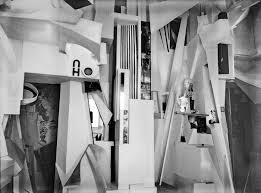
reconstruction of the ‘Merzbau’, originally built by Schwitters in Hannover 1923-36, but bombed in 1943 by an allied air raid

a later reconstruction of Schwitters ‘Merzbau’, bombed in 1943

KURT SCHWITTERS, 32 artist quotes – German painter, sculptor in Dada; famous for his Merz art, Merzbau, collages & poetry

- Merz paintings are abstract works of art. The word ‘Merz’ essentially means the totality of all imaginable materials that can be used for artistic purposes and technically the principle that all of these individual materials have equal value. Merz art makes use not just of paint and canvas, brush and palette, but all the materials visible to the eye and all tools needed… …the wheel off a pram, wire mesh, string and cotton balls – these are factors of equal value to paints. The artist creates by choosing, distributing and reshaping the materials.
* Kurt Schwitters, source of artist quotes on Dada Art & life: ‘Merz Painting’ (1919); as quoted in “I is Style”, ed. Siegfried Gohr & Gunda Luyken, commissioned by Rudi Fuchs, director of the Stedelijk Museum Amsterdam, NAI Publishers, Rotterdam 2000, p. 91 (Dadaist German painter, poet and sculptor, famous for his Merz art, Merzbau, Ursonate; biography below)


- Merz art strives for immediate expression by shortening the path from intuition to visual manifestation of the artwork…. …they will receive my new work als they always have when something new presents itself: with indignation and screams of scorn.
* Kurt Schwitters, source of artist quotes on Dada Art & life: ‘Merz Painting’ (1919); as quoted in “I is Style”, ed. Siegfried Gohr & Gunda Luyken, commissioned by Rudi Fuchs, director of the Stedelijk Museum Amsterdam, NAI Publishers, Rotterdam 2000, p. 91 (Dadaist German painter, poet and sculptor, famous for his Merz art, Merzbau, Ursonate; biography below)


- Merz art strives for immediate expression by shortening the path from intuition to visual manifestation of the artwork…. …they will receive my new work als they always have when something new presents itself: with indignation and screams of scorn.
* Kurt Schwitters, source of artist quotes on Dada Art & life: ‘Merz Painting’ (1919); as quoted in “I is Style”, ed. Siegfried Gohr & Gunda Luyken, commissioned by Rudi Fuchs, director of the Stedelijk Museum Amsterdam, NAI Publishers, Rotterdam 2000, p. 91 (Dadaist German painter, poet and sculptor, famous for his Merz art, Merzbau, Ursonate; biography below)


- Merz stands for the freedom of all fetters… …Merz also means tolerance towards any artistically motivated limitation. Every artist must be allowed to mould a picture out of nothing but blotting paper, for example, provided he is capable of moulding a picture.
* Kurt Schwitters, source of artist quotes on Dada Art & life: ‘Merz. Für den Ararat geschrieben’ (1920), in “Kurt Schwitters, das literarische Werk”. Ed. Friedhelm Lach, Dumont Cologne, 1973 – 1981, Vol. 5 p. 77 (Dadaist German painter, poet and sculptor, famous for his Merz art, Merzbau, Ursonate; biography below)


- The medium is as unimportant as I myself. Essential is only the forming… …I take any material whatsoever if the picture demands it. When I adjust materials of different kinds to one another, I have taken a step in advance of mere oil painting, for in addition to playing off color against color, line against line, form against form etc. I play off material against material, wood against sack clothes. (1921)
* Kurt Schwitters, source of artist quotes on Dada Art & life: “Abstract Art”, Anna Moszynska, Thames and Hudson, London 1990, pp. 68-69 (Dadaist German painter, poet and sculptor, famous for his Merz art, Merzbau, Ursonate; biography below)


- We, the founders of Dada-movement try to give time its own reflection in the mirror.
* Kurt Schwitters, source of artist quotes on Dada Art & life: first edition of his famous magazine ‘’Merz’, 1923 (Dadaist German painter, poet and sculptor, famous for his Merz art, Merzbau, Ursonate; biography below)


- Art is a spiritual function of man, which aims at freeing him from life’s chaos. Art is free in the use of its means in any way it likes, but is bound to its laws and to its laws alone. The minute it becomes art, it becomes much more sublime than a class distinction between proletariat and bourgeoisie. (in discussion with the ‘political’ Dadaist artists like Huelsenbeck, fh)
* Kurt Schwitters, source of artist quotes on Dada Art & life: his famous manifesto ‘Proletkult’, 1923 (Dadaist German painter, poet and sculptor, famous for his Merz art, Merzbau, Ursonate; biography below)


- Kurt Schwitters is the inventor of Merz and I, and aside of himself, he recognizes no one as a Merz artists or an I artist with highest regards.
* Kurt Schwitters, source of artist quotes on Dada Art & life: ‘Die Blume Anna’, a poem of Kurt Schwitters in ‘Consistent Poetry Art’ his contribution to ‘Magazine G’, No. 3, 1924, ed. by Hans Richter; as quoted in “I is Style”, ed. Siegfried Gohr & Gunda Luyken, commissioned by Rudi Fuchs, director of the Stedelijk Museum Amsterdam, NAI Publishers, Rotterdam 2000, p. 151 (Dadaist German painter, poet and sculptor, famous for his Merz art, Merzbau, Ursonate; biography below)


- Classical poetry counts on people’s similarity. It regards idea associations as unequivocal. This is a mistake. In any case, it rests on a fulcrum of idea associations: ‘Above the peaks is peace.’… …The poet counts on poetic feelings. And what is a poetic feeling? The whole poetry of peace/ quiet stands or falls on the reader’s ability to feel. Words are not judged here.
* Kurt Schwitters, source of artist quotes on Dada Art & life: ‘Consistent Poetry Art’ Schwitters contribution to ‘Magazine G’, No. 3, 1924, ed. by Hans Richter; as quoted in “I is Style”, ed. Siegfried Gohr & Gunda Luyken, commissioned by Rudi Fuchs, director of the Stedelijk Museum Amsterdam, NAI Publishers, Rotterdam 2000, p. 151 (Dadaist German painter, poet and sculptor, famous for his Merz art, Merzbau, Ursonate; biography below)


- Consistent poetry is made of letters. Letters have no idea. Letters as such (written!, fh) have no sound, they offer only tonal possibilities, to be valuated by the performer (spoken!, fh). The consistent poem weighs the value of both letters and groups.
* Kurt Schwitters, source of artist quotes on Dada Art & life: ‘Consistent Poetry Art’ Schwitters contribution to ‘Magazine G’, No. 3, 1924, ed. by Hans Richter; as quoted in “I is Style”, ed. Siegfried Gohr & Gunda Luyken, commissioned by Rudi Fuchs, director of the Stedelijk Museum Amsterdam, NAI Publishers, Rotterdam 2000, p. 151 (Dadaist German painter, poet and sculptor, famous for his Merz art, Merzbau, Ursonate; biography below)


- I cannot make a living out of art and I now occupy myself with a variety of things. Of course, I continue to paint and to nail, but in particular I write grotesques and art reviews for newspapers, I organize evenings and draw commercial art for newspapers.
* Kurt Schwitters, source of artist quotes on Dada Art & life: a letter to Galka Scheyer, January 1926; as quoted in “I is Style”, ed. Siegfried Gohr & Gunda Luyken, commissioned by Rudi Fuchs, director of the Stedelijk Museum Amsterdam, NAI Publishers, Rotterdam 2000, p. 34 (Dadaist German painter, poet and sculptor, famous for his Merz art, Merzbau, Ursonate; biography below)


- Just as soon as the great and glorious Revolution broke out (after World War 1., fh) I gave notice and now live entirely for art. For a while, I tried to create new forms of art from the remains of the old culture. From this Merz painting emerged, painting that happily used every material – Pelikan (ink mark, fh) colors or the rubbish from the rubbish heap. So I experienced the Revolution in the most delightful way and pass for a Dadaist, without being one. As a result, I could introduce Dadaism in Holland (together with Theo van Doesburg and his wife, fh) with complete impartiality. In Holland I became familiar with architecture for the first time.
* Kurt Schwitters, source of artist quotes on Dada Art & life: ‘Autobiography of Kurt Schwitters’, 6 June 1926, sent to Hans Hilderbrandt; as quoted in “I is Style”, ed. Siegfried Gohr & Gunda Luyken, commissioned by Rudi Fuchs, director of the Stedelijk Museum Amsterdam, NAI Publishers, Rotterdam 2000, p. 92 (Dadaist German painter, poet and sculptor, famous for his Merz art, Merzbau, Ursonate; biography below)


- In the war ( World War 1., fh) things were in terrible turmoil. What I had learned at the academy was of no use to me and the useful new ideas were still unready…. …I felt myself freed and had to shout my jubilation out to the world. Out of parsimony I took what I could find to do this, because we were now an impoverished country. One can even shout with refuse, and this is what I did, nailing and gluing it (his art pieces, fh) together. I called it ‘Merz’; it was a prayer about the victorious end of the war, victorious as once again peace had won in the end; everything had broken down in any case and new things had to be made out of the fragments; and this is Merz.
* Kurt Schwitters, source of artist quotes on Dada Art & life: ‘Kurt Schwitters’ (1930), in “Kurt Schwitters, das literarische Werk”. Ed. Friedhelm Lach, Dumont Cologne, 1973 – 1981, Vol. 5 p. 335 (Dadaist German painter, poet and sculptor, famous for his Merz art, Merzbau, Ursonate; biography below)


- I know that I am an important factor in the development of art and shall forever remain so. I say this with great emphasis, so that one can not say, at a later ate: ‘The poor fellow had no inkling of how important he was’. Nom I am no fool, nor am I timid. I know full well that the time will come for me and all other important personalities of the abstract movement, when we will influence an entire generation. However, I fear that I shall not experience this.
* Kurt Schwitters, source of artist quotes on Dada Art & life: ‘I and my purpose’ in Merz, no. 21, 1931; as quoted in ‘Introduction’ of the catalogue of Schwitters one-man show at the Marlborough Gallery,London March-April 1963 (Dadaist German painter, poet and sculptor, famous for his Merz art, Merzbau, Ursonate; biography below)


- Nevertheless I like being in Norway (to escape the Nazis Schwitters fled to Norway in 1937?? , fh), for it is a country if unparalleled beauty… …I paint landscapes and portraits, model portrait, glue and paint abstract pictures and glue abstract plastic art; besides, I write poetry in German… … What distresses me most of all is that I can not live in my Merzraum ( a sculptured space Schwitters had built in Germany in the 1920s, but it was bomb-damaged in the war, fh) and that it may be given up to destruction. For that reason I ask you once more, can you keep your ear to the ground again, to see if anyone in America is willing to give me an opportunity to shape a three-dimensional room?
* Kurt Schwitters, source of artist quotes on Dada Art & life: a letter to Galka Scheyer, 24 July 1937; as quoted in “I is Style”, ed. Siegfried Gohr & Gunda Luyken, commissioned by Rudi Fuchs, director of the Stedelijk Museum Amsterdam, NAI Publishers, Rotterdam 2000, p. 41 (Dadaist German painter, poet and sculptor, famous for his Merz art, Merzbau, Ursonate; biography below)


- The custom official was desperate, he did not know whether they were pictures, wood ware or even arms (his abstract art which he exported to France, fh). I got the impression he ha an inner struggle with two options, either to have me arrested or to call the lunatic asylum. Finally he did not want to make a fool of himself, and accepted they were paintings, especially because another customs official knew me personally and confirmed that I was an artist.
* Kurt Schwitters, source of artist quotes on Dada Art & life: a letter to Henriette Schwitters, 16 June 1939; as quoted in “I is Style”, ed. Siegfried Gohr & Gunda Luyken, commissioned by Rudi Fuchs, director of the Stedelijk Museum Amsterdam, NAI Publishers, Rotterdam 2000, p. 41 (Dadaist German painter, poet and sculptor, famous for his Merz art, Merzbau, Ursonate; biography below)


- A museum that really wants to promote modern art might give the artist a guaranty, on certain conditions, so that he can get on with his life and his creations. Or do you believe that the museum is more interested in the artist’s death, in order to see the price of his paintings go up?
* Kurt Schwitters, source of artist quotes on Dada Art & life: a letter to Käthe Steinitz from the internment camp on Isle of Man, England, 11 November 1940 (Dadaist German painter, poet and sculptor, famous for his Merz art, Merzbau, Ursonate; biography below)


- Please help me, in order to get us invited (to the United States, fh). Helma (his wife, fh) will then come later and I will work there (America, fh) and soon pay back the people who lend me the money. Bit finally I must get out of this internment (because the English mistrusted him, being a German, fh) and further away from Norway, I want to be with all of you. Please get it done quickly and write to me about the outcome. Maybe my art is in danger and I, of course, with it. At last I would like to work on my abstracts again and find appreciation for them. Who knows what will happen?
* Kurt Schwitters, source of artist quotes on Dada Art & life: letter to Käthe Steinitz from the internment camp on Isle of Man, England, 22 October 1941; as quoted in “I is Style”, ed. Siegfried Gohr & Gunda Luyken, commissioned by Rudi Fuchs, director of the Stedelijk Museum Amsterdam, NAI Publishers, Rotterdam 2000, p. 45 (Dadaist German painter, poet and sculptor, famous for his Merz art, Merzbau, Ursonate; biography below)


- I was thrilled, and I mean really thrilled, when I read that parts of the Merzbau could still be buried under the ruins. Whatever the circumstances. I will try and come to Hannover to salvage it… …wait until I arrive, for the Merzbau is made of plaster of Paris and could easily be damaged. However by working slowly I am sue I can save parts. And it is certainly worth it, because it is my life’s work. And in the opinion of people abroad it was seen as a new form of art.
* Kurt Schwitters, source of artist quotes on Dada Art & life: letter to Käthe Steinitz 24 June 1945; as quoted in “I is Style”, ed. Siegfried Gohr & Gunda Luyken, commissioned by Rudi Fuchs, director of the Stedelijk Museum Amsterdam, NAI Publishers, Rotterdam 2000, p. 47 (Dadaist German painter, poet and sculptor, famous for his Merz art, Merzbau, Ursonate; biography below)


- In Hanover I built, before Hitler’s time, a studio called Merzbau. This has been reproduced very much, also in the book ‘Dada, Surrealism, Fantastic Art’ of the Museum of Modern Art (this exposition was in 1936, fh) N. Y. I would like to go to Germany for restoring the Merzbau… …Could I come with you to an agreement that you give me for this purpose some money? For example that I give you some pictures for the money ansd use it for restoring the studio… …Or would you prefer that you own with me half and half the * Kurt Schwitters, source of artist quotes on Dada Art & life: letter to Oliver Kaufmann, (department of Paiting and Sculpture of the Moma New York), 30 April 1946; as quoted in “I is Style”, ed. Siegfried Gohr & Gunda Luyken, commissioned by Rudi Fuchs, director of the Stedelijk Museum Amsterdam, NAI Publishers, Rotterdam 2000, p. 48 (Dadaist German painter, poet and sculptor, famous for his Merz art, Merzbau, Ursonate; biography below)


- When I was born 20.6.(18)87, I was influenced by Picasso to cry. When I could walk and speak I still stood under Picasso’s influence and said to my mother: ‘Tom’ or ‘Happening’ meaning the entrances of the canal under the street. My lyrical time was when I lived in the Violet Street. I never saw a violet. That was my influenced by Matisse because when he painted rose I did not paint violet. As a boy of ten I stood under Mondrian’s influence and built little houses with little bricks. Afterwards I stood under the influence of the Surrealists… …In never stood under the influence of Dadaism because whereas the Dadaist created Spiegeldadaismus on the Zurich Lake, I created MERZ on the Leineriver, under the influence of Rembrandt. Time went on, and when Hans Arp made concrete Art, I stayed Abstract. Now I do concrete Art, and Marcel Duchamps went over to the Surrealists… …,and at all I have much fun about Art.
* Kurt Schwitters, source of artist quotes on Dada Art & life: ‘My art and My live (1940 – 1946); as quoted in “I is Style”, ed. Siegfried Gohr & Gunda Luyken, commissioned by Rudi Fuchs, director of the Stedelijk Museum Amsterdam, NAI Publishers, Rotterdam 2000, p. 100 (Dadaist German painter, poet and sculptor, famous for his Merz art, Merzbau, Ursonate; biography below)


- One needs a medium. The best is, one is his own medium. But don’t be serious because seriousness belongs to a passed time. This medium, called you yourself will tell you to take absolutely the wrong material. That is very good, because only the wrong material used in the wrong way, will give the right picture, when you look at it from the right angle. Or the wrong angle. That leads us to the new ism: Anglism. The first art starting from England (where Schwitters stayed when he wrote this, fh), except the former shapes of art.
* Kurt Schwitters, source of artist quotes on Dada Art & life: That is my confession I have to make MERZ. (1940 – 1946); as quoted in “I is Style”, ed. Siegfried Gohr & Gunda Luyken, commissioned by Rudi Fuchs, director of the Stedelijk Museum Amsterdam, NAI Publishers, Rotterdam 2000, pp. 100-101 (Dadaist German painter, poet and sculptor, famous for his Merz art, Merzbau, Ursonate; biography below)


- …Since the loss of the Merzbau, which was a big sculpture (5 x 4 x 4,5 meters) I did a lot of small sculptures…
* Kurt Schwitters, source of artist quotes on Dada Art & life: letter to Edgar Kaufmann, 16 July 1946; as quoted in “I is Style”, ed. Siegfried Gohr & Gunda Luyken, commissioned by Rudi Fuchs, director of the Stedelijk Museum Amsterdam, NAI Publishers, Rotterdam 2000, p. 48 (Dadaist German painter, poet and sculptor, famous for his Merz art, Merzbau, Ursonate; biography below)


- I have two principle aims, two life works. The second is my sonata (his ‘UrSonata’ a long sound poem of 35 minutes ed.)
* Kurt Schwitters, source of artist quotes on Dada Art & life: quote by Margareth Miller to Oliver Kaufmann; as quoted in “I is Style”, ed. Siegfried Gohr & Gunda Luyken, commissioned by Rudi Fuchs, director of the Stedelijk Museum Amsterdam, NAI Publishers, Rotterdam 2000, p. 48 (Dadaist German painter, poet and sculptor, famous for his Merz art, Merzbau, Ursonate; biography below)


- My name is Schwitters, Kurt Schwitters…. …I’m a painter and I nail my pictures… …I’d like to be accepted into the Dada Club (Schwitters is introducing himself to the Dadaist Hans Richter in Zurich, ed.)
* Kurt Schwitters, source of artist quotes on Dada Art & life: ‘Hannover-Dada’, Hans Richter, after 1948; as quoted in “I is Style”, ed. Siegfried Gohr & Gunda Luyken, commissioned by Rudi Fuchs, director of the Stedelijk Museum Amsterdam, NAI Publishers, Rotterdam 2000, p. 151 (Dadaist German painter, poet and sculptor, famous for his Merz art, Merzbau, Ursonate; biography below)


- Eternal lasts the longest.
* Kurt Schwitters, source of artist quotes on Dada Art & life: ‘Hannover-Dada’, Hans Richter, after 1948; as quoted in “I is Style”, ed. Siegfried Gohr & Gunda Luyken, commissioned by Rudi Fuchs, director of the Stedelijk Museum Amsterdam, NAI Publishers, Rotterdam 2000, p. 151 ( great German Dada master artist Kurt Schwitters: his inspirational quotations about life & creating art; Dadaism)


- Whatever became of Kurt Schwitters novel ‘Franz Müllers Drahtfrühling’ [ Franz Müller’s Wire Spring ] several chapters of which we composed together? Is it buried under the bomb ruins of is house on Waldhausenstrasse in Hannover? For hours, Schwitters and I (= Hans Arp, ed.) sat together and spun dialogue, in rhapsody. He took these writings and channelled them into his novel… …We sat together again, writing ‘Franz Müllers Drahtfrühling’:
Hans Arp: The nightingales have had enough of your hymnal Karagösen. Play violin on parrots, but avoid the women red hood ans snow widow.
Kurt Schwitters: Should I pe-trify something for you? Or would you like play cry together?
H. A.: Should we wash our tears or drown them?
K. Schw.: You are a sipsnipper, Since when do your diamonds bark?
H. A.: The water is getting hard. A fruit cries out loud and gives birth to a fish.
K. Schw.: I’ll p-ut it in the sea, or should I st-ab you wth it?
* Kurt Schwitters, source of artist quotes on Dada Art & life: ‘Franz Müllers Drahtfrühling – Memories of Kurt Schwitters’, Hans Arp 1956; as quoted in “I is Style”, ed. Siegfried Gohr & Gunda Luyken, commissioned by Rudi Fuchs, director of the Stedelijk Museum Amsterdam, NAI Publishers, Rotterdam 2000, pp. 139-140 (Dadaist German painter, poet and sculptor, famous for his Merz art, Merzbau, Ursonate; biography below)


- It is not the word that is the original material of poetry, rather the letter.
Word is:
1. Composition of letters
2. Sounds
3. Description (meaning)
4. Vehicle for idea associations
Art is uninterpretable, unending; material must be unequivocal in a consistent formation.
* Kurt Schwitters, source of artist quotes on Dada Art & life: ‘Consistent Poetry Art’ Schwitters contribution to ‘Magazine G’, No. 3, 1924, ed. by Hans Richter; as quoted in “I is Style”, ed. Siegfried Gohr & Gunda Luyken, commissioned by Rudi Fuchs, director of the Stedelijk Museum Amsterdam, NAI Publishers, Rotterdam 2000, p. 151 (Dadaist German painter, poet and sculptor, famous for his Merz art, Merzbau, Ursonate; biography below)


Kurt Schwitters, short biography facts on the life and creating Merz art, by German Dada artist Kurt Schwitters; Dada / Dadaism

Kurt Schwitters studied painting on the German Dresden Art Academy and in 1914 in Berlin. In 1918 he made his first famous collages he called himself ‘Merz’. Schwitters belongs to the not-political Dada; the reason why he is refused by Swiss rather political Dadaist to participate in the Dada movement there. In 1920 his friendship and frequent cooperation with Dadaist Hans Arp started; in 1922 the contact starts with Theo van Doesburg the Dutch artist Theo van Doesburg and his wife Nelie; Schwitters organizes several Dada-evenings in The Netherlands, which provoked sometimes the police to act.

In 1937 Schwitters moves to Norway permanently to escape Hitlers threat, but he has to flee three years later again, for German fascism, to England. There he find a second wife and stayed till his death in 1948. He never reached America despite so many efforts to be accepted there.


Kurt Schwitters, a very extended biography of the German-born Dada artist Kurt Schwitters; Dadaism

20 June 1887
Curt Hermann Eduard Carl Julius Schwitters is born to the shop-owners Eduard and Henriette Schwitters (née Beckemeyer), in 2 Rumannstrasse in Hanover. His father’s family is from Wittmund, East Friesland, his mother’s family from Nienburg on the Weser.
1889–1893

The Schwitters family moves house several times within Hanover: to 5 Veilchenstrasse on 1 April 1889, to 31a Eichstrasse on 1 October 1889, to 10p Freitagstrasse in March 1893, to 84 Waldstrasse in Döhren (now a district of Hanover) in September 1893, and subsequently to 9 Waldstrasse.

1894
Starts school at the Modernes Realgymnasium I, Hanover.

1900
Travels with his father to the World Fair in Paris.

1901
The Schwitters family moves to 5 Waldstrasse (re-named Waldhausenstrasse in 1907). Nervous disorder, first epileptic seizure.

1905
Produces first pictures.

1908
Abitur (school-leaving examination) .

1908–1909
Studies at the School of Applied Art, Hanover. Taught by Richard Schlösser.

10 June 1908
Inofficial engagement to Wilhelmine Eilerdine Gerhardine Friederike Fischer, known as Helma (his second cousin, who was born on 11 October 1890, the daughter of Eleonore and Johann Eduard Fischer, a managing clerk from Hanover) .

1909–1915
Studies at the Royal Saxon Academy of Art in Dresden on the recommendation of his teacher Richard Schlösser.

Summer semester 1909 to summer semester 1911: attends Carl Bantzer’s painting class, from winter semester 1912/13 onward member of master class of Gotthardt Kuehl (teacher of landscape painting, † 15.1.1915); additional tuition from Emmanuel Hegenbarth (animal painting), Hermann Dittrich (anatomical and nude studies) and from literary historian Oskar Walzel. Granted leave from studies in summer semester 1912 and from winter semester 1914/15 onward, removed from students’ register on 9 August 1915. Writes first poems.

Summer 1909
Joins class of Carl Bantzer in a painting excursion to artists’ colony Willingshausen in Hessen.

Spring 1910
Writes notes for a publication on abstract painting.

Winter 1910/11
Hiking holiday in Bohemian Switzerland.

Spring 1911

The Hanoverian Kunstgenossenschaft (local grouping of Allgemeine Deutsche Kunstgenossenschaft) turns down Schwitters’ pictures for inclusion in the spring show of the local art society, the Hanover Kunstverein.

August 1911
Represented for the first time in an exhibition (contributes four still-lifes and the portrait of his mother to a show at the Hanover Kunstverein) .

Autumn 1911
Applies to Berlin Academy. Turned down as “untalented” after four-week probation period.2 .

December 1911
Represented in the Christmas show at the Kunst- und Gewerbehalle, Hanover; included once again in December 1913.

1912
Travels to Lake Garda with patron Leonard Körting (former director of the Hanoverian gasworks and grandfather of a schoolfriend) .

1912–1916
Impressionist-influenced style of painting.

February–May 1913
First inclusion in the “Grosse Kunstausstellung” exhibition at Hanover Kunstverein; contributes again 1914–1918, 1926/27, 1929–1931 and 1933/34.

September/October 1913
First inclusion in the autumn show of Hanoverian artists at the Hanover Kunstverein. Contributes regularly up to 1934.

Summer 1914
Trip to Lake Garda.

August 1914
Outbreak of First World War. Returns to Hanover.

13 June 1915
Official engagement to Helma Fischer.

5 October 1915
Marries Helma Fischer; the couple moves into a flat on the second floor of his parents’ house at 5 Waldhausenstrasse, Hanover. Sets up a studio in his parents’ flat on the first floor.

Winter 1915/16
Honeymoon journey to Opherdicke, Westphalia.

9 and 17 September 1916
Birth and death of Gerd, their first son.

1917
Turns to the Expressionist style and develops towards abstraction. Begins the series of oil paintings entitled Abstractions. Meets the critic, journalist and advertising specialist Christof Spengemann in Hanover, who introduces Schwitters to the town’s literary circles; a lifelong friendship begins between the two families.

12 March–19 June 1917
Soldier in Reichs-Infanterieregiment 73. Declared unfit for service.

May/June 1917
Represented for the first time in the special show of Hanoverian artists at the Hanoverian Kestner-Gesellschaft (founded in June 1916) .

25 June 1917–28 November 1918
Auxiliary military service as a mechanical draughtsman in Wülfel ironworks, Hanover. Hands in notice in order to devote himself to painting.

October 1917
Travels through South Germany (sketchpad, cf. catalogue raisonné no. 208) .

Winter semester 1917/18
Enrols in architecture department of the Royal Technical High School, Hanover.

1918
Produces an extensive series of abstract drawings as well as the series of oil paintings entitled Expressions. The Kestner-Museum, Hanover, purchases 18 drawings (for total sum of 400 reichsmarks) .

January/February 1918
Meets Käte Steinitz, an artist and patron in Hanover. A lifelong friendship begins.

February/March 1918
Contributes to the first show of the Hanover Secession at the Kestner-Gesellschaft. The Hanover Secession was founded in June 1917; Kurt Schwitters joined at the beginning of 1918; included again 1919–1921 and 1932.

June 1918
First included in a show at Herwarth Walden’s Sturm gallery in Berlin (together with Albert-Bloch, Emmy Klinker and Elisabeth Niemann); exhibits there regularly up to 1928.

Autumn 1918
Meets Hans Arp, Raoul Hausmann and Hannah Höch in Berlin. Beginning of lively artistic exchange and lifelong friendships. Produces first collages.

16 November 1918
Birth of son Ernst.

Winter 1918/19
Produces first assemblages. Schwitters invents the term “Merz” for his art. All subsequent activities designated “Merz”, and propagated as such. Even after turning towards abstraction, he continues to produce figurative works in the post-Impressionist style.

1919
Produces first Stempelzeichnungen (rubber-stamp drawings) and graphic prints; begins series of Dadaist watercolours.

Becomes a member of the IVEKF (International Association of Expressionists, Cubists and Futurists), founded by Herwarth Walden, Rudolf Blümner and others.

May 1919
Meets Richard Huelsenbeck in Berlin. Establishes written contact with Tristan Tzara in Zürich.

May/June 1919
Joint exhibition at Jena Kunstverein with Otto Gleichmann and Max Burchartz.

June/July 1919
Exhibits at second special show (with non-members as guests) of the Dresden Secession at the Galerie Emil Richter and the Neue Vereinigung für Kunst, Dresden. Merz picture Iga-Lo reproduced in the periodical Neue Blätter für Kunst und Dichtung, Dresden, edited by Hugo Zehder.

July 1919
First public showing of Merzbilder (Merz pictures) in the 76th exhibition of the Sturm gallery in Berlin, together with work by Magda Langenstrass-Uhlig.

July–September 1919
Represented in a show of Expressionists, Cubists and Futurists organized by the Sturm gallery and held in Kunstsalon Rembrandt, Zürich. Publication of programmatic essay on Merz painting and of poems (including An Anna Blume) in the periodical Der Sturm (no. 4), edited by Herwarth Walden.

October 1919
1 The Merz Stage published in Sturm-Bühne. Jahrbuch des Theaters der Expressionisten (no. 8), Sturm Verlag, Berlin.

November 1919
Contributes to Dada publication Der Zeltweg, Verlag Mouvement Dada, Zürich, edited by Tristan Tzara, Otto Flacke and Walter Serner; poems, texts and reproductions of work published in Der Zweemann. Monatsblätter für Dichtung und Kunst, edited by Christof Spengemann and Friedrich Wilhelm Wagner; other contributions to same publication in 1920. Publication of Christof Spengemann’s essay Kurt Schwitters in periodical Der Cicerone (vol. 11, no. 18) .

End of 1919
Publication of the book Anna Blume. Dichtungen as part of series Die Silbergäule (nos. 39/40), Paul Steegemann Verlag, Hanover.

1919–19244
Regular publication of texts known as Tran (polemical responses to the generally devastating reviews of his works) in diverse periodicals and publications.

1920
Publication of Die Kathedrale. 8 Lithos von Kurt Schwitters as part of series Die Silbergäule (nos. 41/42), Paul Steegemann Verlag, Hanover, and of Sturm Bilderbücher IV Kurt Schwitters, Sturm Verlag, Berlin. Produces first i-Zeichnungen (i-drawings). Poem An Anna Blume (Eve Blossom) translated into French by Roland Schacht. Meets Michel Seuphor in Cologne and George Grosz in Berlin. Paul Ferdinand Schmidt purchases The Merzpicture, 1919, for the Dresden Stadtmuseum (for sum of 1,400 reichsmarks). Christof Spengemann’s monograph Die Wahrheit über Anna Blume, Kritik der Kunst, Kritik der Kritik, Kritik der Zeit appears in Der Zweemann-Verlag, Hanover.

February 1920
Contributes (together with Käte Steinitz and Otto Gleichmann) to a graphics exhibition in Hanover organized by Der Zweemann periodical and publishing house Verlag Robert Goldschmidt.

February/March 1920
First exhibition of Merzbilder in Schwitters’ home town of Hanover (included in the third exhibition of the Hanover Secession at the Kestner-Gesellschaft) .

April 1920
Visits Max Ernst in Cologne; return visit of Max Ernst in Hanover in second half of that year.

May 1920
First public recitals in the Sturm gallery (5 and 11 May; first recital together with Rudolf Blümner, second with Herwarth Walden) .

May–July 1920
Several stays in Berlin, visits the Dada fair staged by the Berlin Dadaists in the Kunsthandlung Dr. Otto Buchard.

July 1920
Represented in a “German Expressionism” exhibition at the Städtische Ausstellungsgebäude Mathildenhöhe, Darmstadt.

August 1920
Trip to Dresden. Joint exhibition at the Galerie Arnold with Oskar Schlemmer and Willi Baumeister.

September 1920
Visits Oegenbostel (Lüneburg Heath). Regularly visits Oegenbostel until 1923 as guest of Marie Heckter, a friend from his youth. Produces landscape paintings.

October 1920
Represented in the exhibition “Esposizione espressionisti Novembergruppe” in Rome. Kurt Schwitters’ studio is presented to the public for the first time in the features A Visit to Anna Blume by Bernhard Gröttrup, published in periodical Die Pille. Eine aktuelle, kritische, witzige, freche, unparteiische hannoversche Wochenzeitschrift (no. 7), and “Kuwitters”. At Schwitters’ Place by Alfred Dudelsack, published in the supplement of the Braunschweiger Illustrierte Woche (no. 5) .

November/December 1920
First inclusion in a show by the Société Anonyme, New York (founded in New York in 1920 by Katherine S. Dreier, Marcel Duchamp and Man Ray); contributes again in 1921, 1926, 1928, 1930, 1936 and 1940; represented in an exhibition of the collection of the Société Anonyme in New Haven in 1942.

1920/21
During frequent visits to Worpswede, establishes contact with the group of young artists surrounding Bernhard Hoetger.

1921
Paul Ferdinand Schmidt purchases Merzpicture with Ring for the Dresden Stadtmuseum (for sum of 225 reichsmarks) .

Contributes the lithograph Composition with Left-side Profile of Head to the third portfolio in the series Neue Europäische Graphik by Bauhaus Weimar.5 Friendship begins with the couple Robert Michel und Ella Bergmann-Michel, who are both artists and live in the “Schmelzmühle” (a converted smelting mill) by Eppstein in the Taunus region north of Frankfurt-on-Main.

January 1921
Joint exhibition with Kurt Krone at the Galerie Hans Goltz (Neue Kunst) in Munich. Publication of the programmatic essay Merz (written in December 1920) and several reproductions of Merzbilder in the periodical Der Ararat (no. 1), edited by Hans Goltz. Publication in the periodical MA (= “Today”), edited by Lajos Kassák (vol. 6, no. 3), of the essay The Merz Stage, the poem Eve Blossom (translated into Hungarian by Kahána Mózes), and Merzbilder reproductions. First inclusion in an exhibition at the Galerie von Garvens in Hanover (inlaid boxes made to Schwitters’ own designs); exhibits at the same gallery again in July 1921 and October/November 1922.

February 1921
Works presented in shop windows in Dresden (Residenz-Kaufhaus, Buchhandlung Heinrich Bender, Zigarrenhaus Robert Herrmann). Recital evening in the Dresdener Kaufmannschaft (19 February) .

March 1921
Involved in producing the periodical Die Quirlsanze, edited by Rudolf Blümner and appearing on the occasion of the “Sturm-Ball”.

April 1921
First one-man show at the Sturm gallery in Berlin (“96th Exhibition. Kurt Schwitters. Merz Pictures, Merz Drawings. Survey”). .

May 1921
Trip to Jena, Dresden and Leipzig.

End of June 1921
Travels to Dresden, Erfurt, Weimar and Leipzig for recitals.

July 1921
First publication of poems and texts in the periodical De Stijl. International maandblad voor nieuwe kunst, wetenschap en kultuur (vol. 4, no. 7), edited by Theo van Doesburg. Reading in Jena (Rosensaal), organized by Jena Kunstverein, whose director is Walter Dexel (4 July) .

August/September 1921
Represented in “Messe-Kunstschau der Lia”, Leipzig.

September 1921
“Anti-Dada-Merz-Trip” to Prague with Raoul Hausmann, Hannah Höch and Helma Schwitters (a literary evening is staged in the Saal Urania on 6 September).

1922
Produces first sound poems. The text Castle and Cathedral with Courtyard Well, in which Merz architecture is propagated in public for the first time, is published in the periodical Frühlicht (vol. 1, no. 3), edited by Bruno Taut. New edition of Anna Blume. Dichtungen, Paul Steegemann Verlag, Hanover. Publication of book of poems Elementar. Die Blume Anna. Die neue Anna Blume. Eine Gedichtsammlung aus den Jahren 1918–1922, Sturm Verlag, Berlin, and Memoiren Anna Blume in Bleie. Eine leichtfaßliche Methode zur Erlernung des Wahnsinns für Jedermann, Verlag Walter Heinrich, Freiburg i. Br. The Merzpicture, 1919, is reproduced in Die Kunst der Gegenwart. Die Sechs Bücher der Kunst (vol. 6), edited by Paul Ferdinand Schmidt, Athenaion, Berlin, and Merz House (Merz architecture) and Construction for Noble Ladies is reproduced in Buch Neuer Künstler, edited by Lajos Kassák and László Moholy-Nagy, MA Verlag, Vienna.

March/April 1922
One-man show in the Roemer-Museum, Hildesheim, where he delivers a lecture on “Developments in Modern Painting” (9 April) .

May 1922
The i-Manifesto is published in the periodical Der Sturm (vol. 13, no. 5).6 Recital evening in the house of the Steinitz family in Hanover (5 May) .

May–July 1922
Represented in the “1st International Art Exhibition. The Young Rhineland” in the courtyard of Tietz department store, Düsseldorf.

Mid-July 1922
Visits Einbeck in the south of Lower Saxony for painting and walking holiday.

September 1922
Visits brother-in-law Friedrich Fischer in Vrestorf (near Lüneburg). Produces landscapes. Stay in Weimar and Jena. Visit to Walter Dexel in Jena along with Theo and Nelly van Doesburg, Hans Arp and Tristan Tzara (23–27 September). Dada recital evenings in Jena Kunstverein (23/24 September). Takes part in “International Congress of Constructivists and Dadaists” in Weimar. Meets Sándor Bortnyik. Dada soirée organized by Theo van Doesburg and Kurt Schwitters takes place in Hotel Fürstenhof in Weimar (25 September). Reading in Jena (26 September). Dada soirée in Jena Kunstverein together with Theo van Doesburg (27 September). Dada soirée (Dadarevon) in Galerie von Garvens, Hanover, together with Hans Arp, Nelly and Theo van Doesburg, and Tristan Tzara (29/30 September) .

October 1922
Trip to Berlin on invitation of El Lissitzky (15 October). Visits “First Russian Exhibition” at the Galerie van Diemen, Berlin.

November/December 1922
Journeys to Lüneburg (recital on 20 November), Hamburg (visits collector and patron Consul Max Leon Flemming), Berlin and Dresden (lecture in Galerie Emil Richter, Dresden, on 5 December); excursion to the Ore Mountains on 14 December. Represented for first time in an exhibition of the Dutch artists’ group De Branding in Rotterdam and The Hague; participates in other exhibitions in Rotterdam and Utrecht (1923/24) and in Amsterdam and Rotterdam in winter 1925/26.

Winter 1922/23
Shares studio with László Moholy-Nagy in Spichernstrasse, Berlin. One-man shows at Graphisches Kabinett Georg Maulhardt and Kunstsalon Maria Kunde, Hamburg.

1922–1926
Intensive preoccupation with the art of International Constructivism.

1923
Probable start of work on the Merzbau (Merz building) in Hanover. Produces first reliefs. Publication of Auguste Bolte (ein Lebertran). Tran Nr. 30, Sturm Verlag, Berlin. Merzpicture 13 A. The Small Mergel, 1919, reproduced in Katherine S. Dreier’s book Western Art and the New Era. An Introduction to Modern Art, New York.

Early 1923
Public presentation of Manifesto of Proletarian Art in The Hague, signed by Kurt Schwitters, Theo van Doesburg, Tristan Tzara, Hans Arp and Christof Spengemann.

January–April 1923
Journey to the Netherlands (5 January–13 April). Start of Dada-Tournee with Theo and Nelly van Doesburg and Vilmos Huszár (10 January 1923). First evening in Haagsche Kunstkring, The Hague; lectures in Haarlem, Amsterdam, Delft, Bois-le-Duc, The Hague and Utrecht in January; in Rotterdam, Leiden and during the “Moderne Soirée” in The Hague (Kurt Schwitters speaks on the subject of abstract poetry) in February; Dada soirée in Drachten in April, organized by Thijs and Evert Rinsema (Kurt Schwitters makes a solo appearance). Meets Piet Zwart (annual meetings with Zwart follow in the summers of 1925 to 1928), the architects Gerrit Rietveld and Jacobus Johannes Pieter Oud, and the poets Til Brugman and Anthony Kock. The first issue of Schwitters’ periodical Merz is published under the title Merz 1. Holland Dada.

March 1923
Included in a show of Constructivist art at the Galerie Emil Richter, Dresden, together with Oskar Schlemmer, László Moholy-Nagy, El Lissitzky and Max Burchartz.

April 1923
Exhibition and recital evening at the Galerie Linné und Ziegert, Bremen. Publication of Merz 2. nummer i. Between April and June 1923 Publication of Merz 3. Kurt Schwitters 6 Lithos auf den Stein gemerzt.

June 1923
Stay in Dresden. One-man exhibition at the Galerie Emil Richter, Dresden.

July 1923
Publication of Merz 4. Banalitäten (Banalities) .

August 1923
Summer holiday in the Villa Garund in Sellin on island of Rügen (together with his family, Hans Arp, Sophie Taeuber-Arp and Hannah Höch). Collaboration with Hans Arp (production of text Franz Müller’s Wire Springtime) and Hannah Höch.

Summer 1923
Publication of Merz 5. 7 Arpaden (portfolio with 7 lithographs by Hans Arp). Fruitless attempts to gain an entry visa for Switzerland.

October 1923
Publication of Merz 6. Imitatoren watch step. Arp 1 Prapoganda und Arp. Represented in a Sturm exhibition touring Scandinavia.

23 November 1923
Merz evening in the Deutsches Haus, Braunschweig (Brunswick). 30 December 1923 Large Merz matinée staged jointly with Raoul Hausmann in Konzerthaus Tivoli, Hanover. El Lissitzky designs the poster publicizing the event.

1924
Publication of Merz 11. Typoreklame = Pelikan-Nummer and Der Hahne Peter (Peter the Rooster), illustrated by Käte Steinitz, in 50 signed, hand-coloured copies, by the publishing house Apossverlag, which Kurt Schwitters coestablished with Käte Steinitz (as Aposs 1; simultaneously as Merz 12), as well as publication of Die Märchen vom Paradies (The Paradise Fairy Tales), illustrated by Käte Steinitz, Aposs Verlag (Aposs 2; 1925 as Merz 16/17). Contributions to the following periodicals: Der Sturm, edited by Herwarth Walden; G. Zeitschrift für elementare Gestaltung, edited by Hans Richter; Pásmo moderní leták, edited in Prague by group Devětsil; BLOK. Revue internationale d’Avantgarde, edited in Warsaw by Henryk Stazéwski, Teresa Žarnowerówna, Mieczysław Szeczuka and Edmund Miller; Het overzicht, edited in Antwerp by Michel Seuphor. Founding of Merz-Werbezentrale (Merz advertising office); increasing amount of work as typographer in the following years. Represented in the exhibition “Contimporanul. Prima expozitie internatională” in Bucharest. Meets Friedrich Vordemberge-Gildewart and Hans Nitzschke in Hanover. Works on the “anti-revue” show Worse and Better together with Hannah Höch and the musician Hans Heinz Stuckenschmidt in Berlin. Robert Siodmak, who later becomes a film director, asks Kurt Schwitters to write a screenplay for a film comedy. He and Raoul Hausmann work together on script that is subsequently turned down and whose whereabouts are now unknown (the script in question was possibly entitled The Engagement). For his film manuscript Einmal ein Huhn, immer ein Huhn, László Moholy-Nagy uses an excerpt from Kurt Schwitters’ Auguste Bolte. New edition of Herwarth Walden’s Einblick in Kunst, Verlag Der Sturm, Berlin (1st edition), with reproductions of The Worker Picture and Franz Müller’s Wire Springtime, both 1919.

January 1924
Nighttime Merz performance in the Operettentheater, Braunschweig (26 January). Publication of MERZ 7. Tapsheft 8.

February/March 1924
Numerous Merz evenings at, among other places, Atelier Dungert, Hanover (3 February), Kunstgewerbeschule, Magdeburg (5 February), Jena (13 February) and Feurich Halle, Leipzig (4 March).

Between April and July 1924
Publication of Merz 8/9. Nasci in collaboration with El Lissitzky.

July 1924
Stay on island of Rügen.

September 1924
Represented with Normalbühne Merz in new theatre exhibition in Vienna. Excerpt from Aus der Welt: Merz. Ein Dialog mit Einwürfen aus dem Publikum reprinted in catalogue; exhibition subsequently travels to Paris and New York.

October 1924
Joint exhibition with Hans Arp and Alexej Jawlensky in the Kestner-Gesellschaft, Hanover.

November/December 1924
Fairy-tale readings in the Kestner-Gesellschaft, Hanover (20 November) and at the Sturm gallery, Berlin (3 December) .

1925
Release of Merz 13 Merz-Grammophonplatte with private recording of the Scherzo from the Ursonate.

Publication of Die Scheuche, Märchen (The Scarecrow) in collaboration with Käte Steinitz and Theo van Doesburg, Apossverlag, Hanover (simultaneously appears as Merz 14/15). Ludwig Hilberseimer’s Grossstadtbauten published by Apossverlag, Hanover, as the first number in the Neue Architektur series (appears in 1926 as Merz 18/19). Due to cost considerations, the scheduled further publications in the series do not appear. Contributes to Elementare Typographie issue of the Typographischen Mitteilungen, edited by Jan Tschichold. Pictures of Kurt Schwitters’ studio in 1920 reproduced in book Die Kunstismen by El Lissitzky and Hans Arp, Eugen Rentsch Verlag, Erlenbach-Zürich et al. Frequent visits to Robert Michel and Ella Bergmann-Michel at the Schmelzmühle near Eppstein.

29 January 1925
Fairy-tale reading at the Bauhaus in Weimar.

14 February 1925
Joint recital evening with Nelly van Doesburg (piano) in Potsdam at the house of Frau Kiepenheuer – first performance of the Ursonate.

March 1925
Stay in Hellerau by Dresden (6 March). Readings in Dresden. Meets Margit von Plato and the collector Ida Bienert. The Twin Picture, 1922, reproduced in the periodical Œsophage, Brussels, edited by E. L. T. Mesens. Merz evening in Hannah Höch’s flat in Berlin.

May–June 1925
Visits to the jeweller and collector Carl Wilkens in Hamburg.

July 1925
Stay in Göhren on island of Rügen. Works on the manuscript of Normalbühne Merz.

Summer 1925
Travels to the Netherlands with Helma Schwitters. Visits the Hungarian painter Maler Lajos d’Ebneth in Kijkduin near Scheveningen.

August 1925
Stay with brother-in-law Friedrich Fischer in Vrestorf near Lüneburg.

September 1925
Becomes subscriptions agent in Germany for the journal De Stijl.9.

October–November 1925
Represented in the “first jury-free exhibition” at the Hanover Kunstverein.

1926
The Fairy Tale), 1919, reproduced in the book Expressionismus und Film by Rudolf Kurtz.

April 1926
Katherine S. Dreier visits Hanover (23 April) in order to prepare the “International Exhibition of Modern Art” to be held as of November in the Brooklyn Museum, New York, organized by the Société Anonyme. She accompanies Schwitters to his recital at the Bauhaus in Dessau (28 April) .

May 1926
Recites in Kunstsalon Fides, Dresden (14 May), and takes part in two “grotesque evenings” in Prague on invitation of the group Devětsil (20/21 May) .

May–June 1926
Week-long tour of the Netherlands with Katherine S. Dreier. Visit to Lajos d’Ebneth in Kijkduin near Scheveningen, where Kurt Schwitters also paints. A meeting possibly took place with the Swiss art theorists Sigfried Giedion and Carola Giedion-Welcker.

Summer 1926
Represented in the “Grosse Berliner Kunstausstellung” in Berlin. Cruise on the Rhine to Bad Neuenahr with his parents and Helma Schwitters.

August 1926
Trip to Wiesbaden and Frankfurt-on-Main.

September/October 1926
Due to a typhoid epidemic in Hanover, spends six weeks on farm of brother-in-law Friedrich Fischer in Retelsdorf by Schönberg (Mecklenburg-Strelitz); works on manuscript of Merzbuch 1 Die Kunst der Gegenwart ist die Zukunft der Kunst (Contemporary Art is the Future of Art), which was announced as a Bauhaus book but never appeared.

October/November 1926
Four-week visit to Berlin and Dresden. Excursion to the Ore Mountains with Ida Bienert. Represented in the second “jury-free exhibition” at Hanover Kunstverein.

November 1926
Joint exhibition with Lajos d’Ebneth and Arnold Topp at the Sturm gallery in Berlin.

December 1926
Takes part in official opening of the Bauhaus in Dessau (recital on 5 December). Subsequently stays in Dresden, holds recital and stays with Ida Bienert in Zwickau, travels on to Halle and Eibenstock. December 1926/January 1927 One-man show in Bohemian Kunstverein, Prague.

1927
One-man exhibition “Grosse Merzausstellung 1927” begins; extensive itinerary (including Wiesbaden, Frankfurton-Main, Bochum, Barmen and Cologne). Publication of Merz 20. Kurt Schwitters. Katalog. to accompany the show. Translation into musical notation of the Ursonate (Primal Sonata) begins (lasting until 1940). Contributes to the periodicals Documents internationaux de l’Esprit nouveau, edited in Paris by Paul Dermée, Enrico Prampolini and Michel Seuphor (it was the sole issue) and i 10. International Revue, edited in Amsterdam by Arthur Müller Lehning.

February 1927
Numerous Merz evenings staged in, among other places, the house of Dr. Ackermann in Hanover (2 February), the Prinzessinnenschlösschen in Jena (13 February), in Schwitters’ house at 5 Waldhausenstrasse in Hanover (15 February) and in Rudolf Jahns’ studio in Holzminden (24 February) .

12 March 1927
Co-founds the group “die abstrakten hannover” (officially a sub-group of the Berlin artists’ group “Die Abstrakten. Internationale Vereinigung der Expressionistem, Futuristen, Kubisten und Konstruktivisten e. V.”) with Carl Buchheister, Rudolf Jahns, Hans Nitzschke and Friedrich Vordemberge-Gildewart. Numerous joint exhibitions in the years that follow.

10 April 1927
Collaboration with Käte Steinitz on a libretto for the grotesque opera Der Zusammenstoss (The Collision), for which they win second prize (300 reichsmarks) at a competition in Vienna in August 1928. Four-week trip to France; stays in Strasbourg (on 3 April) with Hans Arp, who is working on the decoration of the Café l’Aubette; visits Theo and Nelly van Doesburg in Paris. Performance of the Ursonate during a literary soirée in the gallery Le sacre du printemps. Meets Tristan Tzara, André Breton and E. L. T. Mesens; travels on to Brussels with Mesens.

May 1927
Travels to Prague for the premiere of his play Schattenspiel (Shadow Game, written around 1925) in an avantgarde theatre in Prague (8 May). Contributes typographical work to an exhibition of new advertising at the Jena Kunstverein.

June 1927
Poem An Anna Blume (Eve Blossom) published in the American literary journal Transition (no.3), edited by Eugene Jonas (translation by Myrtle Klein).

June/July 1927
Visits Robert Michel and Ella Bergmann-Michel in the Schmelzmühle. First meeting regarding the foundation of the association of new advertising artists “ring neue werbegestalter” with Robert Michel, Willi Baumeister, Jan Tschichold, Walter Dexel, Friedrich Vordemberge-Gildewart, César Domela and László Moholy-Nagy.

August/September 1927
Visits Cologne, Barmen and Bochum. Anregungen zur Erlangung einer Systemschrift published in the periodical i 10 (vol. 1, nos. 8/9). Tours the Netherlands together with Robert Michel and Ella Bergmann-Michel (19–23 September), visits Hannah Höch in The Hague.

December 1927/January 1928
Represented in an exhibition of new typography in the Gewerbemuseum, Basel. Commissioned to design Festschrift of “Cinnabar Festival” in the Hannoversches Konzerthaus, Hanover, organized by Hanover branch of the Reichsverband Bildender Künstler (7 January). Writes the song Zinnoberschlager in collaboration with the composer Walter Gieseking.

Spring 1928
Five-week excursion to Italy (Rome, Naples, Sicily) as a guest student of the art historical institute of the Technical High School, Hanover.

Summer 1928
Stays for several weeks with Lajos d’Ebneth in Kijkduin near Scheveningen.

May–July 1928
Included in the exhibition “Grosse Berliner Kunstausstellung” organized by the Berlin confederation of fine artists’ associations.

28 November 1928
Recital of sound poems by Katherine S. Dreier and I. Weisshaus at an evening staged in the house of the president of the Société Anonyme, New York.

8 December 1928
“Festival of Technology” in Hanover, staged by the association of Hanoverian engineering and science societies. Jointly commissioned with Käte Steinitz to design the festival revue and programme brochure; music by Walter Gieseking.

1929
Signs contract as typographer with the Hanover town administration (until 1934). Increasing lecture activities as typographer (lecture on typographical design “Design in Typography”). The collage Merzpicture 435, 1922, reproduced in Bauhaus book entitled von material zu architektur (vol. 14) by László Moholy-Nagy. Becomes member of artists’ association Cercle et Carré, France; other members include Le Corbusier, Piet Mondrian, Wassily Kandinsky.

January/February 1929
Stay with Til Brugmann and Hannah Höch in The Hague.11.

Spring 1929
Visit from Katherine S. Dreier and Marcel Duchamp in Hanover.

April/May 1929
Contributes to “Neue Typographie. ring neuer werbegestalter” (special exhibition within exhibition “Der neue Druck – das schöne Buch”) in Berlin; other venues are Magdeburg, Heilbronn and Essen.

May–July 1929
Represented in exhibition “Film und Foto. Internationale Ausstellung des deutschen Werkbundes” in Stuttgart.

July 1929
First journey to Scandinavia, together with Helma Schwitters (to Spitzbergen via Norway) .

Autumn 1929
Designs all the exhibition publications for the Dammerstock-Siedlung project, Karlsruhe, led by Walter Gropius.

October/November 1929
Recital of the Ursonate on 24 October in Frankfurt-on-Main during an architects’ conference staged by the CIAM (Congrès International d’Architecture Moderne). Represented in exhibition of abstract and Surrealist painting and sculpture at the Zürich Kunsthaus. Joint recital with Hans Arp during a soirée organized for the exhibition (30 October). Included in an exhibition of contemporary photography in Essen; other venues are Hanover, Berlin, Dresden and Magdeburg.

5 December 1929
The “14th Soirée” of the abstrakten hannover takes place in Kurt Schwitters’ house at 5 Waldhausenstrasse (lecture by Herwarth Walden) .

1929–1932
Annual trips to Paris.

1930
Becomes member of the PEN Club (founded in London in 1922). Co-founds the “Ring of Hanoverian Authors” with Christof Spengemann and Carl Credé.

February–April 1930
Included in the exhibition “Gefesselter Blick”in Stuttgart and Munich. Publication of an autobiographical contribution in the book Gefesselter Blick, 25 Monografien und Beiträge über neue Werbegestaltung by Heinz und Bodo Rasch, Verlag Dr. Zaugg & Co., Stuttgart.

3 March 1930
Visit from Katherine S. Dreier in Hanover.

March/April 1930
Trip to Switzerland; represented in an exhibition of new advertising graphics in the Gewerbemuseum, Basel; catalogue text about the “ring neuer werbegestalter”; three readings in Zürich and Basel.

April/May 1930
Included in the “1ère exposition internationale du groupe Cercle et Carré” in Paris.

21 December 1930
Reading (of, among other works, An Anna Blume and Schacko) at the matinée “Künstler in Front” in the CapitolHochhaus in Hanover; presumably his last public appearance as a recital artist in Germany.

1930–1936
Annual summer trips to Norway; stays primarily in Djupsvashytta Hotel by Lake Djupvand, in Moldefiord and on the island of Hjertøya. Earns his living by selling landscape paintings.

1931
Merz 21: erstes Veilchenheft published (the issues Merz 22 Entwicklung and Merz 23 e. E. were announced but did not appear). Franz Müller’s Wire Springtime, The Big I Picture and Albert Finzler Picture reproduced in the third edition of Die Kunst des 20. Jahrhunderts by Carl Einstein, Propyläen Verlag, Berlin. Elected Honorary President of the Société Anonyme. Represented in the following shows organized by the Société Anonyme: “Special Exhibition Arranged in Honor of the Opening of the New Building of the New School” 12 and “International Exhibition Illustrating the Most Recent Development in Abstract Art”, New School for Social Research, New York (subsequently in the Albright Art Gallery, Buffalo). Becomes member of the artists’ association Abstraction–Création, Paris. Photographs of the Merzbau and other works reproduced in the journal of the same title 1932–1934.

7 March 1931
Death of Theo van Doesburg. Publishes two obituaries – one is written on behalf of the ‘abstrakten hannover’ and emphasises van Doesburg’s significance for the Bauhaus.

16 March 1931
Death of his father Eduard Schwitters.

Spring 1931
Stay with Robert Michel and Ella Bergmann-Michel in the Schmelzmühle.

June/July 1931
Represented in a show by the “ring neue werbegestalter” in Essen and (as part of an international exhibition of advertising prints, photos, and photo-montage) at the Stedelijk Museum, Amsterdam. These are the last public presentations of work by the “ring neue werbegestalter”. Trip to the Netherlands, visits Lajos d’Ebneth in Kijkduin by Scheveningen; attends 9th congress of the PEN Club in The Hague.

1932
Merz 24 Ursonate published (typography executed by Jan Tschichold). Represented in the exhibition “International Collection of Modern Art” in Lodz. The artists’ group “die abstrakten hannover”, which was founded in 1927, begins to gradually disband.

March/April 1932
Represented in the jubilee centenary exhibition of the Hanover Kunstverein. Seven-week cruise accompanied by Helma Schwitters (Guernsey, Brittany, Madeira, Southern Spain, Morocco, Italy) .

5 May 1932
Recording of the Scherzo from the Ursonate and the poem An Anna Blume for the broadcaster Süddeutscher Rundfunk Stuttgart.

Summer 1932
Leases and begins to convert into a Merzbau a shack on the island of Hjertøya in Moldefiord.

1 July 1932
Becomes a member of the Sozialdemokratische Partei Deutschlands (Social Democratic Party) .

1933
Becomes a member of the Deutscher Werkbund (had probably joined earlier, but membership in 1933 is documented). In the course of the following years, increasing withdrawal into “inner emigration” and concentration on the Merzbau in Hanover.

June–September 1933
Defamed in the exhibition “November Spirit: Art in the Service of Moral Corruption” in Stuttgart and Bielefeld, and organized by the National Socialists (presumably only reproductions of Schwitters’ works were shown) .

July 1933
The story Schacko published under the pseudonym Peter Krüger in the periodical Zirkel. Magazin für Wissenschaft, Kunst und Technik (no. 1), edited by Hanne Bauer-Rasch.

January/February 1934
Travels to Oslo with Ernst Schwitters; one-man show (landscapes) in Blomqvist art dealer’s in Oslo.

28 March 1934
Travels to Berlin for the opening of the Futurist exhibition “Aeropittura”, meets Filippo Tommaso Marinetti.

Summer 1934
In Norway, first meets his later friends Hans and Suzanne Freudenthal from the Netherlands.

October/November 1934
Represented in the autumn show of Hanoverian artists at the Hanover Kunstverein. This is the last presentation of Schwitters’ work in National Socialist Germany, apart from inclusion in defamatory exhibitions of so-called “degenerate art” .

December 1934/January 1935
Visits Hans and Suzanne Freudenthal in Amsterdam.

1935
Defamatory presentation of The Merzpicture and Ring Picture (both confiscated in 1935) as well as his poem Anna Blume and the quotation “Everything an artist spits out is art” in “Degenerate Art”, the first touring exhibition organized by the National Socialists (began 23 September 1933 in Dresden and ended, in September 1936, in Frankfurt-on-Main.) Alfred Barr jr. (director of the Museum of Modern Art, New York) pays a visit to 5 Waldhausenstrasse, Hanover, but does not meet Schwitters in person. Barr views the Merzbau and purchases a collage for the Museum of Modern Art, New York.

January/February 1935
Represented in the exhibition “Tentoonstelling van modern schilderwerk, grafiek, reclame en fotografie” in De Nieuwe Kunstschool, Amsterdam. Travels to Rotterdam and Amsterdam; visits Hans and Suzanne Freudenthal.

September 1935
Stay in Copenhagen. Carola Giedion-Welcker visits 5 Waldhausenstrasse in Hanover during his absence and views the Merzbau.

December 1935
Travels to Switzerland. Recital evening held (on 1 December) while staying in Basel with the art collectors Oskar and Annie Müller-Widmann. Visits Jan and Edith Tschichold and stays with Sigfried Giedion and Carola GiedionWelcker in Zürich. Private recital in the home of Otto Nebel in Bern (on 16 December) .

March 1936
Travels to Paris, visits Hans Arp and Sophie Taeuber-Arp; meets Piet Mondrian. Trips to Switzerland and the Netherlands; visits Edith and Jan Tschichold in Basel; visits Hans and Suzanne Freudenthal in Amsterdam (end of March) .

March/April 1936
Included in the exhibition “Cubism and Abstract Art” at the Museum of Modern Art, New York.

August 1936
The Gestapo in Hanover arrests his friends Christof and Luise Spengemann and their son Walter.

Autumn 1936
Travels to Stockholm to visit the exiled photographer Andreas Feininger, the son of Lyonel Feininger.

November/December 1936
Travels to the Netherlands; visits Piet Zwart and Hans and Suzanne Freudenthal. Fruitless attempts to find parties in the USA interested in his Merzbau.

December 1936/January 1937
Included in the exhibition “Fantastic Art, Dada, Surrealism” in the Museum of Modern Art, New York. Schwitters’ 18-year-old son Ernst flees to Norway on 26 December. Kurt Schwitters follows on 2 January 1937 and in view of the political situation decides not to return to Germany. Lives in Lysaker by Oslo and, in the summer months, in Molde (officially registered as resident already on 10 November 1936). Helma Schwitters remains in Hanover and spends only a few months annually in Norway up to 1939. Important works are gradually moved from Hanover to Lysaker. Kurt Schwitters begins work on a new Merzbau in Lysaker, the Haus am Bakken, which was destroyed in fire in 1951. During emigration in Norway, and later in Great Britain, he increasingly produces figurative drawings and paintings (primarily landscapes and portraits) .

January/February 1937
Represented in an exhibition of Constructivist art at the Kunsthalle in Basel.

Spring 1937
Katherine S. Dreier visits Helma Schwitters in Hanover; views the Merzbau.

20. June 1937
50th birthday. Celebrates with Helma Schwitters in Norway.

14 July/August 1937
More works by Schwitters expropriated from German museums (in Berlin, Hanover, Mannheim, Breslau, Saarbrücken and Wiesbaden, among other places). Second “Degenerate Art” exhibition begins, with itinerary taking in Munich, Berlin, Leipzig, Düsseldorf and Hamburg, and ending in Halle on 20 April 1941. Presentation of abstract works (for instance The Merzpicture, 1919, Ring Picture, 1920–21, Merzdrawing 190, 1921, und Mz 195 The One., 1921) in the context of Dadaist works described as being “complete insanity”.

1938
Collaboration with the Norwegian composer and organist Thorolf Høyer-Finn leads to the play Hvad er sannhet? (German title: “Wahrheit”). Sells five collages to Peggy Guggenheim.

July 1938
Represented in “Exhibition of Twentieth Century German Art”, New Burlington Galleries, London (organized in protest against the Nazi “Degenerate Art” exhibition) .

September/October 1938
Represented in the exhibition “International nutidskunst. Konstruktivisme, neoplasticisme, abstrakt kunst, surrealisme” in Oslo.

November 1938
Represented in in “Exhibition of Collages, Papiers-collés, and Photo-montages” at Peggy Guggenheim’s London gallery.

December 1938
Travels to Stockholm, Copenhagen, Göteborg.

1939
Poems and a drawing published in the periodical Plastique (no. 4), edited in Paris by Sophie Taeuber-Arp. The Huth Picture, The Patent-Leather Picuture and Playing-Cards Harmonica, all 1919, reproduced in the book Histoire de l’Art contemporain by Christian Zervos, Paris.

2 July 1939
Family celebration in Oslo (80th birthday of his mother, Henriette Schwitters, and engagement of Ernst Schwitters to Esther Guldahl); last meeting with Helma Schwitters.

November 1939/January 1940
Included in the exhibition “Some New Forms of Beauty” staged by the Société Anonyme in Springfield (Massachusetts) and Hartford (Connecticut).

9 April 1940
German troops invade Norway. Together with son Ernst and his wife Esther, flight over a period of several weeks to Tromsø in north-west Norway via Molde and the Lofoten islands. In Åndalsnes and on the Lofoten, the refugees are briefly detained by the Norwegian and British military administrations.

8–18 June 1940
Crosses to Scotland on the icebreaker Fridtjof Nansen.

1940/41
Internment in various camps in Scotland and England: for ten days in Midlothian (south of Edinburgh), two weeks in Edinburgh, six weeks in York, some four weeks in Bury by Manchester, and from 17 July onward in Hutchinson Camp in Douglas on the Isle of Man (until 21 November 1941). Sets up a studio in Hutchinson Camp. Produces numerous portraits of fellow-internees and holds regular recitals (which include silence, his first poem in English) in the artists’ café at the camp. Publishes stories (including The Story of the Flat and Round Painter) in the internees’ journal The Camp. Becomes member of the FDKB (League of Free German Artists) in Great Britain, founded in 1938 by Fred Uhlman.

5 October 1940
Schwitters celebrates his silver wedding anniversary alone in the internment camp.

November 1940
Contributes figurative paintings to an exhibition in the internment camp.

5 January 194115
Fire breaks out in his studio.

December 1941
Moves to London, 3 St. Stephen’s Crescent, on being released from internment. First meeting with Edith Thomas (nicknamed “Wantee”), who later becomes his companion.

February 1942
Represented in the “AIA 1942 Members’ Exhibition” of the Artists’ International Association in London.

May 1942
Meets Ben Nicholson and his wife Barbara Hepworth.

August 1942
Moves to 39 Westmoreland Road in the London suburb of Barnes, together with Ernst Schwitters and his Norwegian colleague Gert Strindberg.

September 1942
Holidays in the Lake District with Edith Thomas.

1943–1945
Increased production of small abstract (plaster) sculptures.

8/9 October 1943
The house at 5 Waldhausenstrasse 5 in Hanover, the site of the Merzbau, is destroyed by an incendiary bomb by the Allies.

January/February 1944
Included in the exhibition “The World of Imagination” at Jack Bilbo’s Modern Art Gallery in London.

March/April 1944
Represented in an exhibition of Concrete Art at the Kunsthalle, Basel.

April 1944
A stroke suffered during a severe bout of influenza leads to temporary paralysis on one side of his body.

22–26 August 1944
Participates in conference organized by the PEN Club, where he meets up with Stefan and Franziska Themerson and Lucia Moholy-Nagy.

29 October 1944
Helma Schwitters dies of cancer. Kurt Schwitters first learns of her death later that year in December.

December 1944
One-man show at the Modern Art Gallery in London; introduction and catalogue text written by Herbert Read.

February–April 1945
One-man presentation as annex to exhibition “Der Sturm (Sammlung Nell Walden)” at the Bern Kunstmuseum on initiative of Jan Tschichold.

June 1945
Ernst Schwitters returns to Norway from Great Britain, and assumes Norwegian citizenship (in December). Kurt Schwitters moves with Edith Thomas to 2 Gale Crescent, Ambleside, in the Lake District (on 26 June). Meets the teacher Harry Bickerstaff and the artist Hilde Goldschmidt. Earns his living by painting portraits, landscapes and still-lifes. Financial assistance afforded by his friend Walter Dux, a Hanoverian industrialist and fellow-emigré living in London.

16 November 1945
Travels to London to attend the wedding of Ernst Schwitters and his second wife Lola “Eve” Mehrgut from Hamburg.

28 December 1945
Death of his mother Henriette Schwitters.

1945–1947
Trips to London as well as Manchester, Liverpool, Southport, Blackpool, Preston and Penrith undertaken for portrait commissions and in order to buy paints.

1946
Produces extensive series of Merzzeichnungen in the course of this year and the next.16 13 poems published in Carola Giedion-Welcker’s Anthologie der Abseitigen – Poètes à l’Écart, Benteli, Bern.

February/March 1946
Physical collapse due to vascular congestion, which also causes him to lose his sight for a period of four days. Moves house to a lower location in Ambleside (4 Millans Park) in consequence of this illness.

Summer 1946–spring 1947
Works on the periodical PIN planned with Raoul Hausmann.

July/August 1946
Represented in the exhibition “1er Salon des Réalités nouvelles. Art abstrait, concret, constructivisme, non figuratif” in Paris.
September/October 1946
Included as a non-member in the annual show of the Lake Artists’ Society in Grasmere; represented again (as a member) in 1947; after his death, works are exhibited likewise (in 1948).

October–December 1946
Confined to bed for several weeks due to a break of the neck of the femur (on 8 October); increasing financial difficulties.

February/March 1947
Travels to London with Edith Thomas; suffers attack of asthma; spends two weeks recuperating in Broadstairs. Two Merz evenings staged at the London Gallery (5 and 7 March). Futile attempt to persuade the BBC to record his Ursonate.

March/April 1947
Included in the exhibition “The White Plane” at the Rose Fried Gallery, New York.

9 June 1947
His grandson Bengt Schwitters is born in Bærum, Norway.

20 June 1947
60th birthday, is awarded a fellowship of US $ 1,000 by the Museum of Modern Art, New York, originally intended for the re-building or continuation of one of the Merzbauten in Hanover or Lysaker; uses the award for work on a new Merzbau, the Merzbarn, on Cylinders Farm, which belongs to Harry Pierce near Elterwater in the Lake District.

14 July 1947
Suffers a haemorrhage; work on the Merzbarn is interrupted.

5 August 1947
Article Kurt Schwitters. Konstruktive Metamorphose des Chaos by Carola Giedion-Welcker published in the Zürich newspaper Die Weltwoche on the occasion of Kurt Schwitters’ 60th birthday.

Mid-December 1947
Admitted to Kendal Hospital.

7 January 1948
Granted British citizenship.

8 January 1948
Kurt Schwitters’ dies in presence of Edith Thomas and Ernst Schwitters in Kendal Hospital. Causes of death are acute pulmonary oedema and myocarditis.

10 January 1948
Buried in St. Mary’s Cemetery in Amblesid


Kurt Schwitters, links for more facts on art and life of the German Dada artist

* about life and his Dada art of the German artist and facts about his way creating, on Wikipedia

* images of many of Schwitters paintings, glued art (collages) and Merz art, on Google