Baziotes, quotes by the artist on his painting, life and art-teaching in American Abstract Expressionism + biography story
William Baziotes (1912 - 1963), quotes on his painting art and life by the ‘Surrealist’ artist in American Abstract Expressionism. Baziotes was a great painter, creating modern and rather abstract art, with a very personal touch of Surrealism in his paintings. Baziotes - a close friend of Robert Motherwell - was an artist of American Abstract Expressionism; nevertheless he developed highly personal symbolic images in his paintings, . Baziotes was moreover a meaningful art teacher in New York.
* At the bottom more biography facts, life story & art links for the American painter William Baziotes. - the editor
|
|
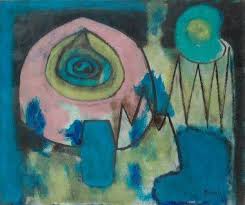
William Baziotes: ‘Waterforms’, oil painting, c. 1952 |
William Baziotes, his quotes on painting art and life in American Abstract Expressionism
- I consider my paintings finished when my eyes goes to a particular spot on the canvas. But if I put the picture away about thirty feet on the wall and the movements keep returning to me and the eye seems to be responding to something living, then it is finished.
* William Baziotes, artist quote on his way of painting ‘Artists Session at Studio 35, 1950′; as quoted in “Abstract Expressionism Creators and Critics”, ed. by Clifford Ross, Abrams Publishers New York 1990
- Let the poet dream his dreams. Yet, the poet must look at the world; must enter into other men’s lives; must look at the earth and the sky, must examine the dust in the street; must walk through the world and his mirror.
* William Baziotes’ famous artist statement on the poetry of visual arts: ‘The Artist and His Mirror’, ‘Right Angle’ Vol. III, no. 2, Washington DC, June 1949
- To be inspired. That is the thing.
to be possessed; to be bewitched.
To be obsessed. That is the thing.
To be inspired.
* Baziotes, great poetry line on creating art: ‘Tiger’s Eye’, Vol. I, no. 5, Westport, Connecticut, October 1948, p. 35
- Today it’s possible to paint one canvas with the calmness of an ancient Greek and the next with the anxiety of a Van Gogh. Either of these emotions, and any in between, is valid to me… …I work on many canvasses at once. In the morning I line them up against the wall of my studio. Some speak, some do not. They are my mirrors. They tell me what I am like at that moment.
* Baziotes, art quote; his statement on the possibilities and varieties in modern painting ‘I Cannot Evolve Any Concrete Theory’, William Baziotes, in ‘Possibilities’, Vol. I, no. 1, New York, winter 1947-48, p. 2
- Each painting has its own way of evolving. One may start with a few color areas on the canvas; another with a myriad of lines, another with a profusion of colors… …Once I sense the suggestion I begin to paint intuitively. The suggestion then becomes a phantom that must be caught and made real. As I work, or when the painting is finished, the subject reveals itself.
* William Baziotes, his art quote on the creation of a painting (referring to automatic writing as a surrealist concept): ‘I Cannot Evolve Any Concrete Theory’, W. Baziotes, in ‘Possibilities’, Vol. l, no. 1, New York, winter 1947-48, p. 2
- Well, I looked at Picasso (Picasso exhibition, Museum of Modern Art, 1939, fh) until I could smell his armpits and the cigarette smoke on his breast. Finally, in front of one picture – a bone figure on a beach – I got it. I saw that the figure was not his real subject. The plasticity wasn’t either – although the plasticity was great. No. Picasso had uncovered a feverishness in himself and is painting it – a feverishness of death and beauty.
* Baziotes, his biography quote on the impact of Picasso’s great but unexpected art: “Modern Art U.S.A.”, R. Blesh, New York, Alfred A. Knopf, 1956, pp. 268-69
-The eye seems to be responding to something living.
* William Baziotes, the collective famous art statement on perception: “Modern Artists in America”‘, R. Motherwell, A. Reinhardt and B. Karpel, eds., First series, New York 1952, p. 100
- As for the subject matter in my painting… … it is very often an incidental thing in the background, elusive and unclear, that really stirred me.
* Baziotes, an explaining statement by the great artist on his painting art: “Fifteen Americans”, exhibition catalogue, Museum of Modern Art, 1952 p. 12
- I think when a man first discovers that two and two is four, there is ‘beauty’ in that; and we can see why. But if people stand and look at the moon and one says ‘I think it’s just beautiful tonight’ and the other says ‘The moon makes me feel awful’ we are both ‘clear’. A geometric shape – we know why we like it; and an unreasonable shape; it has a certain mystery that we recognise as real; but it is difficult to put these things in an objective way. (remark in the Artists Session at Studio 35, 1950, fh)
* William Baziotes, his art quote on beauty and shape in painting: “Abstract Expressionism Creators and Critics”, ed. by Clifford Ross, Abrams Publishers New York 1990, p. 221
- One hundred artists introduce us to one hundred worlds.
* Baziotes’ famous statement on the uniqueness and individual perception in modern art: ‘Artists Club’, January 8, 1952; as quoted in “Abstract Expressionist Painting in America”, W.C, Seitz, Cambridge Massachusetts 1983, p. 136
-There is always an unconscious collaboration among artists… …the artist who imagine himself a Robinson Crusoe is either a primitive or a fool.
* Baziotes, an art quote on the interrelations between the surrounding artists in his artistic life in New York: text for a symposium in 1954; as quoted in “William Baziotes – paintings and drawings”, ed. by Michael Preble, Peggy Guggenheim Collection, Venice, 2004, p. 18
- The talk was mostly of ideas in painting (among the many artists, as De Kooning and Pollock, employed in the Work Project Administration, called WPA, in the 1930s, fh). There was an unconscious collaboration between artists. Whether you agreed or disagreed was of no consequence. It was exciting and you were compelled to paint over your head… …If your painting was criticized adversely, you either imitated someone to give it importance, or you simply suffered and painted harder to make your feelings on canvas convincing… …What does happen when artists meet is that we are able to see more clearly the unfolding of character as time goes on.
* William Baziotes, artist quote on the unconscious collaboration between great American artists in creating painting art: text in symposium ‘The Creative process’, ‘Art Digest’ Vol. 28, no 8, 15; January 1954, p. 33
- I cannot evolve any concrete theory about painting. What happens on the canvas is unpredictable and surprising to me…
* quote of Baziotes’ famous art statement on the impossibility to make predictable theory on his own painting: ‘Willem de Kooning’, Moma Bulletin pp. 6,7; as quoted in “Abstract Expressionist Painting in America”, W.C, Seitz, Cambridge Massachusetts 1983, p. 135
- My whole intention in painting is to make a thing poetical; but not poetical in a literary sense. I want something that evokes mood, a background, a stage set for certain characters that are playing certain parts. When I paint I do not consider myself an abstractionist in the sense that I’m trying to create beautiful forms that fit together like a puzzle. The things in my painting are intended to strike something that is an emotional involvement – that has to do with the human personality and all the mysteries of life, not simply colors or abstract balances. To me, it’s all reality.
* his biography quote on the meaning and intention of his painting art ‘An interview with William Baziotes’, eds. P. Franks and M. White, ‘Perspective no. 2′, Hunter College New York (1956-57), pp. 27, 29-30
- I kept … …returning to the (ancient Roman) wall paintings with their veiled melancholy and elegant plasticity.
* William Baziotes, artist quote on the impact of old Roman mural art on his modern painting: a letter to Alfred H. Barr Jr. 6 November, 1955; as quoted in “Abstract Expressionism”, Barbara Hess, Taschen, Köln, 2006, p. 34
- (on his painting ‘Pompeii’, 1955:)The large gray spiked form rising from the bottom of the picture is to me the symbol of death and ruin. And finally the black ovoid form is the symbol of fire, lava and destruction.
* Baziotes, explaining quote on his famous painting Pompeii: a letter to Alfred H. Barr Jr., 6 November, 1955
- The emphasis on flora, fauna, and beings makes the exhibit a most intriguing and artistic one for it brings forth those strange memories and psychic feelings that mystify and fascinate all of us. (1957)
* his quote on the impact of nature on painting: ‘William Baziotes'; as quoted in “Abstract Expressionism”, Barbara Hess, Taschen, Köln, 2006, p. 34
- In the beginning I drew and painted from nature in order to know her. Then later, only to fall under her spell. And today, to let her mirror my thoughts and feelings.
* Baziotes, artist quotes on the history and development of his painting in relation to the role of Nature in his life: the catalogue of the traveling exhibition ‘Nature in Abstraction’, Whitney Museum of modern Art, 1958, p. 61
- One can begin a picture and carry it through and stop it and do nothing about the title at all.
* Baziotes’ artist quote on the difficulty on making a title: “Abstract Expressionist Painting in America”, W.C, Seitz, Cambridge Massachusetts 1983, p. 147
William Baziotes; not sourced art quotes by the famous American artist in modern abstract Surrealism
- It is the mysterious that I love in painting. It is the stillness and the silence. I want my pictures to take effect very slowly, to obsess and to haunt (1959; art quote by William Baziotes - American Abstract Expressionism)
William Baziotes, more biography facts and life story – famous American artist in Abstract Expressionism
William Baziotes was a great and important American artist, painter and contributor in the development of American Abstract Expressionism / New York School. Surrealism and primitive art both influenced his art fundamentally. Baziotes also assimilated Synthetic Cubist techniques, in a very personal and specific way of painting. He was familiar with the great painting art of Miro and Picasso. His understanding of Cubism and Surrealism he articulated in a highly personal and sensitive pictorial language.
In the latter part of his artistic life, Baziotes taught extensively art. Together with Robert Rauschenberg and Mark Rothko he was an inspirational founding member of the New York ‘Artist School’ in 1948. Later he taught at the Brooklyn Museum Art School, Peoples Art Center, and at the Museum of Modern Art. Baziotes also participated intensively in discussions, debates and exhibitions of the famous American ‘New York School’ - around 1947 and later in his life.
William Baziotes; some art links for detailed biography facts
* many images of William Baziotes’ paintings, on Google
* William Baziotes, stories about the famous artist’s life, on Art Story
