Willem / Bill De Kooning, quotes on painting art in Abstract Expressionism & biography facts of the American painter
Willem / Bill de Kooning (1904 - 1997), painter artist of Dutch origin with his quotes on painting art and life in American Abstract Expressionism + short biography facts. His artist The quotes illustrate de Kooning’s characteristic art approach and his ‘attitude’, as he calls it. With Jackson Pollock De Kooning was the leader of Abstract Expressionism / the New York School. Gesture was important in creating, but also the many hours of watching the painting. Arshile Gorky was one of his great friends and later Franz Kline.
* At the bottom art links for more biography facts for Willem de Kooning.
|
|
Willem de Kooning: ‘Door to the river’, 1960 |
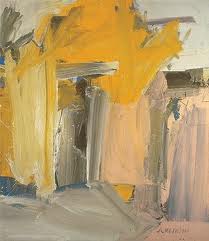
Willem / Bill de Kooning, his artist quotes on modern painting and his art-‘attitude’
- …art never seems to make me peaceful or pure. I always seem to be wrapped in the melodrama of vulgarity. I do not think… …of art as a situation of comfort.
* Willem de Kooning, source of his artist quotes on painting art and life: ‘Beyond the Aesthetic’, Robert Motherwell, ‘Design 47’, April 1946, as quoted in Abstract Expressionist Painting in America, W.C, Seitz, Cambridge Massachusetts, 1983, p. 101 (American Dutch-born artist, famous for his gesture paintings like ‘Woman’ and ‘Excavation’; biography facts at the bottom)
- Jackson Pollock has broken the ice. (his comment on Pollock’s drip paintings, first shown at Betty Parsons gallery, 1948, fh)
* Willem de Kooning, source of his artist quotes on painting art and life: “Abstract Expressionism”, David Anfam, Thames and Hudson Ltd London, 1990, p. 130.
- The texture of experience is prior to everything else. (a remark he made in 1948, in the period of making his painting ‘Excavation’, fh)
* Willem de Kooning, source of his artist quotes on painting art and life: “Abstract Expressionism”, David Anfam, Thames and Hudson Ltd London, 1990, p. 150.
- When, about fifteen years ago, I walked into Arshile’s (Arshile Gorky ,fh) studio for the first time, the atmosphere was so beautiful that I got a little dizzy and when I came to, I was bright enough to take the hint immediately. If the bookkeepers think it necessary to make sure of where things and people came from, well then, I came from 36 Union Square (address of the studio of Gorky, that time, fh)… …I am glad that it is about impossible to get away from his powerful influence.
* Willem de Kooning, source of his artist quotes on painting art and life: ‘ART news’, Vol. 47, no. 9, January 1949.
- There is a train track in the history of art that goes way back to Mesopotamia. It skips the whole Orient, The Mayas, and American Indians. Marcel Duchamp is on it. Cézanne is on it. Picasso and the Cubists are on it; Giacometti, Mondrian, and so many… …I have some feeling about all these people – millions of them – on this enormous track, a way into history. They had a peculiar way of measuring. They seemed to measure with a length similar to their own height… …The idea that the thing that the artist is making can come to know for itself, how high it is, how wide and how deep it is, is a historical one, - a traditional one I think. It comes from man’s own image.
* Willem de Kooning, source of his artist quotes on painting art and life: De Kooning’s lecture ‘Trans/formation’ at Studio 35, 1950.
- I admit I know little of Orient art. But that is because I cannot find in it what I am looking for, or what I am talking about. To me the Oriental idea of beauty is that ‘it isn’t there’. It is in a state of nor being there. It is absent. That is why it is so good. It is the same thing I don’t like in Suprematism, Purism and non-objectivity… …I do like the idea that they - the pots and pans (in the old still lives) , I mean – are always in relation to man. They have no soul of their own, like they seem to have in the Orient…
* Willem de Kooning, source of his artist quotes on painting art and life: De Kooning’s lecture ‘Trans/formation’, at Studio 35, 1950 (American Dutch-born artist, famous for his gesture paintings like ‘Woman’ and ‘Excavation’; biography facts at the bottom)
- Nature then, is just nature. I admit I am very impressed with it. The attitude that nature is chaotic and that the artist puts order into it is a very absurd point of view, I think. All that we can do for is to put some order in ourselves. When a man ploughs his field at the right time, it means just that.
* Willem de Kooning, source of his artist quotes on painting art and life: De Kooning’s lecture ‘Trans/formation’, at Studio 35, 1950.
- But one day, some painter used ‘Abstraction’ as a title for one of his paintings. It was a still life. And it was a very tricky title. And it wasn’t really a very good one. From then on the idea became something extra. Immediately it gave some people the idea that they could free art from itself. Until then, Art meant everything that was in it – not what you could take off it. There was only one thing you could take out of it sometime when you were in the right mood – that abstract and indefinable sensation, the aesthetic part – and still leave it were it was…
* Willem de Kooning, source of his artist quotes on painting art and life: De Kooning’s speech on the symposium at the Museum of Modern Art, New York, 5 February, 1951.
- The aesthetics of painting were always in a state of development parallel to the development of painting itself. They influenced each other and vice versa. But all of the sudden, in that famous turn of the century (around 1900, fh) a few people thought they could take the bull by the horns and invent an aesthetic beforehand. After immediately disagreeing with each other, they began to form all kind of groups, each with the idea of freeing art… …The question as they saw it, was not so much what you could paint, but what you could not paint. You could not paint a house or a tree or a mountain. It was then that the subject matter came into existence as something you ought not to have.
* Willem de Kooning, source of his artist quotes on painting art and life: De Kooning’s speech on the symposium, at the Museum of Modern Art, New York, 5 February, 1951.
- Wassily Kandinsky understood ‘form’ as a form, like an object in the real world; and a object, he said, was a narrative – and so, of course, he disapproved of it. He wanted ‘his music without words’. He wanted to be ‘simple as a child’. He intended, with his ‘inner-self’ to rid himself of ‘philosophical barricades’ (he sat down and wrote something about all this). But in turn his own writing has become a philosophical barricade, even it is a barricade full of holes. It offers a kind of Middle European idea of Buddhism or, anyhow, something too theosophical for me.
* Willem de Kooning, source of his artist quotes on painting art and life: De Kooning’s speech on the symposium, at the Museum of Modern Art, New York, 5 February, 1951.
- I still think that Boccioni was a great artist and a passionate man. I like El Lissitsky’s painting very much. But Mondrian that great merciless artist is the only one who had nothing left over. The point they all had in common was to be both inside and outside at the same time. A new of likeness!… …for me to be inside and outside is to be in an unheated studio with broken windows in the winter.
* Willem de Kooning, source of his artist quotes on painting art and life: De Kooning’s speech on the symposium, at the Museum of Modern Art, New York, 5 February, 1951.
- (in the Italian Renaissance…) there was no ‘subject-matter’. What we call subject matter now, was then painting itself. Subject matter came later on when parts of those works were taken out arbitrarily, when a man for no reason is sitting, standing or ling down. He became a bather, she became a bather; she was reclining; he just stood there looking ahead. That is when the posing in panting began… …For really, when you think of all the life and death problems in the art of Renaissance, who cares if a Chevalier is laughing or that a young girl has a red blouse on.
* Willem de Kooning, source of his artist quotes on painting art and life: ‘The Renaissance and Order’, ‘Trans/formation 1’, 1951, as quoted in “Abstract Expressionist Painting in Americ”, W.C, Seitz, Cambridge Massachusetts, 1983.
- Some painters, including myself, do not care what chair they are sitting on. It does not even have to be a comfortable one. They are too nervous to find out where they ought to sit. They do not want to ‘sit in style’. Rather they have found that painting – any kind of painting, any style of painting – to be painting at all, in fact – a style of living, so to speak. That is where the form of it lies. It is exactly in its uselessness that it is free. Those artists don’t want to conform. They only want to be inspired.
* Willem de Kooning, source of his artist quotes on painting art and life: De Kooning’s speech on the symposium, at the Museum of Modern Art, New York, 5 February, 1951.
- The sentiment of the Cubists was simpler. No space. Everything ought to keep going! That’s probably the reason they went themselves. Either a man was a machine or else a sacrifice to make machines with… …Personally, I do not need a movement. Of all movements, I like Cubism most. It had that wonderful unsure atmosphere of reflection – a poetic frame where something could be possible, where an artist could practice his intuition. It didn’t want to get rid of what went before. Instead it added something to it. The parts that I can appreciate in other movements came out of Cubism… …It has force in it but it was no ‘force-movement’.
* Willem de Kooning, source of his artist quotes on painting art and life: De Kooning’s speech on the symposium, at the Museum of Modern Art, New York, 5 February, 1951.
- The potato seems like a Romantic (organic) object… …you can watch it growing if you don’t eat it. It is going to change – grow, rot, disappear. A pebble is like a Classical thing – it changes little if any… … If it was big you could keep the dead down with it… …The Classical idea is not around much anymore (comparing in a discussion at the Artist’ Club the potatoes of Van Gogh to the pebbles of Hans Arp, fh)
* Willem de Kooning, source of his artist quotes on painting art and life: ‘Artist Club’, 22 February 1952; as quoted in “Abstract Expressionist Painting in America”, W.C, Seitz, Cambridge Massachusetts, 1983.
- I met a lot of artists – but then I met Arshile Gorky. I had some training in Holland, quite a training, the Academy. Gorky didn’t have that at all. He came from no place; he came here (US) when he was sixteen, from Tiflis in Georgia, with an Armenian upbringing. And for some mysterious reason, he knew lots more about painting and art – he just knew it by nature… …He had an extraordinary gift for hitting the nail on the head; very remarkable. So I immediately attached myself to him and we became very good friends. It was nice to be foreigners meeting in some new place.
* Willem de Kooning, source of his artist quotes on painting art and life: interview conducted by David Sylvester for the BBC, 1962; as quoted in “Abstract Expressionism: Creators and Critics”, ed. Clifford Ross, Abrahams Publishers, New York 1990, p. 44.
- Certain artists and critics attacked me for painting the ‘Woman’, but I felt that this was their problem, not mine. I don’t really feel like a non-objective painter at all… …It’s really absurd to make an image, like a human image. With paint, today, when you think about it, since we have this problem of doing it or not doing it. But then all of a sudden it was even more absurd not to do it. So I fear I have to follow my desires.
* Willem de Kooning, source of his artist quotes on painting art and life: interview conducted by David Sylvester for the BBC, 1962; as quoted in “Abstract Expressionism: Creators and Critics”, ed. Clifford Ross, Abrahams Publishers, New York 1990, p. 45.
- The ‘Women’ had to do with the female painted through all ages, all those idols, and maybe I was stuck to a certain extent; I couldn’t go on. It did one thing for me: it eliminated composition, arrangement, relationships, light – all this silly talk about line, colour and form – because that was the thing I wanted to get hold off.
* Willem de Kooning, source of his artist quotes on painting art and life: interview conducted by David Sylvester for the BBC, 1962; as quoted in “Abstract Expressionism: Creators and Critics”, ed. Clifford Ross, Abrahams Publishers, New York 1990, p. 45.
- Today artists are in a belated age of reason. They want to get hold of things. Take Piet Mondrian; he was a fantastic artist. But when we read his ideas and his idea of Neo-Plasticism – pure plasticity – it’s kind of silly. Not for him, but I think one could spend one’s life having this desire to be in - and outside at the same time. He could see a future life and a future city – not like me, who am absolutely not interested in seeing the future city. I’m perfectly happy to be alive now.
* Willem de Kooning, source of his artist quotes on painting art and life: interview conducted by David Sylvester for the BBC, 1962; as quoted in “Abstract Expressionism: Creators and Critics”, ed. Clifford Ross, Abrahams Publishers, New York 1990, p. 47.
- The pictures (De Kooning painted, fh) done since the ‘Women’, they’re emotions, most of them. Most of them are landscapes and highways and sensations of that, outside the city – with the feeling of going to the city or coming from it. I am not a pastoral character. I’m not a – how do you say that? – ‘country dumpling’. I am here and I like New York City. But I love to go out in a car… …I’m just crazy about going over the roads and highways.
* Willem de Kooning, source of his artist quotes on painting art and life: interview conducted by David Sylvester for the BBC, 1962; as quoted in “Abstract Expressionism: Creators and Critics”, ed. Clifford Ross, Abrahams Publishers, New York 1990, p. 48.
- Now I can make some highways, maybe. Of course there will be something else. Now I can set to do it, and then it will be, maybe it will be a painting of something else. Because if you know the measure of things – for yourself there is no absolute measure – you can find the size of everything. You say now that’s just this length and immediately with that length you can paint, well, a cat. If you understand one thing you can use it for something else. That is the way I work… … I mean I have an attitude. I have to have an attitude.
* Willem de Kooning, source of his artist quotes on painting art and life: interview conducted by David Sylvester for the BBC, 1962; as quoted in “Abstract Expressionism: Creators and Critics”, ed. Clifford Ross, Abrahams Publishers, New York 1990, p. 48.
- I feel now if I think of it, it will come out in the painting. In other words, if I want to make the whole painting looks like a bottle, like a lot of bottles - for instance maybe the end of the day, when everything is very light, but not in sunlight necessarily - and so if I have this image of this bottle and if I really think about it, it will come out in the painting. That doesn’t mean that people notice a bottle, but I know when I succeed in it – then the painting would have this.
* Willem de Kooning, source of his artist quotes on painting art and life: interview conducted by David Sylvester for the BBC, 1962; as quoted in “Abstract Expressionism: Creators and Critics”, ed. Clifford Ross, Abrahams Publishers, New York 1990, p. 49 (American Dutch-born artist, famous for his gesture paintings like the ‘Woman’ seies and his famous‘Excavation’)
- I make a little mystique for myself. Since I have no preference or so-called sense of color, I could take almost everything that could be some accident of a previous painting. Or I set out to make a series. I take, for instance, some pictures where I take a color, some arbitrary color I took from some place. Well, this is gray maybe, and I mix the color for that, and then I find out that when I am through with getting the color the way I want it, I have six other colors in it, to get that color; and then I take those six colors and I use them also with this color. It is probably like a composer does a variation on a certain theme. But it isn’t technical, it isn’t just fun…
* Willem de Kooning, source of his artist quotes on painting art and life: interview conducted by David Sylvester for the BBC, 1962; as quoted in “Abstract Expressionism: Creators and Critics”, ed. Clifford Ross, Abrahams Publishers, New York 1990, p. 49.
- The word ‘abstract’ comes from the light tower of the philosophers… …one of their spotlights that they have particularly focused on ‘Art’… …(abstraction was) not so much what you could paint but rather what you could not paint. You could not paint a house or a tree or a mountain. It was then that subject matter came into existence as something you ought not have.
* Willem de Kooning, source of his artist quotes on painting art and life: ‘Willem de Kooning’, MOMA Bull., pp. 4, 6; as quoted in “Abstract Expressionist Painting in America”, W.C, Seitz, Cambridge Massachusetts, 1983, p. 104.
- …for me a truly modern movement because it implies that each artist can do what he thinks he ought to – a movement for each person and open for everybody. (remark on the individualistic Surrealism by Marcel Duchamp, fh)
* Willem de Kooning, source of his artist quotes on painting art and life: ‘Willem de Kooning’, MOMA Bull., pp. 4, 6; as quoted in “Abstract Expressionist Painting in America”, W.C, Seitz, Cambridge Massachusetts, 1983, p. 104.
- What fascinates me about Van Gogh is that his sun dries up everything. Maybe he was melodramatic but my point really is… …if you are a painter you have to face that self-consciousness. You get dirty and pathetic; very miserable. It makes me self-conscious to talk about it. There is something corrupt on art. Nothing do with any ‘ism’ but a thing in nature loses its innocence and becomes a grotesque thing… …maybe this difficulty is personal with me, and maybe it is something that other painters have in common. Perhaps it is also something of today. (in conversation with W.C. Seitz, fh)
* Willem de Kooning, source of his artist quotes on painting art and life: “Abstract Expressionist Painting in America”, W.C, Seitz, Cambridge Massachusetts, 1983, p. 121.
- …Man’s own form in space – his body – was a private prison; and that it was because of this imprisoning misery – because he was hungry and overworked and went to a horrid place called home late at night in the rain, and his bones ached and his head was heavy.
* Willem de Kooning, source of his artist quotes on painting art and life: ‘Willem de Kooning’, MOMA Bull., pp. 7,6; as quoted in “Abstract Expressionist Painting in America”, W.C, Seitz, Cambridge Massachusetts, 1983, p. 135.
- I am always in the picture somewhere. The amount of space I use I am always in, I seem to move around in it. And there seems to be a time when I lose sight of what I wanted to do, and then I am out of it. If the picture has a countenance I keep it. If it hasn’t, I throw it away.
* Willem de Kooning, source of his artist quotes on painting art and life: ‘Modern Artists in America’, First Series, eds. R. Motherwell, Ad Reinhardt, B. Karpel, 1952 p. 12.
- I think I would choose Soutine (French landscape painter from Russian origin, died in 1942 fh) as my favourite artist… …I’ve always been crazy about Soutine - all of his paintings. Maybe it’s the lushness of the paint. He builds up a surface that looks like a material, like a substance. There’s a kind of transfiguration, a certain fleshiness in his work… …I remember when I first saw the Soutine’s in the Barnes Collection… …the Matisse’s had a light of their own, but the Soutine’s had a glow that came from within the paintings - it was another kind of light. (remark probably around 1977, fh)
* Willem de Kooning, source of his artist quotes on painting art and life: “The impact of Chaim Soutine (1893-1943): De Kooning, Pollock, Dubuffet, Bacon’; publisher Hatje Cantz, Galerie Gmurzynska, Cologne (Köln), 2001.
not sourced artist quotes by Willem de Kooning
- You know the real world, this so-called real world, is just something you put up with. Like everybody else. I’m in my element when I am a little bit out of this world. Then I’m in the real world – I’m on the beam. Because when I’m falling, I’m doing all right. When I’m slipping, I say: he, this is interesting. It’s when I’m standing upright that bothers me… (artist quote by Willem De Kooning from the film script, Sketchbook 1, Time inc; 1960, fh)
- The attitude that nature is chaotic and that the artist puts order into it is a very absurd point of view, I think. All that we can hope for is to put some order into ourselves (quote W. De Kooning on his famous artist concept: attitude).
art links for more biography information on the American artist Willem de Kooning
* the American painter Willem de Kooning, his biography on Wikipedia
* many images and pictures of Willem (Bill) de Kooning’’ gestural abstract painting art, on Google
* artist quotes by the painter Willem de Kooning, in Dutch language
