DE STIJL / NEO-PLASTICISM, art style: history information, artists, definitions, meaning of the Manifesto and characteristics of the Dutch art movement (Mondrian, van Doesburg)

De Stijl / Neo Plasticism was from origin a Dutch modern abstract art movement, founded in 1917 with the art magazine ‘De Stijl’ published by Theo van Doesburg & Piet Mondrian. In his quotes Jacob Bendien defines De Stijl in rather rigid characteristics and manifestos as the art movement with the main meaning to reach a pure painting art. De Stijl idea was to create artworks as far as possible purified to be able to serve as an art expression of the universal powers of life. De Stijl group had huge impact on modern architecture and design. At the bottom short history facts of the Dutch artist Bendien; the De Stijl art quotes are taken from his texts. When you enjoy these quotes, please share them on Facebook, Google +1 or Twitter; – the editor.

DE STIJL,
in characteristics
& facts

editor: Fons Heijnsbroek
translation: Anne Porcelijn

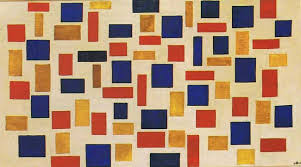
’Composition II’, Theo van Doesburg c. 1917

DE STIJL movement, the Dutch modern art style (Mondrian, Van Doesburg) in characteristics, manifesto & history facts; definitions and meaning of Neo-Plasticism

- In ‘Cercle et Carré ‘ No. 2 from 1930, Mondrian writes:
‘Until now, man has let himself be lulled to sleep by pathetic lyric. That is why it is so fatal for the evolution of man, for all his activities, his necessary fight for equilibrium. On the other hand it has overfilled man with tragedy: tragedy has been so overrated that people have had enough. And already this is visible, man tries to ban it from all forms of art. Thus art achieves its goal at last; it takes evolution to balance’…
* source of De Stijl / Neo Plasticism art style: Dutch art movement in quotes: “Trends in the Present Day Art of Painting”, Jacob Bendien, Rotterdam, 1936 (famous artists Mondrian, Van Doesburg; manifesto, history and definitions about characteristics, meaning definitions)


*****

- Not only in the manner of presentation, but also in the subject, De Stijl artists (a.o. Mondrian, Van Doesburg and the Belgian artist Vantongerloo, ed.) imposed limits upon themselves. They exclude all individual life – in general each special instance – and attempt to dissolve themselves to a more abstract and universal form of life, where there is no place for coincidental extras.
* source of De Stijl / Neo Plasticism art style: Dutch art movement in quotes: “Trends in the Present Day Art of Painting”, Jacob Bendien, Rotterdam, 1936 (famous artists Mondrian, Van Doesburg; manifesto, history and definitions about characteristics, meaning definitions)


*****

- Why should something that no one finds strange in music, be impossible in the art of painting/sculpture? By comparing works of art that do not represent an object, is in our experience, the most fruitful way of exercising our receptivity for them.
* source of De Stijl / Neo Plasticism Dutch art movement in quotes: “Trends in the Present Day Art of Painting”, Jacob Bendien, Rotterdam, 1936 (famous artists Mondrian, Van Doesburg; manifesto, history and definitions about characteristics and meaning of Dutch abstract painter style)


*****

- As far as the subject is concerned, the aspiration of De Stijl artists is based on what they call the universal or cosmic, as opposed to individualistic artists.
* source, art quotes: “Trends in the Present Day Art of Painting”, Jacob Bendien, Rotterdam, 1936.
* source of De Stijl / Neo Plasticism Dutch art movement in quotes: “Trends in the Present Day Art of Painting”, Jacob Bendien, Rotterdam, 1936 (famous artists Mondrian, Van Doesburg; manifesto, history and definitions about characteristics and meaning of Dutch abstract painter style)


*****

- However, even in the expression of the subject, De Stijl artist subjects himself to the same strict means and his individuality will only be apparent in the way he uses these means. This can be seen in the proportions of the composition, the rhythm, the way he applies the paint and, as far as is possible, the colors.
* source of De Stijl / Neo Plasticism art style: Dutch art movement in quotes: “Trends in the Present Day Art of Painting”, Jacob Bendien, Rotterdam, 1936 (famous artists Mondrian, Van Doesburg; manifesto, history and definitions about characteristics, meaning definitions)


*****

- All dominance of the individual is seen, without motivation by De Stijl artists, as erraticism and irregularity. There is a lot to say against this viewpoint.
* source of De Stijl / Neo Plasticism Dutch art movement in quotes: “Trends in the Present Day Art of Painting”, Jacob Bendien, Rotterdam, 1936 (famous artists Mondrian, Van Doesburg; manifesto, history and definitions about characteristics and meaning of Dutch abstract painter style)


*****

- However, De Stijl artists go even further than this. They exclude not only lyric and dramatic emotion, but every form of lyric and drama, including dry lyric and dry drama.
* source of De Stijl / Neo Plasticism art style: Dutch art movement in quotes: “Trends in the Present Day Art of Painting”, Jacob Bendien, Rotterdam, 1936 (famous artists Mondrian, Van Doesburg; manifesto, history and definitions about characteristics, meaning definitions)


*****

- Their art is sculptural, the geometric means and their proportions and relationships, that also have to be well balanced, must speak directly to the emotion, and not indirectly as more or less abstract expressions of reality, as in the works by Cubists and Purists for instance.
* source of De Stijl / Neo Plasticism Dutch art movement in quotes: “Trends in the Present Day Art of Painting”, Jacob Bendien, Rotterdam, 1936 (famous artists Mondrian, Van Doesburg; manifesto, history and definitions about characteristics and meaning of Dutch abstract painter style)


*****

- At the same time De Stijl artist sees all enclosed, geometric figures as ‘descriptive’, ‘individual” and, as such, too much preconceived ‘form.’ They feel themselves to be locked up in a figure, and thus cut off from the entirety of life, the universe.
* source of De Stijl / Neo Plasticism Dutch art movement in quotes: “Trends in the Present Day Art of Painting”, Jacob Bendien, Rotterdam, 1936 (famous artists Mondrian, Van Doesburg; manifesto, history and definitions about characteristics and meaning of Dutch abstract painter style)


*****

- The Stijl artist calls all these figures ‘form’. Form, open as well as enclosed is always an expression of imprisonment (lack of freedom), either a ‘bourgeois’ small-mindedness or a ‘natural’ conformity.
* source of De Stijl / Neo Plasticism art style: Dutch art movement in quotes: “Trends in the Present Day Art of Painting”, Jacob Bendien, Rotterdam, 1936 (famous artists Mondrian, Van Doesburg; manifesto, history and definitions about characteristics, meaning definitions)


*****

- Generally speaking, they use only means that can be broken or destroyed. These are means that can be used together with their opposites, such as a straight line with its rectangular opposite. By using them both together, the individuality can be deleted. For this reason they are called universal means.
* source of De Stijl / Neo Plasticism Dutch art movement in quotes: “Trends in the Present Day Art of Painting”, Jacob Bendien, Rotterdam, 1936 (famous artists Mondrian, Van Doesburg; manifesto, history and definitions about characteristics and meaning of Dutch abstract painter style)


*****

- However, the rectangles and straight lines form square corners and squares in a Neo Plastic painting. In fact yes, the entire painting consists only of these figures, which seems to be in opposition to the idea of avoiding form. In our perception this appears not to be the case if the corner points of the interacting lines are extended and, if in doing so the square form is clearly dominated and destroyed by the thickness of these lines.
* source of De Stijl / Neo Plasticism Dutch art movement in quotes: “Trends in the Present Day Art of Painting”, Jacob Bendien, Rotterdam, 1936 (famous artists Mondrian, Van Doesburg; manifesto, history and definitions about characteristics and meaning of Dutch abstract painter style)


*****

- It is very clear that De Stijl artists recognize and use the plane, they do not try to make it into a three dimensional pseudo space, nor do they create a pseudo depth. Three-dimensional space would only increase the chance of creating form, and deceptive form at that. Not filling in the forms evenly would also work descriptively and would also obscure the color.
* source of De Stijl / Neo Plasticism art style: Dutch art movement in quotes: “Trends in the Present Day Art of Painting”, Jacob Bendien, Rotterdam, 1936 (famous artists Mondrian, Van Doesburg; manifesto, history and definitions about characteristics, meaning definitions)


*****

- Not only do De Stijl artists limit their use of color to the basic red, yellow and blue, but, over time, they also use the three less and less together. Mainly they chose colors that symbolically contrast and therefore, when used together are more or less universals.
* source of De Stijl / Neo Plasticism Dutch art movement in quotes: “Trends in the Present Day Art of Painting”, Jacob Bendien, Rotterdam, 1936 (famous artists Mondrian, Van Doesburg; manifesto, history and definitions about characteristics and meaning of Dutch abstract painter style)


*****

- Reasoned / intellectual lines exclude all lyrical and dramatic emotion, reasoned/intellectual colors do the same. They exclude all mood. Only an active rather than passive disposition can reflect them. They do not carry us away as do the flowing differences of emotive colors. They stand before us, and each other, like naked facts.
* source of De Stijl / Neo Plasticism Dutch art movement in quotes: “Trends in the Present Day Art of Painting”, Jacob Bendien, Rotterdam, 1936 (famous artists Mondrian, Van Doesburg; manifesto, history and definitions about characteristics and meaning of Dutch abstract painter style)


*****

- The Neo-Plastici or De Stijl artists deny all unity through equality, they search for unity in contrasts, internally as well as externally. They achieve this unity by balancing these more or less reasoned/intellectual colors, by their positioning, stance and size.
* source of De Stijl / Neo Plasticism Dutch art movement in quotes: “Trends in the Present Day Art of Painting”, Jacob Bendien, Rotterdam, 1936 (famous artists Mondrian, Van Doesburg; manifesto, history and definitions about characteristics and meaning of Dutch abstract painter style)


*****

- There can be no question of flowing passively in a pleasant peacefulness. This work demands active participation with the strict working of the colors, which in turn demands a finer and more developed sense of colour.
* source of De Stijl / Neo Plasticism Dutch art movement in quotes: “Trends in the Present Day Art of Painting”, Jacob Bendien, Rotterdam, 1936 (famous artists Mondrian, Van Doesburg; manifesto, history and definitions about characteristics and meaning of Dutch abstract painter style<)


*****

- According to the theoretical explanation of De Stijl artists – thankfully not in their work – when balancing the universal intellectual lines and colors, the question is not what sort of balance they express but, specifically that they express balance. However, balance of ‘pure’ contrasting means, because only then is the balance itself pure.
* source of De Stijl / Neo Plasticism Dutch art movement in quotes: “Trends in the Present Day Art of Painting”, Jacob Bendien, Rotterdam, 1936 (famous artists Mondrian, Van Doesburg; manifesto, history and definitions about characteristics and meaning of Dutch abstract painter style)


*****

- This is not an intellectual balance in as much as it could be constructed by intellect,….. but, an emotional balance which only exists in feeling/emotion. De Stijl artists call this emotional balance (they speak of spiritual balance). The pure expression of cosmic, or universal balance. It would be better to call cosmic balance the subject of The Style artists’ art.
* source of De Stijl / Neo Plasticism Dutch art movement in quotes: “Trends in the Present Day Art of Painting”, Jacob Bendien, Rotterdam, 1936 (famous artists Mondrian, Van Doesburg; manifesto, history and definitions about characteristics and meaning of Dutch abstract painter style)


*****

- The De Stijl artists who focus entirely on the ‘absolute’, see life in all its facets as a search for balance between extreme contrasts: man-woman, objective-subjective, universal-individual, internal-external etc. Sometimes one is dominant and sometimes the other.
* source of De Stijl / Neo Plasticism Dutch art movement in quotes: “Trends in the Present Day Art of Painting”, Jacob Bendien, Rotterdam, 1936 (famous artists Mondrian, Van Doesburg; manifesto, history and definitions about characteristics and meaning of Dutch abstract painter style)


*****

- However, the ideal is that by allowing equal dominance, both extremes create an annulment of one’s own separation, thus coming from most sensitive tension to balance. For De Stijl artists, the true art of painting is nothing other than balancing the opposing universal means.
* source of De Stijl / Neo Plasticism Dutch art movement in quotes: “Trends in the Present Day Art of Painting”, Jacob Bendien, Rotterdam, 1936 (famous artists Mondrian, Van Doesburg; manifesto, history and definitions about characteristics and meaning of Dutch abstract painter style)


*****

- According to De Stijl artists, this painting balance is the detachment of our ripened individuality, which is living and feeling the awareness of its connection to universal life, – it feels itself absorbed by cosmic unity.
* source of De Stijl / Neo Plasticism Dutch art movement in quotes: “Trends in the Present Day Art of Painting”, Jacob Bendien, Rotterdam, 1936 (famous artists Mondrian, Van Doesburg; manifesto, history and definitions about characteristics and meaning of Dutch abstract painter style<)


*****

- ‘Although born from matter, art combats this matter. This enmity grows the more the matter forces its way into the apparition. The most intimate art is dressed in the least capricious appearance’, wrote Mondrian in ‘Neue Gestaltung’, one of the Bauhaus art books page 36 .
* source of De Stijl / Neo Plasticism Dutch art movement in quotes: “Trends in the Present Day Art of Painting”, Jacob Bendien, Rotterdam, 1936 (famous artists Mondrian, Van Doesburg; manifesto, history and definitions about characteristics and meaning of Dutch abstract painter style)


*****

- Even if the art -work first gains its value through the experience of the idea, the artist gives the impression that it is the fullness of the idea itself in which he loses himself. His awe for the idea and his need to serve the idea mean that he does not want to admit that the idea is only the inspiration of the moment, and that he himself is the creator of its fullness.
* source of De Stijl / Neo Plasticism Dutch art movement in quotes: “Trends in the Present Day Art of Painting”, Jacob Bendien, Rotterdam, 1936 (famous artists Mondrian, Van Doesburg; manifesto, history and definitions about characteristics and meaning of Dutch abstract painter style)


*****

- However, if De Stijl artists’ material were to miss all expression and only serve to balance the planes, their art – even if vague – would express the peaceful enormity and nobility of their style principles, but not the full expression of a life controlled by this style.
* source of De Stijl / Neo Plasticism Dutch art movement in quotes: “Trends in the Present Day Art of Painting”, Jacob Bendien, Rotterdam, 1936 (famous artists Mondrian, Van Doesburg; manifesto, history and definitions about characteristics and meaning of Dutch abstract painter style)


*****

- We feel De Stijl artists sell themselves short with the assertion that they only express balance by relating mundane means (specifically planes and rhythm). This is a pity because their art gives many the impression that this unconscious self-accusation of spiritual poverty is actually earned, whereas the people who are able to let the work sink in slowly and more deeply know that this is absolutely not the case.
* source of De Stijl / Neo Plasticism Dutch art movement in quotes: “Trends in the Present Day Art of Painting”, Jacob Bendien, Rotterdam, 1936 (famous artists Mondrian, Van Doesburg; manifesto, history and definitions about characteristics and meaning of Dutch abstract painter style)


*****

- Also, the character of a colour is decided to a great extent by the material it is made from. Whether a red, yellow or blue are transparent or not, is of great importance. What remains of the purity of color?
* source of De Stijl / Neo Plasticism Dutch art movement in quotes: “Trends in the Present Day Art of Painting”, Jacob Bendien, Rotterdam, 1936 (famous artists Mondrian, Van Doesburg; manifesto, history and definitions about characteristics and meaning of Dutch abstract painter style)


*****

- The expressive means used by De Stijl artists depend on their mutual context, and are not so expressionless that we would speak of ‘pure’ materials in the way De Style artist means.
* source of De Stijl / Neo Plasticism Dutch art movement in quotes: “Trends in the Present Day Art of Painting”, Jacob Bendien, Rotterdam, 1936 (famous artists Mondrian, Van Doesburg; manifesto, history and definitions about characteristics and meaning of Dutch abstract painter style)


*****

- But, first by using the symbolic working of their expressionist materials, these become impure enough to make the expression of a rich experience of an essentially meagre balance. De Stijl artists however, reject emphatically any symbolism. We don’t think this can be totally avoided.
* source of De Stijl / Neo Plasticism Dutch art movement in quotes: “Trends in the Present Day Art of Painting”, Jacob Bendien, Rotterdam, 1936 (famous artists Mondrian, Van Doesburg; manifesto, history and definitions about characteristics and meaning of Dutch abstract painter style)


*****

- Mondrian and van Doesburg do mention the word ‘symbol’, however they use it only in the unfavourable meaning of allegory. Kandinsky is less afraid. He says in his Bauhaus art book ‘Punkt und Linie zur Fläcke’: ‘Of course the new science of art can only develop when the signs translate to symbols, and the open eye and the open ear make the way possible from silence to speech. Those unable to do that would be better off learning only theoretical and practical art.’
* source of De Stijl / Neo Plasticism Dutch art movement in quotes: “Trends in the Present Day Art of Painting”, Jacob Bendien, Rotterdam, 1936 (famous artists Mondrian, Van Doesburg; manifesto, history and definitions about characteristics and meaning of Dutch abstract painter style)


*****

- What De Stijl artists call ”bringing the expressive material into balance”, is, in our view often unconscious, at least in Mondrian’s later work…… forming symbols together and deciding the strength and heaviness of their function.
* source of De Stijl / Neo Plasticism Dutch art movement in quotes: “Trends in the Present Day Art of Painting”, Jacob Bendien, Rotterdam, 1936 (famous artists Mondrian, Van Doesburg; manifesto, history and definitions about characteristics and meaning of Dutch abstract painter style)


*****

- If one or other symbol has only suggestive power, and if it dominates all other symbols available, De Stijl artist will never use this particular symbol….For instance, a large black square on a white background. This symbol, ignored by The Stijl artists, played a large part in work by Suprematist Malevich.
* source of De Stijl / Neo Plasticism Dutch art movement in quotes: “Trends in the Present Day Art of Painting”, Jacob Bendien, Rotterdam, 1936 (famous artists Mondrian, Van Doesburg; manifesto, history and definitions about characteristics and meaning of Dutch abstract painter style)


*****

- Of course, De Stijl artist does not admit that his style principle is only one of many. According to him, his style principle is the abolition of opposite values, De Stijl principle and also life principle. But the stamp of inferiority with which they threaten artists who think differently, does not stop us from seeing it as merely one form of style amongst many.
* source of De Stijl / Neo Plasticism Dutch art movement in quotes: “Trends in the Present Day Art of Painting”, Jacob Bendien, Rotterdam, 1936 (famous artists Mondrian, Van Doesburg; manifesto, history and definitions about characteristics and meaning of Dutch abstract painter style)


*****

- It is difficult to see De Stijl ever growing into a general life style. In any case we can establish that Piet Mondrian, the creator of De Stijl, and van Doesburg, whose work is only understood by so few, have directly or indirectly, greatly influenced architecture in nearly all countries.
* source of De Stijl / Neo Plasticism Dutch art movement in quotes: “Trends in the Present Day Art of Painting”, Jacob Bendien, Rotterdam, 1936 (famous artists Mondrian, Van Doesburg; manifesto, history and definitions about characteristics and meaning of Dutch abstract painter style)

-NB: Theo van Doesburg’s Elementarism (his later art style, developed after his De Stijl period with Mondrian, ed.) is born from De Stijl, but particularly in essence it had undergone the most radical possible change.
* source of De Stijl / Neo Plasticism Dutch art movement in quotes: “Trends in the Present Day Art of Painting”, Jacob Bendien, Rotterdam, 1936 (famous artists Mondrian, Van Doesburg; manifesto, history and definitions about characteristics and meaning of Dutch abstract painter style)

*****

You enjoyed
De Stijl-in-art-quotes??

editor, Fons Heijnsbroek
translation, Anne Porcelijn


ART LINKS

for more information about the Dutch art movement De Stijl / Neoplasticism, with artists Piet Mondrian & Theo van Doesburg

* more information on the modern Dutch art movement De Stijl / Neoplasticism, on Wikipedia

* many images of modern art created in the Dutch art movement De Stijl / Neoplasticism, on Google


Biography of Jacob Bendien, short history facts of the writer of the De Stijl / Neo plasticism art quotes

The selected art quotes here, over the modern Dutch art movement De Stijl / Neoplasticism are taken from Bendien’s unknown but great Dutch art-book ‘Trends in the Present Day Art of Painting”, 1936.

As a young, exploratory, Dutch artist, Jacob Bendien spent some time in France, in Paris around 1913, just before the outbreak of the First World War. He was greatly inspired by early Cubism of Picasso and George Braque, by Delaunay’s Orphism and Matisse’s Fauvism. In Paris he witnessed the beginnings of the modern art movements such as Futurism, Dada, Purism and early Surrealism. He also learnt about the new abstract art styles; the ideas of Piet Mondrian, Kandinsky and the Blue Rider, and the Russian Constructivism and Suprematism of Lissitsky and Malevich.

Bendien was an inspirational and also empathic artist, he was eager to learn and understood the up and coming new modern art. He needed to do this in order to express his own position as a practicing artist, but he also loved to explain and teach other people about the ‘miracles’ of modern art. As an artist himself, Bendien needed to understand and describe the new art movements from the ‘inside’.

After 1930 Bendien became seriously ill with tuberculosis, and was forced to spend a great deal of time in bed reflecting on all the ideas and concepts of the new art movements, their differences and contrasts in style, but also about the elements they had in common with one another. In this way Bendien functioned as an inspirational and great teacher for several famous young Dutch art critics, such as Hammacher, who enjoyed frequent visits.
Bendien was an emphatic, inspirational artist and a truly witness to the start of the new art movements and styles till 1930. So we like to present his art quotes and hope you will enjoy them.

Fons Heijnsbroek