John Constables’s quotes and art statements by the English painter on landscape painting and Nature; biography & life facts
John Constable (1776 - 1837, quotes on landscape painting by the English artist. Constable was a famous painter in English Romanticism, creating wide and huge landscapes with large skies. He wrote a lot of letters about his life, travelling through the country for finding good motives for painting them. His art quotes give us a lot of inside information about his view on landscape, light and atmosphere and on his favorite locations. As an artist of his time John Constable painted big oil paintings in his studio, as a definite distillation from the many oil-sketches, he made in the wide fields. Constable is famous for painting in oil, in open air. In fact he was the earliest ‘plain air’ painter in Europe.
* At the bottom more biography facts & art links for the great painter of English Romantic landscape, John Constable. - the editor
|
|
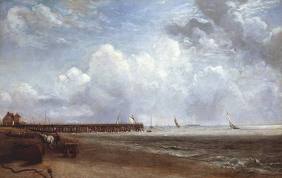
Constable: ‘Yarmouth Yetty’, c. 1826 |
John Constable, his artist quotes on English landscape painting art and Nature
- When I sit down to make a sketch from nature, the first thing I try to do is to forget that I have ever seen a picture.
* John Constable, source of his artist quote from letters, as quoted in:”Letters of the great artists – from Blake to Pollock”, Richard Friedenthal, Thames and Hudson, London, 1963 (painter of English romantic landscape paintings, oil sketches & drawings in open air)
- Here I am quite alone amongst the Oaks and solitudes of Helmingham Park ( a deer park, the seat of the Earl of Dysart, fh). I have taken quiet possession of the parsonage finding it quite empty. A woman comes up from the farm house ( where I eat) and makes the bed; and I am left at liberty to wander were I please during the day. There are abundance of fine trees of all sort; through the place upon the whole affords good objects [rather] than fine scenery, but I can badly judge yet what I may have to show You. I have made one of two… … drawing that may be useful. I shall not come home yet.
* John Constable’s quote on Helmingham Park landscape, from ”Letters of the great artists – from Blake to Pollock”, Richard Friedenthal, Thames and Hudson, London, 1963
- I paint by all the daylight we have and that is little enough, less perhaps than you have by much … … imagine to yourself how a purl must look through a burnt glass.
* source of his artist quote on little day-light in Nature: a letter to his friend Dunthorne on his drawing: Helmingham Dell, 1800; as quoted in “Constable”’, Leslie Parris and Ian Fleming-Williams, Tate Gallery Publications, London 1993, p. 510
- .. However one’s mind may be elevated, and kept us to what is excellent, by the works of the Great Masters, - still Nature is the fountain’s head, the source form whence all originality must spring. (around 1802, fh)
* his quote on Nature as source for his art, from: “Constable”, Leslie Parris and Ian Fleming-Williams, Tate Gallery Publications, London 1993, p. 57 (
- …but You know Landscape is my mistress – ‘t is to her that I look for fame – and all that the warmth of the imagination renders dear to Man…
* John Constable’s quote on Nature as his ‘mistress': from a letter to his future wife, 22 September 1812; as quoted in “Constable”, Leslie Parris and Ian Fleming-Williams, Tate Gallery Publications, London 1993, p. 23
- I have been living a hermit-life, though always with my pencil in my hand..
..How much real delight have I had with the study of landscape this summer! Either I am myself improved in the art of seeing nature, which Sir Joshua call painting, or nature has unveiled her beauties to me less fastidiously. Perhaps there is something of both, so we will divide the compliment.
* Constable quote informs us on the delight, beauty, trouble and pain of landscape painting: a letter to Rev. John Fisher, 22 July, 1812; as quoted in ”Letters of the great artists – from Blake to Pollock - ”, Richard Friedenthal, Thames and Hudson, London, 1963
- I have added some ploughmen to the landscape form the park pales which is a great help, but I must try and warm the picture a little more if I can… …but I look to do a great deal better in future. I am determined to finish a small picture in the spot (instead of finishing later in his studio, as usual, fh) for every one I intend to make in future. But this I have always talked about but never yet done – I think however my mind is more settled and determined than ever on this point.
* important quote of John Constable which reveals his desire for a future attempt to finish a painting on the spot (inopen air), from: a letter to Dunthore, 22 February 1814; as quoted in ’Constable’, Leslie Parris and Ian Fleming-Williams, Tate Gallery Publications, London 1993, p. 151
- I am going on very well with my pictures… …the park (Wivenhoe Park) is the most forward – the great difficulty has been to get so much in as they wanted (the Slater-Rebows, fh) to make them acquainted with the scene – on my left is a grotto with some elms – at the head of a piece of water – in the center is the house over a beautiful wood and very far to the right is a Deer House – what it was necessary to add. So that my view comprehended to many degrees – but to day I got over the difficulty and I begin to like it ‘myself’… …I live in the park and Mrs. Rebow says I am very unsociable.
* artist quote, reporting his daily way of painting landscape, here the park Wivenhoe, taken from a letter to his future wife Maria, 26 August 1816; as quoted in ’Constable’, Leslie Parris and Ian Fleming-Williams, Tate Gallery Publications, London 1993
- ..I am most anxious to get into my London painting-room, for I do not consider myself at work unless I am before a six-foot canvas. I have done a good deal of skying (making sketches in colour of skies, fh) for I am determined to conquer all difficulties, and that among the rest…
* John Constable’s quote on his ‘skying’ (sketching airs in oil paint, on the spot), from a letter to Rev. John Fisher, 23 October, 1821; as quoted in ”Letters of the great artists – from Blake to Pollock -”, Richard Friedenthal, Thames and Hudson, London, 1963
- That landscape painter who does not make his skies a very material part of his composition, neglects to avail himself of one of his greatest aids. Sir Joshua Reynolds (English painter, fh) speaking of the “Landscape” of Titian & Salvator & Claude (famous French classical landscape painter, fh) says ‘Even their skies seem to sympathize with the Subject’. I have often been advised to consider my sky as a ‘White Sheet thrown behind the Objects’. Certainly, if the sky is ‘obtrusive’, (as mine are) it is bad, but if they are ‘evaded’ (as mine ate not) it is worse, they must and always shall with me make an effectual part of the composition. It will be difficult to name a class of landscape in which the sky is not the ‘key note’, the ‘standard of Scale’ and the chief “Organ of sentiment”. You may conceive, then, what a “white sheet” would do for me, impressed as I am with these notions…
* Constable’s painter-quote on the sky as an essential part of the composition in landscape painting, from: a letter to Rev. John Fisher, 23 October, 1821; as quoted in ”Letters of the great artists – from Blake to Pollock -”, Richard Friedenthal, Thames and Hudson, London, 1963
- The sky is the ‘source of light’ in nature, and governs every thing. Even our common observations on the weather of every day, are suggested by them, but it does not occur to us. Their difficulty in painting both as to composition and execution is very great, because, with all their brilliancy and consequence, they ought not to come forward, or be hardly thought about in a picture… …I know very well what I am about, and that my skies have not been neglected, though they have often failed in execution, no doubt, from an over-anxiety about them, which will alone destroy that easy appearance which nature always has in all her movements.
* source of his artist quote on the sky as the ‘source of light’, from: a letter to Rev. John Fisher, 23 October, 1821; as quoted in: “Constable”, Leslie Parris and Ian Fleming-Williams, Tate Gallery Publications, London 1993, p. 229
- .. But the sound of water, escaping from mill dams, & c., willows, old rotten planks, slimy posts, and brickwork, I love such things. - Shakespeare could make everything poetical - he mention “poor Tom’s” haunts among ‘Sheep cots - & Mills”… …As long as I do paint, I shall never cease to paint such places. They have always been my delight…
* his poetical artist quote, describing the landscape with water, from: a letter to Rev. John Fisher, 23 October, 1821; as quoted in: “Constable”, Leslie Parris and Ian Fleming-Williams, Tate Gallery Publications, London 1993, p. 119
- I should paint my own places best; painting is but another word for feeling. I associate “my careless boyhood’’… … to all that lies on the banks of the ‘Stour’. They made me a painter (& I am grateful); that is, I had often thought of pictures of them before I ever touched a pencil, and your (John Fisher, fh) picture [‘The White Horse’] is one of the strongest instances I can recollect of it.
* John Constable’s quote, relating his youth experiences to his actual way of painting with feeling, from: a letter to Rev. John Fisher, 23 October, 1821; as quoted in: “Constable”, Leslie Parris and Ian Fleming-Williams, Tate Gallery Publications, London 1993, p. 119
- This appearance of the Evening was … … just after a very heavy rain - more rain in the night and very - [?light] wind which continued all the - day following (the 13th) while making – this sketch observed the Moon easing – very beautifully… …(in the) due East over the – heavy clouds from which the late showers – had fallen..
* artist quote on the evening, the night and the light of the moon, from an inscription: 12 September, 1821, written on the back of ‘Hampstead Heath, Sun setting over Harrow’, a sketch in oil on paper; as quoted in “Constable”, Leslie Parris and Ian Fleming-Williams, Tate Gallery Publications, London 1993
- I have likewise made many ‘skies’ and effects – for I wish it could be said of me as Fuselli (painter from Austria, fh) says of Rembrandt, “he followed nature in her calmest abodes and could pluck a flower on every hedge – yet he was born to cast a steadfast eye on the bolder phenomena of nature”… …We have had noble clouds & effects of light & dark & color.
* source of his quote, quoting the painter Fuselli who describes Rembrandt’s following Nature in his art, a remark to Rev. John Fisher 1821 on his oil-sketches of stormy weather, as quoted in “Constable”, Leslie Parris and Ian Fleming-Williams, Tate Gallery Publications, London 1993, p. 222
- How sweet and beautiful is every place & I visit my old Haunts with renewed delight… …nothing can exceed the beautiful green of the meadows which are beginning to fill with butter Cups - & various flowers – the birds are singing from morning trill night but most of all the Sky larks – How delightful is the Country.
* artist quote from letters, on landscape painting in the green meadows, from: a letter to his wife Maria, 20 April 1821; as quoted in ’Constable’, Leslie Parris and Ian Fleming-Williams, Tate Gallery Publications, London 1993, p. 28
- Sept. 6 th, 1822, looking S.E. – 12 to 1 o’clock, fresh and bright, between showers – much the look of rain all the morning, but very fine and grand all the afternoon and evening.
* artist quote of John Constable, from : an inscription at the back of a cloud study, 6 September 1822, as quoted in “Constable”, Leslie Parris and Ian Fleming-Williams, Tate Gallery Publications, London 1993, p. 233
- They (the French art critics of the Paris Salon of 1824 where his painting ”the Hay Wain’ received a gold medal, fh) are very amusing and acute- but very shallow and feeble. Thus one – after saying: “it is but justice to admire the truth – ‘the color’ – and ‘general vivacity’ & richness –“, – yet they want the objects more formed and defined &c, and say they are like the rich preludes in music, and the full harmonious warbling’s of the Aeolian lyre, which means ‘nothing’, and they call them orations – and harangues – and high-flown conversations affecting a careless ease - &c &v &c - Is not some of this ‘blame’ the highest ‘praise’ – what is poetry? – What is Coleridge’s Ancient Mariner (the very best modern poem) but something like this?
* artist quote on the French art-comments on his gold rewarded painting The Hay Wain, in: a letter to Rev. John Fisher, 1824; as quoted in: “’Constable”, Leslie Parris and Ian Fleming-Williams, Tate Gallery Publications, London 1993, p. 205
- My picture (‘Boat Passing a Lock’, 1823-6, fh) is liked at the (Royal) Academy (it was bought on the first day of the exhibition, fh) indeed it forms a decided feature and its light can not be put out. Because it is the light of nature – the Mother of all that is valuable in poetry – painting or anything else… …my execution annoys most of them and all the scholastic ones – perhaps the scarifies I make for ‘lightness’ and ‘brightness’ is too much but these things are the essence of Landscape…
* source of his quote on the light in his painting ‘Boat Passing a Lock’ as the essence for landscape painting, from: a letter to Rev. John Fisher, 1824; as quoted in: “’Constable”, Leslie Parris and Ian Fleming-Williams, Tate Gallery Publications, London 1993, p. 288 (painter of English romantic landscape paintings, oil sketches & drawings in open air; biography information + history facts below)
- our little drawing Room (his lodgings at Hamptstead with a view on London, fh) commands a view unequalled in Europe – from Westminster Abbey to Gravesend – the doom of St Paul’s in the Air –realizes Michael Angelo’s Idea on seeing that of the Pantheon –“I will build such a thing in the Sky”
* quote on the wide view from his small studio at Hamptstead, in: letter to his friend Fisher, 26 August 1827; as quoted in “Constable”, Leslie Parris and Ian Fleming-Williams, Tate Gallery Publications, London 1993, p. 473
- it is always my endeavour however in making a picture that it should be without a companion in the world. At least such should be a painters ambition.
* John Constable’s quote on realizing the uniqueness of an art piece, in : a letter to his client Mr Carpenter, 23 July 1828; as quoted in “Constable”, Leslie Parris and Ian Fleming-Williams, Tate Gallery Publications, London 1993, p. 474
- I had on Friday a long visit from Mr. — (a college painter, fh) alone; but my pictures do not come into his rules of whims of the art, and he said I had “lost my way”. I told him that I had, “perhaps other notions of art than picture admirers have in general. I looked on pictures as ’things to be avoided’, connoisseurs looked on them as things to be ‘imitated’; and that, too, with such a defence and humbleness of submission, amounting to a total prostration of mind and original feeling, as must serve only to fill the world with abortions.
* source of Constable’s artist quote in: a letter to Rev. John Fisher, 2 April 1833; as quoted in ”Letters of the great artists – from Blake to Pollock -”, Richard Friedenthal, Thames and Hudson, London, 1963
- But he (a colleague painter, fh) was very agreeable, and endured the visit, I trust, without the usual courtesies of life being violated. What a sad thing it is that his lovely art is ‘so wrested to its own destruction! Used only to blind our eyes, and to prevent us from seeing the sun shine – the fields bloom – the tree blossom – and from hearing the foliage rustle; while old – black – rubbed out and dirty canvases take the place of God’s own works..
* John Constable’s critical remark on another landscape painter, in: a letter to Rev. John Fisher, 2 April 1833; as quoted in ”Letters of the great artists – from Blake to Pollock -”, Richard Friedenthal, Thames and Hudson, London, 1963
- my friend Bonner has just set off to Charlotte Street to pack your picture (an old painting) and forward it; it is a beautiful representation of a summer’s evening; calm, warm and delicious; the colour on the man’s face is perfect sunshine. The liquid pencil of this school is replete with a beauty peculiar to itself. Nevertheless, I don’t believe they had any ‘nostrums’, but plain linseed oil; ‘honest linseed’ as old Wilson called it. But it is always right to remember that the ordinary painters of that day used, as now, the same vehicle as their betters, and also that their works have all received (by their age, fh) the hardening and enameling effects of time, so that we must not judge of originality by these signs always.
* Constable’s artist quote on linseed oil in: a letter to Rev. John Fisher, 20 December 1833; as quoted in ”Letters of the great artists – from Blake to Pollock -”, Richard Friedenthal, Thames and Hudson, London, 1963, pp. 45 - 46
- he (the artist in general, fh) ought to have “these powerful organs of expression” – colour and chiaroscuro –“entirely at his command, that he may use them in every possible form, as well as that he may do with the most perfect freedom; therefore, whether he wishes to make the subject of a joyous, solemn, or meditative character, by flinging over it the cheerful aspect which the sun bestows, by a proper disposition of shade, or by the appearances that beautify its arising or its setting, a true “General Effect” should never be lost sight of.
* John Constable’s quote on using colour and chiaroscuro in his landscape painting technique, from: his text for the “Old Sarum”, ‘On print in English Landscape’ 1835/36; as quoted in “Constable”, Leslie Parris and Ian Fleming-Williams, Tate Gallery Publications, London 1993, p. 380
- I am glad you encouraged me with the ‘Stoke’ (his painting ‘Stoke-by-Nayland, circa 1835, fh) What say you to a summer morning? July or August, at eight or nine o’clock, after a slight shower during the night, to enhance the dews in the shadowed part of the picture, under ‘Hedge row elms and hillocks green’. Then the plough, cart, horse, gate, cows, donkey, &c. are all good paintable material for the foreground, and the size of the canvas sufficient to try one’s strength, and keep one at full collar.
* artist quote on his painting ‘Stoke-by-Nayland’, in: a letter to his friend William Purton, 6 February 1836; as quoted in “Constable”, Leslie Parris and Ian Fleming-Williams, Tate Gallery Publications, London 1993, p. 380
- Many of my Hamptstead friends may remember this ‘young lady’ (an ash tree, fh) at the entrance to the village. Her fate was distressing, for it is scarcely too much to say that she died of a broken heart. I made this drawing ( a study of Trees, pencil on paper, circa 1821, fh) when she was in full health and beauty; on passing some times afterwards, I saw, to my grief, that a wretched board had been nailed to her side, on which was written in large letters: ‘All vagrants and beggars will be dealt with according to law’. The tree seemed to have felt the disgrace, for even then some of the top branches had withered. Two long spike nails had been driven far into her side. In another year one half became paralyzed, and not long after the other shared the same fate, and this beautiful creature was cut down to a stump, just high enough to hold the board.
* his artist quote, describing the history of an ‘ash tree': from his last lecture, given at Hamptstead, July 1836; as quoted in “Constable”, Leslie Parris and Ian Fleming-Williams, Tate Gallery Publications, London 1993, p. 391
not sourced artist quotes by the famous English painter John Constable
- My observations on clouds and skies are on scraps and bits of paper, and I have never yet put them together so as to form a lecture, which I shall do… …next summer. (1836).
- We must bear in recollection that the sentiment of the picture is that of solemnity, not gaiety, nothing garish, but the contrary – yet it must be bright, clear, alive fresh, and all the front seen (quote on the mezzo print of the “Salisbury Cathedral from the Meadows”, fh) (artist quote on the sentiment by Constable).
- Only think that I am now writing in a room full of Claudes (Claude Lorrain: famous French 17th century landscape-painter, fh)… … almost of the summit of my earthly ambitions.
- It is much to my advantage that several of my pictures should be seen together, as it displays to advantage their varieties of conception and also of execution, and what they gain by the mellowing hand of time (the aging of the materials, fh), which should never be forced or anticipated. Thus my pictures when first coming forth have a comparative harshness which at the time acts to my disadvantage. (artist quote, John Constable).
- because he (the Dutch 17th century landscape-painter Ruysdael, fh) attempted to tell (in his painting: ’The Jewish Cemetery’, fh) that which is outside the reach of art… …there are ruins to indicate old age, a stream to signify the course of life, and rocks and precipices to shadow forth its dangers. But how are we to discover all this.
John Constable; biography and life history facts about the English Romantic painter
Happily Constable wrote many letters on the road, so there we can find his quotes and information about the views, locations and their history he painted, the biography information about his private life and wife, and on the techniques of making his oil-sketches, drawings and oil-paintings in the studio or on the spot. Eugéne Délacroix and other French landscape painters admired Constable (and Bonnington) a lot. John Constable was one of the famous English landscape painters, living and working in the period of Romanticism. He admired the old landscape masters like the Dutch painter Jacob Ruydael and the French painter Claude Lorrain. Constable painted numerous oil paintings of the English landscape, in which he attempted to strengthen the visual impression by using ‘highlights’ layers of light oil colors, to create suggestion and brightness.
Constable frequently made drawings and small oil sketches on paper, working in the fields; so he became one of the earliest painters who painted art ‘en plain air’. The oil sketches he painted with firm brushstrokes in a very direct and sober way; they contained studies of skies, natural atmospheres and broad landscapes. It were particularly these sketches that made his influence on later French Barbizon landscape painters and Impressionism so strong.
During his life Constable was not very successful financially, but he found some recognition in his art; at the age of 52 he became a member of the Royal Academy in London. In his time he was famous in France, for instance the young Delacroix admired his landscape paintings and used them as inspiration to free his brush work. So it is not strange that Constable sold more paintings in France than in his own England.
art links for more biography facts of Constable; English Romanticism
* information on life and painting of the landscape painter Constable, on Wikipedia
* images of many landscape paintings & sketches of John Constable, on Google
* biography & history of John Constable, on Wikipedia
