Ellsworth Kelly: biography & quotes on painting; American painter of the Hard Edge
plumduff.co.uk Grand Viewty2019
Ellsworth Kelly (1923 -), quotes by the American abstract artist who depicthis Hard Edge painting art & life, with some biography facts. Kelly is famous for his theory of American Hard Edge (extreme flat paintings) art style of his many created ‘shaped forms’ (paintings in irregular forms) build up in just simple forms and colors. Many of his paintings consist of a single color.
* At the bottom more biography facts, life story & art links for Ellsworth Kelly.
|
Ellsworth Kelly ‘Color sketches’, 1949 - 1973 |
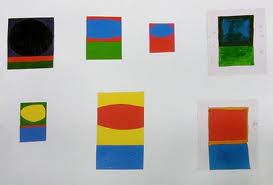
Ellsworth Kelly, his quotes on painting Hard Edge and biography facts
- My collages are only ideas for things much larger; – things to cover walls. In fact all the things that I have done I would like to see much larger. I am not interested in painting as it has been accepted for so long – to hang on walls of houses as pictures. To hell with pictures – they should be the wall – even better – on the outside wall – of large buildings. Or stood up outside as billboards or a kind of modern ‘icon’. We must make our art like the Egyptians, the Chinese & the African and the Island primitives – with their relation to life. It should meet the eye direct.
* Ellsworth Kelly, source of his artist quotes and notes on life, art life, theory and painting: a letter to John Cage, 4 September 1950; as quoted in “Ellsworth Kelly, a Retrospective”, ed. Diane Waldman, Guggenheim museum, New York 1997, p. 11 (famous abstract American painter of Hard Edge and Shaped Forms, created paintings, prints and drawings; art links for Kelly and more biography facts at the bottom)
- I like to work from things that I see, whether they’re man-made or natural or a combination of the two… …The things that I’m interested in have always been there. The idea of a shadow and a natural object has existed, like the shadow of the pyramids, or a rock and its shadow; I’m not interested in the texture of the rock, or that it is a rock, but in the mass of it, and its shadows.
* Ellsworth Kelly, source of his artist quotes and notes on life, art life, theory and painting: interview with Ellsworth Kelly by Henry Geldzahler, ‘Art International 1’., February 1964, p. 48.
- Simple, I don’t like the word simple. I like easy better. I want to forget about the technique. I sweat and worry but I don’t want it look like that; but you can’t separate the artist and his technique.
* Ellsworth Kelly, source of his artist quotes and notes on life, art life, theory and painting: interview with Ellsworth Kelly by Henry Geldzahler, ‘Art International 1’., February 1964, p. 48.
- I usually let them (his drawings, fh) lies around for a long time. I have to get to really like it. And then when I do the painting I have to get to like that too. Sometimes I stay with the sketch, sometimes I follow the original idea exactly if the idea is solved. But most of the time there have to be adjustments during the painting. Through the painting of it I find the color and I work the form and play with it and it adjusts itself.
* Ellsworth Kelly, source of his artist quotes and notes on life, art life, theory and painting: interview with Ellsworth Kelly by Henry Geldzahler, ‘Art International 1’., February 1964, p. 48.
- The form of my painting is the content.
* Ellsworth Kelly, source of his artist quotes and notes on life, art life, theory and painting: “Abstract Art”, Anna Moszynska, Thames and Hudson 1990, p. 173.
- In 1949, I ceased figurative painting and began works that were object oriented. The drawings from plant life seem to be a bridge to the way of seeing that brought about the paintings in 1949 that are the basis for all my later work. After arriving in Paris in 1948, I realized that figurative painting and also abstract painting (though my knowledge of the latter was very limited) as I had known in the 20th century no longer interested me as a solution to my own problems. I wanted to give up easel painting which I felt was too personal.
* Ellsworth Kelly, source of his artist quotes on life, art life, theory and painting: ‘Notes from 1969’, Ellsworth Kelly; as quoted in “Ellsworth Kelly: Works on Paper”, ed. Diane Upright, Harry N. Inc., Publishers, New York, in association with the Fort Worth Art Museum, New York, 1987, p. 9.)
- All the art since the Renaissance seemed too men-oriented. I liked (the) object quality. An Egyptian pyramid, a Sung vase, the Romanesque church appealed to me. The forms found in the vaulting of a cathedral or even a splatter of tar on the road seemed more valid and instructive and a more voluptuous experience than either geometric or action painting.
* Ellsworth Kelly, source of his artist quotes on life, art life, theory and painting: ‘Notes from 1969’, Ellsworth Kelly; as quoted in “Ellsworth Kelly: Works on Paper”, ed. Diane Upright, Harry N. Inc., Publishers, New York, in association with the Fort Worth Art Museum, New York, 1987, p. 9.
- Instead of making a picture that was an interpretation of a thing seen, or a picture of invented content, I found an object and ‘presented’ it as itself alone. My first object was “Window, Museum of Modern Art, Paris’, done in 1949. After constructed ‘Window’ with two canvases and a wood frame I realized that from then on painting as I had known it was finished for me. The new works were to be objects, unsigned, anonymous (as was Hans Arp’s option as well, fh)
* Ellsworth Kelly, source of his artist quotes on life, art life, theory and painting: ‘Notes from 1969’, Ellsworth Kelly; as quoted in “Ellsworth Kelly: Works on Paper”, ed. Diane Upright, Harry N. Inc., Publishers, New York, in association with the Fort Worth Art Museum, New York, 1987, pp. 9, 10.
- Everything that I saw became something to be made, and it had to be exactly as it was, with nothing added. It was a new freedom: there was no longer the need to compose. The subject was there already made, and I could take from everything. It all belonged to me: a glass roof of a factory, with its broken and patched panels, lines on a road map, a corner of a Braque painting, paper fragments in the street. It was all the same: anything goes.
* Ellsworth Kelly, source of his artist quotes on life, art life, theory and painting: ‘Notes from 1969’, Ellsworth Kelly; as quoted in “Ellsworth Kelly: Works on Paper”, ed. Diane Upright, Harry N. Inc., Publishers, New York, in association with the Fort Worth Art Museum, New York, 1987, p. 10.
- I felt that everything is beautiful, but that which man tries intentionally to make beautiful; that the work of an ordinary bricklayer is more valid than the artwork of all but a very few artists.
* Ellsworth Kelly, source of his artist quotes on life, art life, theory and painting: ‘Notes from 1969’, Ellsworth Kelly; as quoted in the exhibition catalogue, Stedelijk Museum Amsterdam.
- I began to draw from plant life and found the flat leaf forms were easier to do than thighs and breasts. I wanted to flatten. The plant drawings from that time until now have always been linear. They are exact observations of the form of the leaf or flower of fruit seen. Nothing is changed or added, no surface marking. They are not an approximation of the thing seen nor are they a personal expression or an abstraction. They are an impersonal observation of the form. When I applied the procedure to other things such as the vaulting of Notre Dame or a patch of tar on the road, the subject of the drawings and the subsequent paintings were not recognizable even though they were exact copies of the thing seen. I wanted to use things that had no pictorial use.
* Ellsworth Kelly, source of his artist quotes on life, art life, theory and painting: ‘Notes from 1969’, Ellsworth Kelly; as quoted in “Ellsworth Kelly: Works on Paper”, ed. Diane Upright, Harry N. Inc., Publishers, New York, in association with the Fort Worth Art Museum, New York, 1987, pp. 25, 26.
- I made it from just three lines in less than a minute. It was the first of the series (Water lily drawings, 1968, fh) that got the weight right. My eye followed my hand. Then I did al the others, but this was the best.
* Ellsworth Kelly, source of his artist quotes on life, art life, theory and painting: ‘Notes from 1969’, Ellsworth Kelly; as quoted in “Ellsworth Kelly: Works on Paper”, ed. Diane Upright, Harry N. Inc., Publishers, New York, in association with the Fort Worth Art Museum, New York, 1987, p. 26.
- My work is about structure. It has never been a reaction to Abstract Expressionism. I saw the Abstract Expressionists for the first time in 1954. My line of influence has been the ‘structure’ of the things I liked: French Romanesque architecture, Byzantine, Egyptian and Oriental art, Van Gogh, Cézanne, Monet, Klee, Picasso, Beckman
* Ellsworth Kelly, source of his artist quotes on life, art life, theory and painting: ‘Notes from 1969’, Ellsworth Kelly; as quoted in “Ellsworth Kelly: Works on Paper”, ed. Diane Upright, Harry N. Inc., Publishers, New York, in association with the Fort Worth Art Museum, New York, 1987.
- I admired and felt the anonymous structure of the work of Brancusi, Vantongerloo, Arp, and Taeuber-Arp (the wife of Hans Arp, fh) whose studios I visited. (Kelly frequently visited Hans Arp and his wife in Paris and discussed his own work with them frequently, fh). Their work reinforced my own ideas for the creation of a Pre-Renaissance, European type art: its anonymous stone work, the object quality of the artifacts, the fact that the work was more important than the artist’s personality. (also Hans Arp - who Kelly visited frequently during his stay in Paris - wanted to create anonymous art, fh). Of the Europeans, I mostly admired the way Picasso, Klee and Brancusi ‘made’ their art. Contrary to what has been said about me, Mondrian and Matisse did not interest me when I was in Paris. Mondrian’s (paintings, fh)could not be seen in Paris and when I did see them in Holland in 1953, I thought their structure too rigid and intellectual.
* Ellsworth Kelly, source of his artist quotes on life, art life, theory and painting: ‘Notes from 1969’, Ellsworth Kelly; as quoted in “Ellsworth Kelly: Works on Paper”, ed. Diane Upright, Harry N. Inc., Publishers, New York, in association with the Fort Worth Art Museum, New York, 1987.
- When I left Paris in 1954, I saw no art that was being ‘made’ like mine and returning to the U.S. I found no one ‘making’ art that way either. In my own work, I have never been interested in painterliness (or what I find is) a very personal handwriting, putting marks on a canvas. My work is a different way of seeing and making something and which has a different use.
* Ellsworth Kelly, source of his artist quotes on life, art life, theory and painting: ‘Notes from 1969’, Ellsworth Kelly; as quoted in “Ellsworth Kelly: Works on Paper”, ed. Diane Upright, Harry N. Inc., Publishers, New York, in association with the Fort Worth Art Museum, New York, 1987.
- In my painting, negative space is never arbitrary. (I believe lithographs to be colored marks printed on a ground – the paper and the measure of the ground and the marks are to be considered of equal importance). In my painting, the painting is the subject rather than the subject the painting
* Ellsworth Kelly, source of his artist quotes on life, art life, theory and painting: ‘Notes from 1969’, Ellsworth Kelly; as quoted in “Ellsworth Kelly: Works on Paper”, ed. Diane Upright, Harry N. Inc., Publishers, New York, in association with the Fort Worth Art Museum, New York, 1987.
- When I was a child, I spent all my spare time looking at birds and insects (beetles). My color use, and the object quality of the ‘painting’, and the use of fragmentation is closer to birds and beetles and fish, than it is to De Stijl or the Constructivists.
* Ellsworth Kelly, source of his artist quotes on life, art life, theory and painting: ‘Notes from 1969’, Ellsworth Kelly; as quoted in “Ellsworth Kelly: Works on Paper”, ed. Diane Upright, Harry N. Inc., Publishers, New York, in association with the Fort Worth Art Museum, New York, 1987.
- Looking through an aperture (a door or a window, fh) is a way that I have been able to isolate or fragment a single form. My first memory of focusing through an aperture occurred when I was around twelve years old. One evening, passing the lighted window of a house. I was fascinated by red, blue and black shapes inside a room. But when I went up and looked in, I saw a red coach, a blue drape and a black table. The shapes had disappeared. I had to retreat to see them again.
* Ellsworth Kelly, source of his artist quotes on life, art life, theory and painting: ‘Notes from 1969’, Ellsworth Kelly; as quoted in “Ellsworth Kelly: Works on Paper”, ed. Diane Upright, Harry N. Inc., Publishers, New York, in association with the Fort Worth Art Museum, New York, 1987.
- Making art has first of all to do with honesty. My first lesson was to see objectively, to erase all ‘meaning’ of the thing seen. Then only, could the real meaning of it be understood and felt.(1969)
* Ellsworth Kelly, source of his artist quotes on life, art life, theory and painting: ‘Notes from 1969’, Ellsworth Kelly; as quoted in “Ellsworth Kelly: Works on Paper”, ed. Diane Upright, Harry N. Inc., Publishers, New York, in association with the Fort Worth Art Museum, New York, 1987.
- Soon after completing the ‘La Combe’ series (around 1950, fh) I had a dream in which I was assisted by many children on a scaffold, painting a huge mural made up of square panels fitted together. Each panel was being painted by a child very quickly in long black strokes with huge brushes. The work was done in seconds. Upon waking I immediately made a reminder sketch of the mural. Later I made a drawing of many ink strokes, which I cut up into twenty squares and placed at random in a four-by-five grid…
* Ellsworth Kelly, source of his artist quotes on life, art life, theory and painting: “Ellsworth Kelly”, John Coplands, Harry N. Abrams, New York.
- There is always for me a dominant figure, I simply don’t agree with people who see both readings as possible (figure ànd ground, fh)
* Ellsworth Kelly, source of his artist quotes on life, art life, theory and painting: “Ellsworth Kelly: Works on Paper”, ed. Diane Upright, Harry N. Inc., Publishers, New York, in association with the Fort Worth Art Museum, New York, 1987, p. 16.
- The three horizontal bands at the top (his collage: landscape with paintings 1954, fh) correspond to sea, sand and sky, while the yellow/white and red/white shapes at the bottom are the paintings – though of a kind I actually painted only later. It was the collage that suggested the idea of doing such paintings.
* Ellsworth Kelly, source of his artist quotes on life, art life, theory and painting: “Ellsworth Kelly: Works on Paper”, by Diane Upright, Harry N. Inc., Publishers, New York, in association with the Fort Worth Art Museum, New York, 1987, p. 18.
- Like the postcard collages, the colors are shapes in a landscape. In this case (his collage ‘Napoleon at Würtsburg’, fh) it is a painting of a landscape, not a photo as in the postcards-(collages, fh), and therefore a contrast of the traditional painting and a presentation of literal space on top of depicted space.
* Ellsworth Kelly, source of his artist quotes on life, art life, theory and painting: ‘Kelly in conversation, summers 1985 and 1986’, in “Ellsworth Kelly: Works on Paper”, ed. Diane Upright, Harry N. Inc., Publishers, New York, in association with the Fort Worth Art Museum, New York, 1987, p. 21 (famous abstract American painter of Hard Edge and Shaped Forms, created paintings, prints and drawings; art links for Kelly and more biography facts at the bottom)
- I made the photographs just like I draw… … I wanted the photographs (he made already around 1950 in Paris, fh) to be enlightening to my art…
* Ellsworth Kelly, source of his artist quotes on life, art life, theory and painting: ‘Kelly in conversation, summers 1985 and 1986’, “Ellsworth Kelly: Works on Paper”, ed. Diane Upright, Harry N. Inc., Publishers, New York, in association with the Fort Worth Art Museum, New York, 1987, p. 21.
- I’m interested in the mass and color, the black and the white, the edges happen because the forms get as quiet as they can be. (early 1960s)
* Ellsworth Kelly, source of his artist quotes on life, art life, theory and painting: “Ellsworth Kelly, a Retrospective”, ed. Diane Waldman, Guggenheim Museum, New York 1997, p. 11.
- This book (full of linoleum prints, fh) will be an alphabet of pictorial elements without text, which shall aim at establishing a larger scale of painting, a closer contact between the artist and the wall, and a new spirit of art accompanying architecture (in his proposal in 1951 of his not published book: Line Form and Color, fh)
* Ellsworth Kelly, source of his artist quotes on life, art life, theory and painting: “Ellsworth Kelly, a Retrospective”, ed. Diane Waldman, Guggenheim Museum, New York 1997, p. 22.
Ellsworth Kelly, short biography notes on abstract art and life of the American artist
During World War II, Kelly served in a deception unit known as The Ghost Army; he had a lot of exposure to military camouflage during the time he served. His exposure to the visual art of camouflage can be seen as part of his basic training. Kelly served until the end of the European phase of the war. Upon his discharge at the end of World War II, Kelly studied from 1946 to 1947 at the School of the Museum of Fine Arts, Boston, and at the École nationale supérieure des Beaux-Arts in Paris; there he immersed himself in the rich artistic resources of France. It was in Paris that Kelly established his aesthetic attitude, partly influenced by his many visits to Hans Arp and his wife Sophie Arp Tauber. Kelly decided to return to America in 1954 after being abroad for six years.
Ellsworth Kelly; art links for more information and biography facts of life and painting
* about the American Hard Edge artist Ellsworth Kelly, on Wikipedia
