Paul Cezanne’s quotes on painting art and life + biography facts - painter of Mont St Victoire and Aix de Provence
Paul Cezanne (1839-1906), his quotes on his painting art and life. As a starting young painter Cezanne was the ‘wildest’ artists in Impressionism (described in a novel by his youth-friend Zola) but at the end probably the most focused painter of French landscape (Aix, Mont St. Victoire, Estaque), still lifes and portraits. Cezanne painted many times with the Impressionist painter Pissarro in open air; later he broke with color-divisionism of Impressionism art. His quotes express Cezanne’s intimate relation with Nature; his influence on Cubism was huge.
* At the bottom more biography facts & some art links for the famous French painter-artist Paul Cezanne. - the editor
|
Paul Cézanne: ‘Mont St. Victoire’, watercolor |
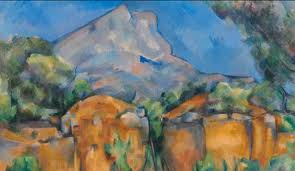
Paul Cezanne, his quotes on painting Nature & artist life in Aix en Provence
- I’ve ripped it (an early portrait, Cezanne made of his youth friend the novel writer Zola; because Cezanne didn’t accept it as a good one, ed.) to pieces; your portrait, you know. I tried to work on it this morning, but it went from bad to worse, so I destroyed it…
* source of his artist quotes with information on his paintings, art, technique & life facts: letter to his youth-friend Emile Zola, around 1861; as quoted in “Cezanne”, by Ambroise Vollard, Dover publications Inc. New York, 1984, p. 23 (painter of Aix en Provence, famous for his Mont St. Victoire paintings and landscapes from Estaque; he broke Impressionism + prepared Cubism; more biography facts at the bottom)
- Don’t you think your Corot (remark to Guilemet the painter, fh) is a little short on temperament? I’m painting a portrait of Vallabreque; the highlight on the nose is pure vermilion (before 1860)
* artist quote: “Cézanne”, by Ambroise Vollard, Dover publications Inc. New York, 1984, p. 28
- He (Manet, fh) hits of the tone… …but his work lacks unity and temperament too. (ca. 1863)
* source: “Cezanne”, by Ambroise Vollard, Dover publications Inc. New York, 1984, p. 27
- At Aix (en Provence, f.h.) I am not free; whenever I want to return to Paris, I always have to put up a fight, and, although your (his father’s, fh) opposition may not be absolute, I am always deeply affected by the resistance that I encounter from you. I sincerely want my liberty unfettered… …; it would give me great pleasure to work in the Midi, some aspects of which offer many resources to the painter; there I would be able to attack some of the problems that I wish to solve…
* artist quote by Cezanne, written from Paris, in a: letter to his father in Aix; 1871-73; as quoted in “Cezanne”, by Ambroise Vollard, Dover publications Inc. New York, 1984, pp. 33-34
- The sun here (in Estaque, ed.) is so terrific that objects appear silhouetted not only in white or black, but in blue, red, brown, violet. I may be wrong, but it seems to me to be the opposite of modeling.
* source:goute from a letter to his teacher Pissarro (they painted a lot together in open air, ed.) around 1878; as quoted on website http://www.nga.gov (famous painter of still life, portrait and landscape paintings
- I was very pleased with myself when I discovered that sunlight could not be reproduced; it had to be represented by something else… …by colour.
* Cezanne’s artist quote on reproducing sun-light in his painting art, from “Renoir – his life and work”, Francois Fosca, Book Club Associates /Thames and Hudson Ltd, London 1975, p. 79
- I saw Monet and Renoir at about the end of December; they had been on holiday in Genoa, in Italy.
* artist quote from a letter to his youth-friend Zola, 23rd February 1884, as quoted in “Renoir – his life and work”, Francois Fosca, Book Club Associates /Thames and Hudson Ltd, London 1975, p. 175
- When I use paint to outline the skin of a beautiful peach, or the melancholy of an old apple, I catch a glimpse, in their reflections of… …their love of the sun; their memories of dew and freshness.. ..(Cezanne wanted to paint, fh:) classical again, through nature.
* his artist remark to friends, in 1884, as quoted in “as quoted in ‘’The private lives of the Impressionists’’ Sue Roe, Harpen Collins Publishers, New York 2006, p. 182
- I had the company of monsieur Gibert. Such people see clearly, but they have the teacher’s eye. As the train was taking us past Alexis’ place a staggering subject for a picture came into view towards the east: St-Victoire (later Cezanne would made series of paintings of Mont St. Victoire, fh) and the crags above Beaurecueil. I said’ What a splendid subject’; he replied, ‘’The lines are too symmetrical’. Referring to L’Assommoir’ (novel of his youth friend Emile Zola, fh) about which, incidentally, he was the first person to speak to me, he said some very sound things, and praised it, but always from the point of view of technique.
* Cezanne’s quote with information from a: letter to his friend Émile Zola, Aix-en-Provence, 14 April 1878, as quoted in ”Letters of the great artists – from Blake to Pollock - ”, Richard Friedenthal, Thames and Hudson, London, 1963, pp. 178-179
- Listen, monsieur Vollard, I worked a lot out of doors at Estaque. Except for that there was no other event of importance in my life during the years 1870-71. I divided my time between the field and the studio… …Zola closed his letter by urging me to come back to Paris too (in 1872 Cezanne went back, fh)… …but all the same, something told me to go back to Paris. It was too long since I had seen the Louvre. But understand, Monsieur Vollard, I was working at that time on a landscape which was not going well. So I stayed at Aix (en Provence, fh) a little while longer to study on my canvas.
* source of this artist quote: “Cezanne”, by Ambroise Vollard, Dover publications Inc. New York, 1984, p. 32-33
- …’The Nightwatch ( large, famous painting of Dutch 17th century painter Rembrandt, fh)… …the grandiose (I don’t say it in bad part) grows tiresome after a while. There are mountains like that; when you stand before them you shout Nom de Dieu… …But for every day a simple little hill does well enough. Listen Monsieur Vollard, if the ‘Raft of the Medusa’ hung in my bedroom, it would make me sick.
* source of his quote: a conversation in Aix with Vollard, in the studio of Cézanne in 1896; as quoted in “Cezanne”, by Ambroise Vollard, Dover publications Inc. New York, 1984, p. 67
- Everybody’s going crazy over the Impressionists; what art needs is a Poussin (French Classical painter, fh) made over according to nature. There you have it in a nutshell.
* his quote, taken from: a conversation in Aix with Vollard and Cezanne, in his studio, in 1896; as quoted in “Cezanne”, by Ambroise Vollard, Dover publications Inc. New York, 1984, p. 67
- Wouldn’t it be wonderful to paint a nude there? (along the river near Aix, fh) There are innumerable motifs here on the banks of the river; the same spot viewed from a different angle offers a subject of the utmost interest. It is so varied that I think I could keep busy for months without changing my place., simply turning now tot the right and now to the left.
* Paul Cézanne, his quote from: a conversation, in Aix near the river, in 1896; as quoted in “Cezanne”, by Ambroise Vollard, Dover publications Inc. New York, 1984, p. 74 (studio in Aix en Provence, near the Mont St. Victoire, of which he made several landscape-paintings
- …painting certainly means more to me than everything else in the world. I think my mind becomes clearer when I am in the presence of nature. Unfortunately, the realization of my sensations is always a very painful process with me. I can’t seem to express the intensity which beats in upon my senses. I haven’t at my command the magnificent richness of color which enlivens Nature…. …Look at that cloud; I should like to be able to paint that! Monet could. He had muscle.
*source, from: a conversation, in Aix near the river, in 1896; as quoted in “Paul Cezanne”, by Ambroise Vollard, Dover publications Inc. New York, 1984, p. 74
- You wretch (portraying the art dealer Vollard who changed his pose during a painter session; Vollard had been posed more than 150 times for one portrait, fh)! You’ve spoiled the pose. Do I have to tell you again you must sit like an apple? Does an apple move?
* source of this artist quote: a conversation in his studio in Paris, around 1896-98; as quoted in “Cezanne”, by Ambroise Vollard, Dover publications Inc. New York, 1984, p. 74
- Painting must give us the flavour of nature’s eternity. Everything, you understand. So I join together nature’s straying hands… …From all sides, here there and everywhere, I select colours, tones and shades; I set them down, I bring them together… …They make lines, they become objects – rocks, trees – without my thinking about them… …But if there is the slightest distraction, the slightest hitch, above all if I interpret too much one day, if I’m carried away today by a theory which contradicts yesterday’s, if I think while I’m painting, if I meddle, then whoosh!, everything goes to pieces.
* artist quote from: ‘What he told me – The motif’, ín “Cezanne, - a Memoir with Conversations” (1897 – 1906) by Joachim Gasquet, Thames and Hudson, London 1991 p. 148
- Art has a harmony which parallels that of nature. The people who tell you that the artist is always inferior to nature are idiots! He is parallel to it. Unless, of course, he deliberately intervenes. His whole aim must be silence. He must silence all the voices of prejudice within him, he must forget… …And then the entire landscape will engrave itself on the sensitive plate of his being.
* source: from ‘What he told me – The motif’, ín “Cezanne, - a Memoir with Conversations” (1897 – 1906) by Joachim Gasquet, Thames and Hudson, London 1991 p. 150
- You positively paint like a madman (when Vincent van Gogh showed Cezanne some of his recent paintings, he recently made in Paris, fh)
* artist quote, reacting on the young artist Vincent Van Gogh: quoted in ‘Mercure de France’, 16 December 1908, p. 607
- … that distinguished aesthete (Gustave Moreau, famous artist and art teacher in Paris, fh) who paints nothing than rubbish, it is because his dreams are suggested not by the inspiration of Nature, but by what he has seen in the museums… …I should like to have that good man under my wing, to point out to him the doctrine of a development of art by contact with Nature. It’s so sane, so comforting, the only just conception of art.
* source of his artist quote, criticizing the Paris painter Moreau, from : a conversation in Aix, in his studio in 1896; as quoted in “Cezanne”, by Ambroise Vollard, Dover publications Inc. New York, 1984, p. 66
- …Nature as it is seen and nature as it is felt, the nature that is there.. (he pointed towards the green and blue plain, J. G.) and the nature that is here (he tapped his forehead, J. G.) both of which have to fuse in order to endure, to live that life, half human and half divine, which is the life of art or, if you will.… the life of god. The landscape is reflected, humanized, rationalized within me. I objectives it, project it, fix it on my canvas…
* artist quote on Nature, from: ‘What he told me – The motif’, ín “Cézanne, - a Memoir with Conversations” (1897 – 1906) by Joachim Gasquet, Thames and Hudson, London 1991 p. 150
- Color is the place where our brain and the universe meet. That’s why colour appears so entirely dramatic, to true painters. Look at mont Sainte-Victoire there (the hill Cezanne painted frequently, fh) How it soars, how imperiously it thirsts for the sun… …For a long time I was quite unable to paint Sainte-Victoire; I had no idea to go about it because, like others who just look at it, I imagined the shadow to be concave, whereas in fact it’s convex, it disperses outward from the centre. Instead of accumulating, it evaporates, becomes fluid, bluish, participating in the movements of the surrounding air.
* source of Cezanne’s art quote, on color in relation to St Victoire, from: ‘What he told me – The motif’, ín “Cézanne, - a Memoir with Conversations” (1897 – 1906) by Joachim Gasquet, Thames and Hudson, London 1991 p. 153
- Painting from nature is not copying the object; it is realizing sensations.
* quote on Nature and representation, from ‘What I know or have seen of his life’, in “Cezanne, - a Memoir with Conversations” (1897 – 1906) by Joachim Gasquet, Thames and Hudson, London 1991 p. 46
- Yes, a bunch of carrots, observed directly, painted simply in the personal way one sees it, worth more than the Ecole’s (French Classical Art Academy, ed.) everlasting slices of buttered bread, that tobacco-juice painting, slavishly done by the book? The day is coming when a single original carrot will give birth to a revolution.
* source ‘What I know or have seen of his life’, in “Cezanne, - a Memoir with Conversations” (1897 – 1906) by Joachim Gasquet, Thames and Hudson, London 1991 p. 68
- Here you are, put this somewhere, on your worktable. You must always have this before your eyes… …It’s a new order of painting. Our Renaissance starts here… …There’s a pictorial truth in things. This rose and this white lead us to it by a path hitherto unknown to our sensibility.. (talking about a black white photo of the painting ‘Olypmpia’ of Édouard Manet, fh)
* Cezanne’s artist quote from: ‘What I know or have seen of his life’, in “Cezanne, - a Memoir with Conversations” (1897 – 1906) by Joachim Gasquet, Thames and Hudson, London 1991 p. 71 (painter of Aix en Provence, famous for his Mont Victoire paintings and from Estaque; he broke Impressionism + prepared Cubism; more biography facts at the bottom)
- This will be my picture, the one I shall leave behind… …But the center? Where is the centre? I can’t find the center… …Tell me, what shall I group it all around? Ah, Poussin’s arabesque! He knew all about that. In the London ‘Bacchanal’, in the Louvre ‘Flora’ (both are paintings of Poussin, which Cézanne admired, fh), where does the line of the figures and the landscape begin, where does it finish… …It’s all one. There is no center. Personally I would like something like a hole, a ray of light, an invisible sun to keep an eye on my figures, to bathe them, care them, intensify them… …in the middle (remark on one of his own ‘Bathers’ paintings, fh)
* source of this information, from: ‘What I know or have seen of his life’, in “Cezanne, - a Memoir with Conversations” (1897 – 1906) by Joachim Gasquet, Thames and Hudson, London 1991 p. 78
- See how the light tenderly love the apricots, it takes them over completely, enters into their pulp, light them from all sides! But it is miserly with the peaches and light only one side of them.
* artist quote from:”Fumées dans la campagne”, Edmond Jaloux, as quoted in “Cezanne, - a Memoir with Conversations” (1897 – 1906) by Joachim Gasquet, Thames and Hudson, London 1991 p. 119, note 2
- Personally I would like to have pupils, a studio, pass on my love to them, work with them, without teaching them anything… …A convent, a monastery, a phalanstery of painting where one could train together… …but no program, no instruction in painting… …drawing is still alright, it doesn’t count, but painting – the way to learn is to look at the masters, above all at nature, and to watch other people painting..
* Paul Cézanne, source of his artist quote on his desire of being an art teacher: ‘What I know or have seen of his life’, in “Cezanne, - a Memoir with Conversations” (1897 – 1906) by Joachim Gasquet, Thames and Hudson, London 1991 p. 124
- Alas, because I’m no longer innocent. We’re civilized beings. Whether we like it or not, we have the cares and concerns of classical civilization in our bones. I want to express myself clearly when I paint. In people who feign ignorance there is a kind of barbarism even more detestable than the academic kind: it’s no longer possible to be ignorant today. One no longer is. We come into the world armed with facility. Facility is the death of art and we must rid ourselves of it.
* his artist quote on ignorance: ‘What I know or have seen of his life’, in “Cézanne, - a Memoir with Conversations” (1897 – 1906) by Joachim Gasquet, Thames and Hudson, London 1991 p. 155
- Anyone who wants to paint should read Bacon. He defined the artists as homo additus naturae… …Bacon had the right idea, but listen Monsieur Vollard, speaking of nature, the English philosopher, (Bacon, fh) didn’t for see our open-air school, nor that other calamity which has followed close upon its heels: open-air indoors,
* artist quote on open-air painting art: a conversation with Vollard in The Luxembourg, Paris 1897, standing before the ‘Olympia’ of Manet; as quoted in “Cézanne”, by Ambroise Vollard, Dover publications Inc. New York, 1984, p. 36
- In that Renaissance (Cellini, Tintoretto, Titian..) there was an explosion of unique truthfulness, a love of painting and form… …Then come the Jesuits and everything is formal; everything has to be taught and learned. It required a revolution for nature to be rediscovered; for Delacroix to paint his beach at Étratat, (coast of Normandy, France, fh), Corot his roman rubble, Courbet his forest scenes and his waves. And how miserable slow that revolution was, how many stages it had to go through! …These artists had not yet discovered that nature has more to do with depth than with surfaces. I can tell you, you can do things to the surface… … but by going deep you automatically go to the truth. You feel a healthy need to be truthful. You’d rather strip your canvas right down than invent or imagine a detail. You want to know.
* Cezanne’s quote on rediscovering Nature by the former painters Corot and Courbet and truth in painting: ‘What he told me – The motif’, ín “Cézanne, - a Memoir with Conversations” (1897 – 1906) by Joachim Gasquet, Thames and Hudson, London 1991 pp. 157-158
- … But there is better. Simplicity, being direct. Everything else is just a game, just building castles in the sky. Basically I don’t think of anything when I paint. I see colours. I strive with joy to convey them on to my canvas just as I see them. They arrange themselves as they choose, any old way. Sometimes that makes a picture. I’m brainless animal. Very content if I could be just that …
* artist quote on his way of painting: brainless: ‘What he told me – The motif’, ín “Cezanne, - a Memoir with Conversations” (1897 – 1906) by Joachim Gasquet, Thames and Hudson, London 1991 pp. 158-159
-… and wanting to force nature to say things, making trees twist and rocks frown, as Gustave Doré does, or even painting it like Leonardo da Vinci, that’s literature too. There’s logic of colour, damn it all! The painter owes allegiance to that alone. Never to the logic of the brain; if he abandons himself to that logic, he’s lost… …Painting is first and foremost an optical affaire. The stuff of our art is there, in what our eyes are thinking… …If you respect nature, it will always unravel it’s meaning for you.
* source of his quote on painting as an optical way of seeing: ‘What he told me – The motif’, ín “Cezanne, - a Memoir with Conversations” (1897 – 1906) by Joachim Gasquet, Thames and Hudson, London 1991 p. 161
- Colour, if I may say so, is biological. Colour is alive and colour alone makes things come alive… …Without losing any part of myself, I need to get back to that instinct, so that these colours in the scattered fields signify an idea to me, just as to them they signify a crop. Confronted by a yellow, they spontaneously feel the harvesting activity required of them, just as I, when faced with the same ripening tint …
* source of this quote on colour: ‘What he told me – The motif’, ín “Cezanne, - a Memoir with Conversations” (1897 – 1906) by Joachim Gasquet, Thames and Hudson, London 1991 p. 162
-…Everything I am telling you ( to Joachim Gasquet, fh) about - the sphere, the cone, cylinder, concave, shadow – on mornings when I’m tired these notions of mine get me going, they stimulate me, I soon forget them once I start using my eyes. (famous quote, which influenced early Cubism art of Braque and Picasso strongly, fh)
* source of his most famous and quoted quote on sphere, the cone, cylinder, concave, shadow – strongly admired by the Cubist painters, like the young Braque and Picasso: ‘What he told me – The motif’, ín “Cezanne, - a Memoir with Conversations” (1897 – 1906) by Joachim Gasquet, Thames and Hudson, London 1991 pp. 163-164
<
- But what an eye Claude Monet has, the most prodigious eye since painting began! I raise my hat to him. As for Courbet, he already had the image in his eye, ready-made. Monet used to visit him, you know, in his early days… …But a touch of green, believe me, is enough to give us a landscape, just as a flesh tone will translate a face for us …
* artist quote on the superb way of seeing by the French landscape painter-artist Monet: ‘What he told me – The motif’, ín “Cezanne, - a Memoir with Conversations” (1897 – 1906) by Joachim Gasquet, Thames and Hudson, London 1991 pp. 164
- That is why, perhaps, all of us derive Camille Pissarro (his ‘teacher’ in impressionistic landscape painting; they frequently painted together in open air, fh). He had the good luck to be born in the West Indies, where he learned how to draw without a teacher. He told me all about it. In 1865 he was already cutting out black, bitumen, raw sienna and the ochre’s. That’s a fact. Never paint with anything but the three primary colours and their derivatives, he used to say me. Yes, he was the first Impressionist.
* source: ‘What he told me – The motif’, ín “Cezanne, - a Memoir with Conversations” (1897 – 1906) by Joachim Gasquet, Thames and Hudson, London 1991 p. 164
- Monet’s cliffs will survive as a prodigious series, as will a hundred others of his canvases… …He’ll be in the Louvre, for sure, alongside Constable and Turner (famous English Romantic landscape painters, fh). Damn it, he’s even greater. He painted the iridescence of the earth. He’s painted water. Remember those Rouen cathedrals (famous series of paintings by Monet, fh)… …But where everything slips away in these pictures of Monet’s, nowadays we must insert a solidity, a framework …
* artist quote, expressing his admiration for the French impressionist painter Monet: ‘What he told me – The motif’, ín “Cezanne, - a Memoir with Conversations” (1897 – 1906) by Joachim Gasquet, Thames and Hudson, London 1991 p. 165
- You can’t ask a man to talk sensibly about the art of painting if he simply doesn’t know anything about it. But by God, how can he (Zola his youth friend who used Cezanne as a model in his novel ‘L’Oeuvre’, fh) dare to say that a painter is done because he has painted one bad picture? When a picture isn’t realized, you pitch it in the fire and start another one.
* source of his artist quote on the painter-novel, written by his youth-freind Zola, from conversation in Cezanne’s studio in Aix, after the death of Zola in 1902; as quoted in “Cézanne”, by Ambroise Vollard, Dover publications Inc. New York, 1984, p. 74
- I work obstinately, and once in a while I catch a glimpse of the Promised Land. Am I to be like te great leader of the Hebrews, or will I really attain unto it?… …I have a large studio in the country. I can work better there than in the city. I have made some progress. Oh, why so late and so painful? Must art indeed be a priesthood, demanding that the faithful be bound to it body and soul?
* quote on still making progress in painting: letter to Vollard, Aix, 9 January, 1903; as quoted in “Cezanne”, by Ambroise Vollard, Dover publications Inc. New York, 1984, p. 103
- Allow me to repeat what I said when you were here: deal with nature by means of the cylinder, the sphere and the cone, all placed in perspective, so that each side of an object or a plane is directed towards a central point. Lines parallel to the horizon give breadth, a section of nature, or if you prefer, of the spectacle spread before our eyes by the ‘Pater Omnipotens Aeterne Deus’ Lines perpendicular tot that horizon give depth. But for us men, nature has more depth than surface, hence the need to introduce in our vibrations of light, represented by reds and yellows, enough blue tints to give a feeling of air.
* Paul Cezanne, source of his famous artist quote on … the cylinder, the sphere and the cone, all placed in perspective …, strongly admired by the Cubist painters: letter to Émile Bernhard, 15 April 1904, as quoted in ”Letters of the great artists – from Blake to Pollock - ”, Richard Friedenthal, Thames and Hudson, London, 1963, p. 180
- …This is what happens, unquestionably – I am positive: an optical sensation is produced in our visual organ, which leads us classify as light, half-tone or quarter-tone, the planes represented by sensations of color. (Thus the light itself does not exist for the painter.) As long as, inevitably, one proceeds from black to white, the former of these abstractions being a kind of point of rest both for eye and brain, we flounder about, we cannot achieve self-mastery, get possession of ourselves. During this period (I tend to repeat myself, inevitably) we turn to the admirable works (here: of the five great Venetian painters like Titian and Tintoretto, fh) handed down to us through the ages, in which we find comfort and support…
* Paul Cezanne, his quote on how using color, planes and tones: letter to Émile Bernhard, 23 December 1904, as quoted in ”Letters of the great artists – from Blake to Pollock - ”, Richard Friedenthal, Thames and Hudson, London, 1963, p. 184
- The point to be made clear is that, whatever may be our temperament, or our power in the presence of nature, we have to render what we actually see, forgetting everything that appeared before our own time. Which, I think, should enable the artist to express his personality to the full, be it large or small. Now that I am an old man, about seventy, the sensations of colour which produce light give rise to abstractions that prevent me from covering my canvas, and from trying to define the outlines of objects when their points of contact are tenuous and delicate; with the result that my image or picture is incomplete. For another thing, the planes become confused, superimposed; hence Neo-Impressionism, where everything is outlined in black, an error which must be uncompromisingly rejected. And nature, if consulted, shows us how to achieve this aim (also Pissarro and Monet emphasized this question of using the primary colors and avoiding black, fh).
* Paul Cezanne, his artist quote of rejecting French neo-impressionism as a big error in history of painting: a letter to Émile Bernhard, 23 October 1905, as quoted in ”Letters of the great artists – from Blake to Pollock - ”, Richard Friedenthal, Thames and Hudson, London, 1963, p. 180
- Alas! The memories that are swallowed up in the abyss of the years! I’m all alone now+ I would never be able to escape from the self-seeking of human kind anyway. Now it’s theft, conceit, infatuation, and now it’s rapine or seizure of one’s production. But Nature is very beautiful. They can’t take that away from me. (the last conversation Vollard had with Cezanne, fh)
* his artist quote on memory in his life as an old man: a conversation in Cézanne’s studio in Aix, the End of 1905; as quoted in “Cezanne”, by Ambroise Vollard, Dover publications Inc. New York, 1984, p. 112
- I still work with difficulty, but I seem to get along. That is the important thing to me. Sensations form the foundation of my work, and they are imperishable, I think. Moreover, I am getting rid of that devil who, as you know, used to stand behind me and forced me at will to “imitate”; he’s not even dangerous any more. (a week later Cezanne died, fh)
* quote on painting in his last year, from: the last letter to his son Paul, Aix, 15 October 1906; as quoted in “Cezanne”, by Ambroise Vollard, Dover publications Inc. New York, 1984, p. 112; (more biography facts at the bottom)
not sourced artist quotes by Paul Cezanne
- All tones interpenetrate; all forms revoltingly interlock. This is coherence.
- Art must make nature eternal in our imagination.
- I try to render perspective through colour alone.
- I want to make Impressionism something solid and durable.
- Impressionism, what does it mean? It is the optical mixing of colours… …which are broken down on the canvas and reassembled by the eye. (short statement on Impressionism painting )
- Light is not a thing that can be reproduced, but something that must be depicted using something else… … colours. (artist quote on light and color in painting , Paul Cézanne)
- My canvas “joins hands”, it holds firm. (short statement on creating art)
- Nature is not on the surface; it is in the depths. Colours are an expression of these depths on the surface. They rise from the roots of the world. (remark on color in painting)
- Perhaps I came too early. I am the primitive of a new art. (statement on his place in painting)
- The means of expressing emotion is only to be acquired through very long experience.
- We must not paint what we think we see, but what we see. (short statement on the artist duty to see and look.
- When colour has its greatest richness, then form has its plenitude. (short statement on color)
- The eye absorbs… … the brain produces form. (short quotes on the eye and the brain, concerning form; Paul Cezanne)
Paul Cezanne, his biography facts & information on life and painting
Paul Cezanne was an artist painter of the first generation impressionist French painters like Monet, Degas, and Renoir. Cézanne frequently painted landscapes ‘en plain air’ with the impressionist painter Pissarro (also with Renoir in opne air) who helped him in discovering landscape painting. From then he gradually developed his personal style; a style of painting in which ‘form’ became most important again (like the classical painters and as opposed to the impressionist emphasis on broken ‘color’), together with the new structures he discovered in landscape and Nature in general. Color was most important for Cézanne, but not broken!
Paul Cezanne had a huge influence on the art and painters after him, like French Cubists, Braque and Picasso, Italian Futurism and the modern abstract painters from Munich: the ‘Blue Rider’. Until 1905 he continued to paint his characteristic landscapes in oil and in watercolor, a lot of them with his famous motif, the mountain hill ‘Mont St. Victoire’ near Aix en Provence.
Early in his life Cézanne and the writer Emile Zola were youth friends from Aix, and he frequently visited the novelist in Paris, until the moment that Zola published his novel ‘L’Oeuvre’, in which Cezanne recognized himself as the tortured painter who could not master his own passions and talents. He broke his friendship with Zola immediately. This written portrait of the ‘artist’ in Zola’s novel is in strong contradiction to the highly focused painting art of the older Cezanne who developed a painting which was very conscious, quiet and well-balanced. It was the poet Rilke who recognized this patience and hard labor in the slowly developing ‘artwork’ of the old master Cézanne. Rilke wrote his famous series ‘Letters on Cézanne’ to his wife, the German sculptress Clara Westrop, a friend of the woman painter Paula Modersohn-Becker who had some stays in Paris and discovered the late Cezanne.
art links: biography facts about life and art of the painter Paul Cezanne
* many images of paintings and watercolors of Paul Cézanne, on Google
* quotes by Paul Cezanne, in Dutch language
