Franz Kline, quotes on painting art and life in American Abstract Expressionism + biography facts &
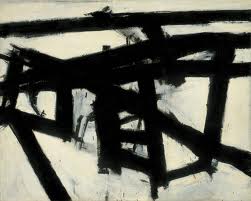
Franz Kline (1910 - 1962), his quotes on painting art and life. Kline was an artist of American Abstract Expressionism / the New York School. He started as a painter of American industrial landscapes, what kept still recognizable in his later abstract art. Here you find his quotes on art & life. Franz Kline was famous for ‘Mahoning’, the painting which shows clearly his characteristic approach: painting in black / white. Kline became a close friend of Willem de Kooning.
* At the bottom biography and life facts & art links for Franz Kline.
|
|
Franz Kline: ‘Mahoning’, painting 1956 |
Franz Kline, his quotes on painting art in American Abstract Expressionism
- I paint not the things I see but the feelings they arouse in me.
* Franz Kline, source of his artist quotes on painting, art and the New York School ”Conversations with Artists”, ed. Seldon Rothman, Capricorn Books, New York, 1961 (painter in American of Abstract Expressionism, famous for his black-white paintings like ‘Mahoning’; more biography facts at the bottom)
- People sometimes think I take a white canvas and paint a black sign on it, but this is not true. I paint the white as well as the black, and the white is just as important.
* Franz Kline, source of his artist quotes on painting, art and the New York School ”Talks with Seventeen Artists”, Katherine, Harper and Row, New York, 1962.
- If I feel a painting I’m working on doesn’t have imagery or emotion, I paint it out and work over it, until it does.
* Franz Kline, source of his artist quotes on painting, art and the New York School ”Conversations With Artists”, ed. Selden Rodman, 1957.
-
Braque and Gris (both Cubist painters, fh), they seemed to have idea of the organization beforehand in their mind. With Bonnard, he is organizing in front of you. You can tell in Fernand Leger just when he discovered how to make it like an engine… …What’s wrong with that? You see it in Barney (Barnett Newman, fh) too, that he knows what a painting should be. He paints as he thinks painting should be, which is pretty heroic…
* Franz Kline, source of his artist quotes on painting, art and the New York School ‘Evergreen Review’, Vol. 2. no. 6, Autumn 1958, pp. 11-15.
- If you’re a painter, you are not alone. There’s no way to be alone. You think and you care and you’re with all the people who care, including the young people who don’t know they do yet. Tomlin in his late paintings knew this, Jackson Pollock always knew it…
* Franz Kline, source of his artist quotes on painting, art and the New York School ‘Evergreen Review’, Vol. 2. no. 6, Autumn 1958, pp. 11-15.
- When Jackson Pollock talked about painting he didn’t usurp anything that wasn’t himself. He didn’t want to change anything, he wasn’t using any outworn attitude about it; he was always himself. He just wanted to be in it (in the painting, fh) because he loved it. The response in the person’s mind to that mysterious thing that has happened before has nothing to do with ‘who did it first’. Tomlin (early American abstract-expressionist painter, fh) however, did hear these voices and in reference to his early work and its relation to Georges Braque. I like him for that. He was not an academician of Cubism even then; he was an extremely personal and sensitive artist.
* Franz Kline, source of his artist quotes on painting, art and the New York School ‘Evergreen Review’, Vol. 2. no. 6, Autumn 1958, pp. 11-15 (painter in American Abstract Expressionism / New York School - famous for his black-white paintings like ‘Mahoning’; more biography facts at the bottom)
- You don’t paint the way someone, by observing his life, thinks you have to paint, you paint the way you have to, in order to give. That’s life itself, and someone will look and say it is the product of knowing, but it has nothing to do with knowing, it has to do with giving. The question about knowing will naturally be wrong. When you’ve finished giving, the look surprises you (yourself, fh) as anyone else. Some painters talking about painting are like a lot of kids dancing at a prom. An hour later you are too shy to get out on the floor.
* Franz Kline, source of his artist quotes on painting, art and the New York School ‘Evergreen Review’, Vol. 2. no. 6, Autumn 1958, pp. 11-15.
- The final test of painting, theirs, mine, any other, is; does the painter’s emotion comes across?… …Procedure is the keyword… …The difference is that we (the Abstract expressionists, fh) don’t begin with a definite sense of procedure. It’s free association from the start to the finished state. The old idea was to make use of your talent. This, we feel, is often to take the line of least resistance… …painters like Rothko, Pollock, Still, (all Color Field painters, fh) perhaps in reaction to the tendency to analyse which has dominated painting from Seurat to Josef Albers, associate with very little analysis. A new form of expressionism inevitably followed. With Willem de Kooning the procedure is continual change, and the immediacy of the change. With Jackson Pollock it’s the confidence you feel from the concentration of his energy in a given picture…
* Franz Kline, source of his artist quotes on painting, art and the New York School ‘Evergreen Review’, Vol. 2. no. 6, Autumn 1958, as quoted in ”Conversations with Artists”, ed. Seldon Rothman, Capricorn Books, New York, 1961, p. 106.
-…I don’t think of my work as calligraphic. Critics also describe Jackson Pollock and Willem de Kooning as calligraphic painters, but calligraphy has nothing to do with us. It’s interesting that the Oriental critics never say this. The Oriental idea of space is an infinite space; it is not painted space, and ours is. In the first place, calligraphy is writing and I am not writing.
* Franz Kline, source of his artist quotes on painting, art and the New York School ”Talks with Seventeen Artists”, Katherine, Harper and Row, New York 1962.
- There is imagery. Symbolism is a difficult idea. I’m not a symbolist. In other words, these are painting experiences. I don’t decide in advance that am going to paint a definite experience, but in the act of painting, it becomes a genuine experience for me. It’s not symbolism any more than it’s calligraphy. I’m not painting bridge constructions, skyscrapers or laundry tickets… …I don’t paint a given object – a figure or a table; I paint an organization that becomes a painting… …it’s not these things that get me started on a painting…
* Franz Kline, source of his artist quotes on painting, art and the New York School ”Talks with Seventeen Artists”, Katherine, Harper and Row, New York.
- I do both: I make preliminary drawings, other times I paint directly, other times I start a painting and then paint it out so that it becomes another painting or nothing at all. If a painting doesn’t work, throw it out. When I work from preliminary sketches, I don’t just enlarge these drawings, but plan my areas in a large painting by using small drawings for separate areas. I combine them in a final painting, often adding to or subtracting from the original sketches… …There are certain canvases here in my studio - the little one over there – that I’ve worked on for a good six months – painting most of it out and then painting it over and over again. I think I’ve got it now. (1958)
* Franz Kline, source of his artist quotes on painting, art and the New York School ”Talks with Seventeen Artists”, Katherine, Harper and Row, New York 1962.
- My old landscapes of Pennsylvania are worth so much now that I have to hide them, so I don’t get put in a even higher tax bracket. For years nobody would pay a dime for them. They’re still the same paintings. They didn’t get any better. I treasure them as much as my recent black and white abstracts… …My dealer was furious when I showed him my latest works. I’m returning to color. He tells me to ride it out and change when the fashion changes. I told him no! I told him I paint each painting from the heart. I have followed my heart all my life. (1959)
* Franz Kline, source of his artist quotes on painting, art and the New York School Kline’s talk in the jazz club ‘The Five Spot’; as quoted in ‘Introduction’ by David Anram, ”The Stamp of Impulse, Abstract expressionist prints”, David Anram, David Acton, p. 21.
-…Paint never seems to behave the same. Even the same paint doesn’t, you know. In other words, if you use the same white or black or red, through the use of it, it never seems to be the same. It doesn’t dry the same. It doesn’t stay there and look at you the same way. Other things seem to affect it. There seems to be something that you can do so much with paint and after that you start murdering it…
* Franz Kline, source of his artist quotes on painting, art and the New York School ‘Living Art’, Vol. 1. (no. 1), David Sylvester, Spring 1963.
- There are moments or periods when it would be wonderful to plan something and do it and have the thing only do what you planned to do, and then, there are other times when the destruction of those planned things becomes interesting to you. So then, it becomes a question of destroying – of destroying the planned forms; it’s like an escape, it’s something to do, something to begin the situation. You yourself, you don’t decide, but if you want to paint, you have to find out some way to start this thing off, whether it is painting it out or putting it in…
* Franz Kline, source of his artist quotes on painting, art and the New York School ‘Living Art’, Vol. 1. (no. 1), David Sylvester, Spring 1963 (painter in American of Abstract Expressionism, famous for his black-white painting: ‘Mahoning’)
-…it’s not an illusionistic thing. It just seems as though there are forms in some experience in your life that have an excitement for you… …those sort of forms in your experience do, in some way, not dominate, but they become the things that you are involved with. I don’t mean that squares become windows; after all, squares become heads, they become everything you know. I don’t mean it in that sense. A curve or line or rhythmical relation do have, in some way, some psychological bearing, not only on the person who looks at them after they’ve been conceived but also they do have a lot to do with the creative being who is involved with wondering just how exciting it can be…
* Franz Kline, source of his artist quotes on painting, art and the New York School ‘Living Art’, Vol. 1. (no. 1), David Sylvester, Spring 1963.
- I think that if you use long lines, they become – what could they be? The only thing they could be is either highways or architecture or bridges.
* Franz Kline, source of his artist quotes on painting, art and the New York School ‘Living Art’, Vol. 1. (no. 1), David Sylvester, Spring 1963.
-…as a matter of fact it is nice to paint a happy picture after a sad one. I think there is a kind of loneliness in a lot of them which I don’t think about as the fact that I’m lonely and therefore I paint lonely pictures, but I like kind of lonely things anyhow; so if the forms express that to me, there is a certain excitement that I have about that… …What I try to do is to create the painting so that the overall thing has the particular emotion; not just the forms in it… …in other words, there’s a particular static or heavy form that can have a look to it, an experience that translated through the form; so then it does have a mood. And when that is there, well then it becomes it becomes a painting whereas all the other pictures that have far more interesting shapes and so on, don’t become that to me.
* Franz Kline, source of his artist quotes on painting, art and the New York School ‘Living Art’, Vol. 1. (no. 1), David Sylvester, Spring 1963.
- I rather feel that painting is a form of drawing and the painting that I like has a form of drawing to it. I don’t see how it could be disassociated from the nature of drawing… …I find in many cases a drawing has been the subject of the painting – that would be a preliminary stage to that particular painting… …the painting can develop something that is not at all related to the drawing and have no particular mood about it at all; it’s just a cool kind of reality that has a series of involvements within it; and the pure excitement of those things happening within this form is enough for that particular panting…
* Franz Kline, source of his artist quotes on painting, art and the New York School ‘Living Art’, Vol. 1. (no. 1), David Sylvester, Spring 1963.
- Some of the pictures I work on a long time and they look as if I’ve knocked them out, you know, and there are other pictures that come off right away. The immediacy can be accomplished in a picture that’s been worked on for a long time just as well as if it’s been done rapidly, you see. But I don’t find that any of these things prove anything really.
* Franz Kline, source of his artist quotes on painting, art and the New York School ‘Living Art’, Vol. 1. (no. 1), David Sylvester, Spring 1963
not sourced artist quotes of the painter artist Franz Kline
- A four by five inch black drawing of a rocking chair… …loomed in gigantic black strokes which eradicated any image, the strokes expanding as entities in themselves, unrelated to any entity but that of their own existence (artist quote, Kline)
links for more information of the American painter artist Franz Kline + biography facts
* the famous American painter Franz Kline, on Wikipedia
* many images and pictures of Franz Kline’s painting art, on Google
