Lee Krasner, her quotes on art & life, by the woman painter in American Abstract Expressionism; + biography facts
Lee Krasner (1908 - 1984), her woman artist quotes on abstract painting art and life with Jackson Pollock + biography facts. Lee Krasner was creating her art as woman painter in American Abstract Expressionism and was married with Jackson Pollock till his death in 1956. The quotes of Krasner on her painting and life with Pollock describe very accurately her changes and shifts in development during the years, creating her abstract art.
* At the bottom biography facts & art links for Lee Krasner.
|
Lee Krasner: ‘Another Storm’, 1963 |
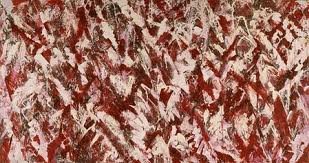
Lee Krasner, her artist quotes on painting art in Abstract Expressionism and life with Pollock
- He (Hans Hofmann, one of her art teachers, fh) would come up to me (around 1937-38, fh), look at my work, and do a critique half in English and half in German, but certainly nothing I could understand. When he left the room I would call George McNeil, who was then the monitor, over and I would ask: ’What did this man say to me?’ Hoffman was teaching Cubism and that was pretty exciting. Matisse and ( Picasso were my highlights. It was as though I was swinging between them. First I started to work with color and then there was a heavy swing toward the linear.
* Lee Krasner, source of her woman artist quotes on painting, art and life with Jackson Pollock: “Art Talk, Conversations with 15 woman artists”, Cindy Nemser, 1975, Library of Congress Cataloging-in-Publication Data 1995, p. 73 ( great American woman painter in Abstract Expressionism; biography facts & art links at the bottom )
- His (Modrian’s, fh) comment was: ‘You have a very strong inner rhythm. You must never lose it’. Then we moved on. Piet Mondrian had said something quite beautiful to me. Hofmann (who was in New York a senior abstract expressionist painter of German origin and temporarily her teacher, fh) was also excited and enthusiastic about what I was doing at this time (around 1938, fh) but his comment was: ‘This is so good that you would not know it was done by a woman’. His was a double-edged compliment. But Mondrian’s evaluation rides through beautifully.
* Lee Krasner, source of her woman artist quotes on painting, art and life with Jackson Pollock: “Art Talk, Conversations with 15 woman artists”, Cindy Nemser, 1975, Library of Congress Cataloging-in-Publication Data 1995, p. 73.
- Without getting complicated let me recapitulate my art training in the following way: the Academy first, the break with the Academy when I hit the Hofmann School which is Cubist. The next real break follows when I see Pollock’s work (1940/41, fh) and once more another transition occurs… …It was a force (in Pollock’s work, fh), a living force, the same sort of thing I responded to in Matisse, in Picasso, in Mondrian. Once more, I was hit that hard with what I saw… ….I began feeling the need to break with what I was doing and to approach something else.
* Lee Krasner, source of her woman artist quotes on painting, art and life with Jackson Pollock: “Art Talk, Conversations with 15 woman artists”, Cindy Nemser, 1975, Library of Congress Cataloging-in-Publication Data 1995, p. 74.
- I went into my own black-out period (1942 - 1945, fh) which lasted two or three years where the canvases would simply build up until they’d get like stone and it was always just a gray mess. The image wouldn’t emerge, but I worked pretty regularly. I was fighting to find I knew not what, but I could no longer stay with what I had.
* Lee Krasner, source of her woman artist quotes on painting, art and life with Jackson Pollock: “Art Talk, Conversations with 15 woman artists”, Cindy Nemser, 1975, Library of Congress Cataloging-in-Publication Data 1995, p. 74.
- In 1946 what I call my ‘Little Image’ began breaking through this (former, fh) gray matter of mine. I felt fantastic relief that something was beginning to happen after all this time when there was nothing, nothing, nothing… …The canvas is down on a floor or table and I am working out of a tiny can. In other words, I have to hold the paint so I can move it. But I wouldn’t have been using Duco (industrial paint, fh). My paint would always have been oil and I could get the consistency of a thick pouring quality in it by squeezing it into a can and cutting it with turp (turpentine, fh) - the way I use paint today (1975, fh)… …The only thing I can say with absolute assurance is that my ‘Little Image’ work starts about 1946 and ends in 1949.
* Lee Krasner, source of her woman artist quotes on painting, art and life with Jackson Pollock: “Art Talk, Conversations with 15 woman artists”, Cindy Nemser, 1975, Library of Congress Cataloging-in-Publication Data 1995, p. 77.
- Well I think it (one of her ‘Little Image’ paintings, fh) does suggest hieroglyphics of some sort. It is a preoccupation of mine from way back and every once in a while it comes into my work again. For instance in my 1968 show at the Marlborough I have a painting called ‘Kufic’, an ancient form of Arabic writing. Every once in a while I fall back to what I call my mysterious writings. I haven no idea what this is about but it runs through periods of my work.
* Lee Krasner, source of her woman artist quotes on painting, art and life with Jackson Pollock: “Art Talk, Conversations with 15 woman artists”, Cindy Nemser, 1975, Library of Congress Cataloging-in-Publication Data 1995, p. 78.
- I merge what I call the organic with what I call the abstract, which is what you (interviewer Cindy Nemser, fh) are calling the geometric. As I see both scales, I need to merge these two in the ever-present. What they symbolize I have never stopped to decide. You might want to read it as matter and spirit and the need to merge as against the need to separate. Or it can be read as male and female.
* Lee Krasner, source of her woman artist quotes on painting, art and life with Jackson Pollock: “Art Talk, Conversations with 15 woman artists”, Cindy Nemser, 1975, Library of Congress Cataloging-in-Publication Data 1995, p. 78 (famous American woman painter in Abstract Expressionism)
- That’s right. I couldn’t run out and do a one-woman job on the sexist aspects of the art world, continue my painting, and stay in the role I was in as Mrs. Pollock (Lee Krasner was married with Jackson Pollock till 1956, when Jackson died by a car accident, fh). I just couldn’t do that much. What I considered important was that I was able to work and other things would have to take their turn. You have to brush a lot of stuff out of the way or you get lost in the jungle. Now rightly or wrongly I made my decisions.
* Lee Krasner, source of her woman artist quotes on painting, art and life with Jackson Pollock: “Art Talk, Conversations with 15 woman artists”, Cindy Nemser, 1975, Library of Congress Cataloging-in-Publication Data 1995, p. 79.
- Right up until today (that moment he was dead for 16 years, fh) Pollock takes a lot of mine time… …and while you ask ’How much did it take out of me as a creative artist’ I ask simultaneously, ‘What did it give?’ It is a two-way affair at all times. I would give anything to have someone giving me what I was able to give Pollock.
* Lee Krasner, source of her woman artist quotes on painting, art and life with Jackson Pollock: “Art Talk, Conversations with 15 woman artists”, Cindy Nemser, 1975, Library of Congress Cataloging-in-Publication Data 1995, p. 79.
- They ( the other woman artists in the Abstract Expressionism art movement like Helen Frankenthaler and Joan Mitchell, fh) are the next generation and it is another scene, another story. You forget that in my generation Paris was still the leading school of painting and this situation was being changed by a tiny handful of artists to a scene called New York, America, which never before had a leading role in the art world. That didn’t happen just by reading a newspaper. Now the next generation comes in and they may think it is rough for them but it is a pie… …We broke the ground.
* Lee Krasner, source of her woman artist quotes on painting, art and life with Jackson Pollock: “Art Talk, Conversations with 15 woman artists”, Cindy Nemser, 1975, Library of Congress Cataloging-in-Publication Data 1995, p. 80.
- He (Jackson Pollock, fh) is the one who would pull me out of a state when I would say, ‘the work has changed and I can’t stand it. It’s just like so and so’s work.’ Then he would come and look and say, ‘You are crazy, It is nothing like so and so’s work. Just continue painting and stop hanging yourself up.’ We had that kind of rapport.
* Lee Krasner, source of her woman artist quotes on painting, art and life with Jackson Pollock: “Art Talk, Conversations with 15 woman artists”, Cindy Nemser, 1975, Library of Congress Cataloging-in-Publication Data 1995, p. 80.
- Just like when I had a gray-out for a period of time and then the ‘Little Image’ emerged (in 1946, fh). It went along until about 1949 and once more the work started to change. I can’ tell why this happens. This process (of shifts, fh) has continued right up until today. I go for a certain length of time and the image breaks again… …You could say they (the paintings she made after the ‘Little Image’ series, fh) started to blow up and the use of the pigment was very thin compared to what I was doing before. For me it was only holding the vertical, though some of them move horizontally as well. In a letter from Pollock to Ossorio - in 1951 - he says: ‘Lee is doing some of her best paintings. It has a freshness and bigness that she didn’t get before.’
* Lee Krasner, source of her woman artist quotes on painting, art and life with Jackson Pollock: “Art Talk, Conversations with 15 woman artists”, Cindy Nemser, 1975, Library of Congress Cataloging-in-Publication Data 1995, p. 81.
- My studio was hung with a series of black and white drawings I had done. I hated them and started to pull them off the wall and tear them and throw them on the floor and pretty soon the whole floor was covered with them. Then another morning I walked in and saw a lot of things there that began to interest me. I began picking up torn pieces of my own drawings and re-gluing them. Them I started cutting up some of my oil paintings. I got something going there and I start pulling out a lot of raw canvas and slashing it as well. That’s how I started my collaging and the tail end of it was the collaging of the paintings in the Betty Parsons show (she had this show around 1951 and later collaged these paintings around 1954/55, fh)… …They (the collages, fh) also have that vertically. Vertically comes back in my work again and again but it comes back in forms that are not exactly as pure. If we use that word vertical with the meaning it has now taken on – the ‘vertical’ doesn’t interest me. It is too pure, and purity given to me in that form makes me nervous.
* Lee Krasner, source of her woman artist quotes on painting, art and life with Jackson Pollock: “Art Talk, Conversations with 15 woman artists”, Cindy Nemser, 1975, Library of Congress Cataloging-in-Publication Data 1995, p. 81.
- I think for every level you go higher, you slip down one or two levels, and then come back up again. When I say slip back, I don’t mean that detrimentally. I think it is like the swing of a pendulum rather than better or back, assuming that back means going down. If you think of it in terms of time, in relation to past, present, and future, and think of them all as one an oneness, you will find that you swing the pendulum constantly to be with now. Part of it becomes past and the other is projection but it has got to become one to be now. I think there is an order but it isn’t good, better, best.
* Lee Krasner, source of her woman artist quotes on painting, art and life with Jackson Pollock: “Art Talk, Conversations with 15 woman artists”, Cindy Nemser, 1975, Library of Congress Cataloging-in-Publication Data 1995, p. 83.
- In July ’56 there was another break in the work. There is a painting called ‘Prophecy’ which I did just before I left for Europe. Every time the work broke, it sent me into a tailspin because I couldn’t tell what was happening. I asked Jackson (Pollock, fh) to come and look at this painting and he did and said I needn’t be nervous about it. He thought it was a good painting and the only thing that he objected to was this image in the upper right hand which I had scratched in with the back of a brush. It made a kind of an eye form. He advised me to take it out. I said that I didn’t agree with him and left it in… …it is the change that I had to get used to and accept. It frightened me… …it frightened me, particularly because it happened just before I left for Europe. Jackson looked at it, said what he said, and I went off to Europe. Jackson was killed in the automobile accident (1956, fh) while I was there and when I came back I had to confront myself with this painting before I was able to start again. I went through a rough period in that confrontation… …’Prophecy’ was painted before Jackson died and these (a series of paintings in the spirit of ‘Prophecy’, fh) were the first to appear afterwards. As you can see the eye is really coming through now. That’s why I wanted to mention it in relation to ‘Prophecy’.
* Lee Krasner, source of her woman artist quotes on painting, art and life with Jackson Pollock: “Art Talk, Conversations with 15 woman artists”, Cindy Nemser, 1975, Library of Congress Cataloging-in-Publication Data 1995, pp. 83.
- Most of it occurs a great deal without my consciously knowing it. In other words, it is there and I see it and recognize it. So all right, I get a bird image. I get a floral image. But I don’t go around consciously thinking these images up. They come through. So in that sense, it’s archetypal.
* Lee Krasner, source of her woman artist quotes on painting, art and life with Jackson Pollock: “Art Talk, Conversations with 15 woman artists”, Cindy Nemser, 1975, Library of Congress Cataloging-in-Publication Data 1995, p. 89.
- This exhibition (her exhibition in 1965, organized by the director of the White Chapel in London, fh) is the sort of experience that should be allowed to every living artist. I have to confront myself with my own work from time to time, and it is impossible for me to put up a ten-year cycle of my work any place and look at it, unless a museum puts it up. It should be a natural process every ten years so that the artist and the interested public can have a look at it.
* Lee Krasner, source of her woman artist quotes on painting, art and life with Jackson Pollock: “Art Talk, Conversations with 15 woman artists”, Cindy Nemser, 1975, Library of Congress Cataloguing-in-Publication Data 1995, p. 89.
- I daresay that a great deal of my so-called position or lack of position, whichever you want to call it, in the official art world is based on the association with Pollock (Lee Krasner was married with Jackson Pollock until he died in 1956, fh). It is almost impossible to deal with me without relating it to Pollock. There is no question in my mind that because I stepped on many toes in handling the Pollock estate as I saw it. I offended a great many people and so my name became a bit of an irritant as a painter.
* Lee Krasner, source of her woman artist quotes on painting, art and life with Jackson Pollock: “Art Talk, Conversations with 15 woman artists”, Cindy Nemser, 1975, Library of Congress Cataloging-in-Publication Data 1995, p. 90.
- I do not mean extended, to mean aesthetic definition of space. For me, it is a matter of whether the canvas allows me to breathe or not – if the canvas soars into space or if it is earthbound. When it is earthbound it irritates me enormously. I would like to soar in a canvas.
* Lee Krasner, source of her woman artist quotes on painting, art and life with Jackson Pollock: “Art Talk, Conversations with 15 woman artists”, Cindy Nemser, 1975, Library of Congress Cataloging-in-Publication Data 1995, p. 91.
- I think every once in a while I feel the need to break my medium.. …if I have been doing a very large painting I like to drop into something in small scale. It is a challenge to go into this size. It is just to hold my own interest, and then each media has its own conditions.
* Lee Krasner, source of her woman artist quotes on painting, art and life with Jackson Pollock: “Art Talk, Conversations with 15 woman artists”, Cindy Nemser, 1975, Library of Congress Cataloging-in-Publication Data 1995, p. 93.
- I don’t think scale has to do with the physical aspects of the work. I think you can have giant physical size with no statement on it so that is an absurd blow-up of nothingness. And vice versa, you can have a very tiny painting which is monumental in scale. Too often there is confusion as to what ‘s known as scale in painting. Footage doesn’t mean scale.
* Lee Krasner, source of her woman artist quotes on painting, art and life with Jackson Pollock: “Art Talk, Conversations with 15 woman artists”, Cindy Nemser, 1975, Library of Congress Cataloging-in-Publication Data 1995, p. 93. (American woman painter in Abstract Expressionism)
not sourced woman artist quotes by Lee Krasner
- We get used to a certain kind of color of form or format, and it’s acceptable. And to puncture that is sticking your neck out a bit. And then pretty soon, that’s very acceptable. (woman artist quote by Lee Krasner)
- I think, if one is a painter, all you experience does come out when you’re painting. (woman artist quote on the moment of paintings, Krasner)
- I like a canvas to breathe and be alive. Be alive is the point. And, as the limitations are something called pigment and canvas, let’s see if I can do it. (artist quote on the character of the canvass she likes, Lee Krasner)
- I like to surprise myself. I have to be interested in what I’m doing. Surprise, for me, is as important as it is to anyone that views it once it becomes a painting. (quote on surprise as a moment of painting, Lee Krasner)
- I never violate an inner rhythm. I loathe to force anything. I don’t know if the inner rhythm is Eastern or Western. I know it is essential for me. I listen to it and I stay with it. I have always been this way. I have regards for the inner voice. (artist quote on maintaining the inner rhythm / voice as source of painting, Lee Krasner)
- It would start with a color, a form, and it begins dictating to me what’s needed in terms of color as well as form. (woman artist quote by Krasner)
- All my work keeps going like a pendulum… …it seems to swing back to something I was involved with earlier, or it moves between horizontality and verticality, circularity, or a composite of them. For me, I suppose, that change is the only constant. (woman artist quote on her art, changing as a pendulum, Lee Krasner)
Links for more information on the American woman-artist Lee Krasner
* many images and pictures of Lee Krasners abstract expressionist painting art, on Google
